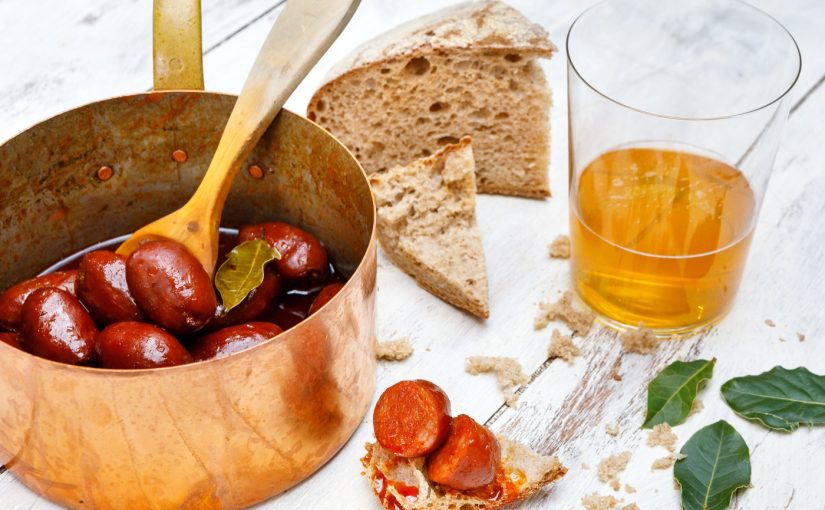
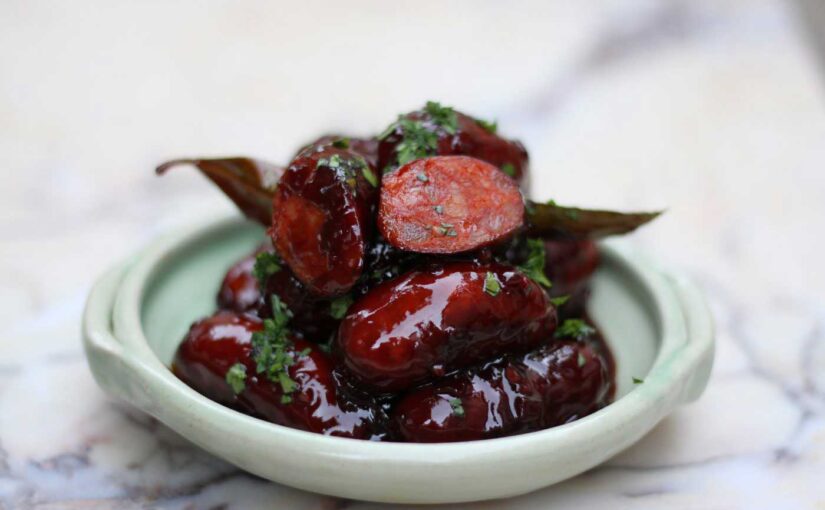
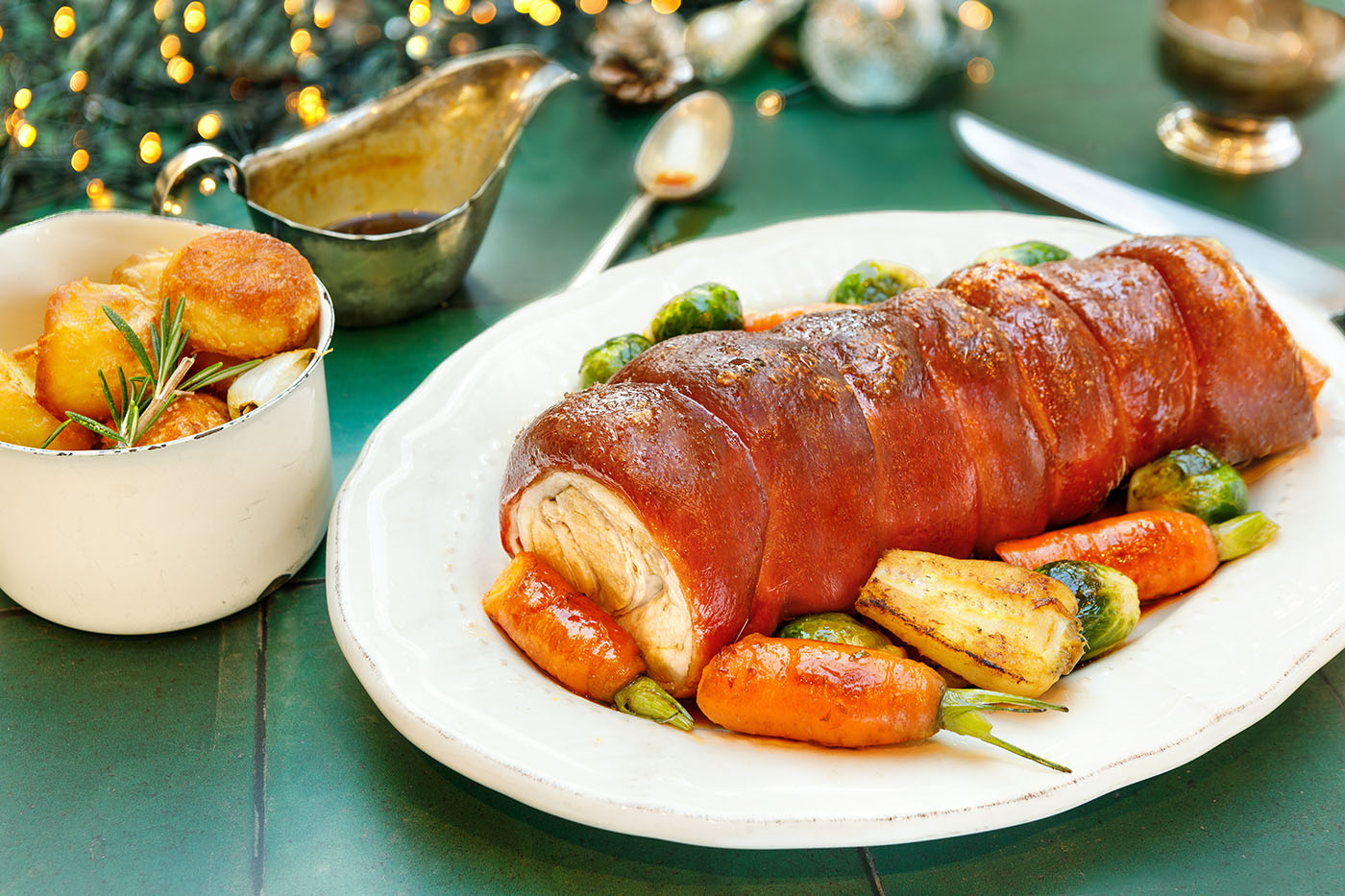
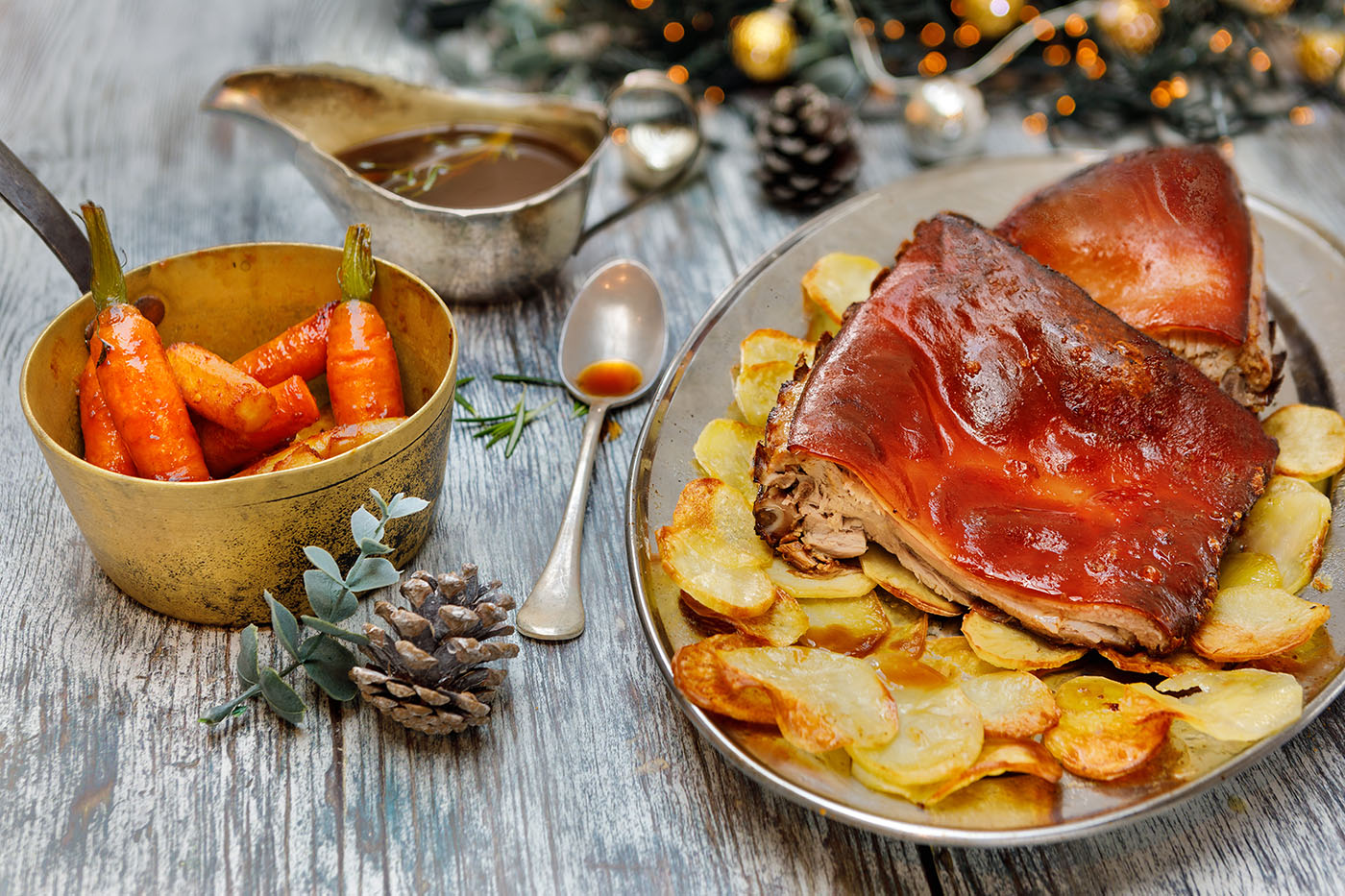
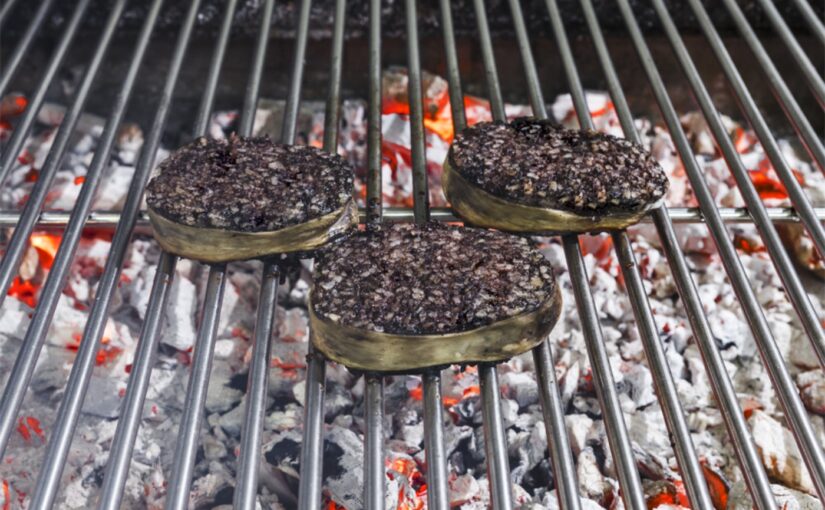
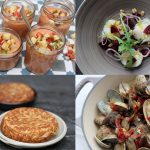
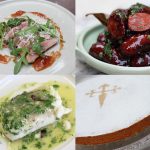
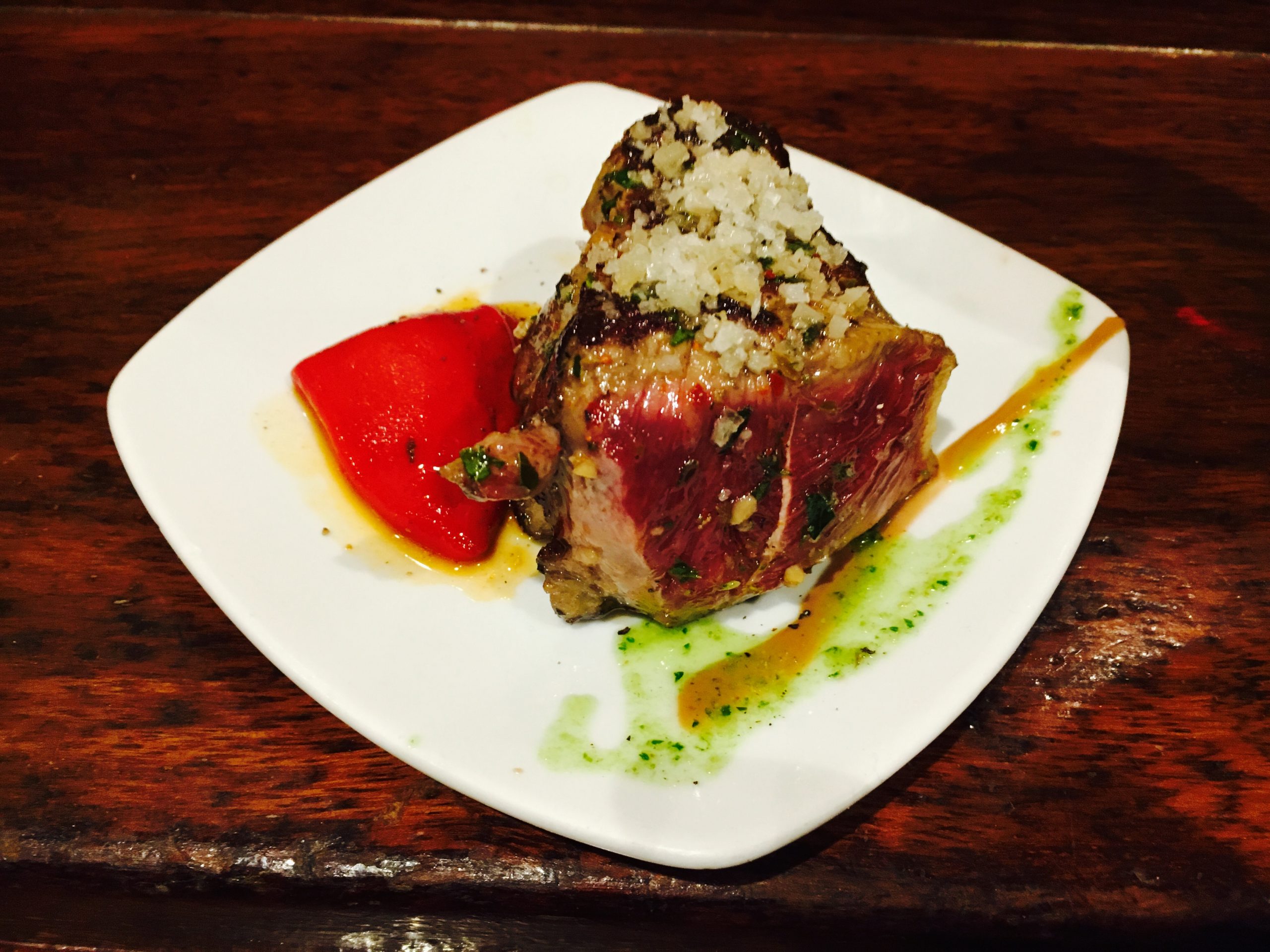
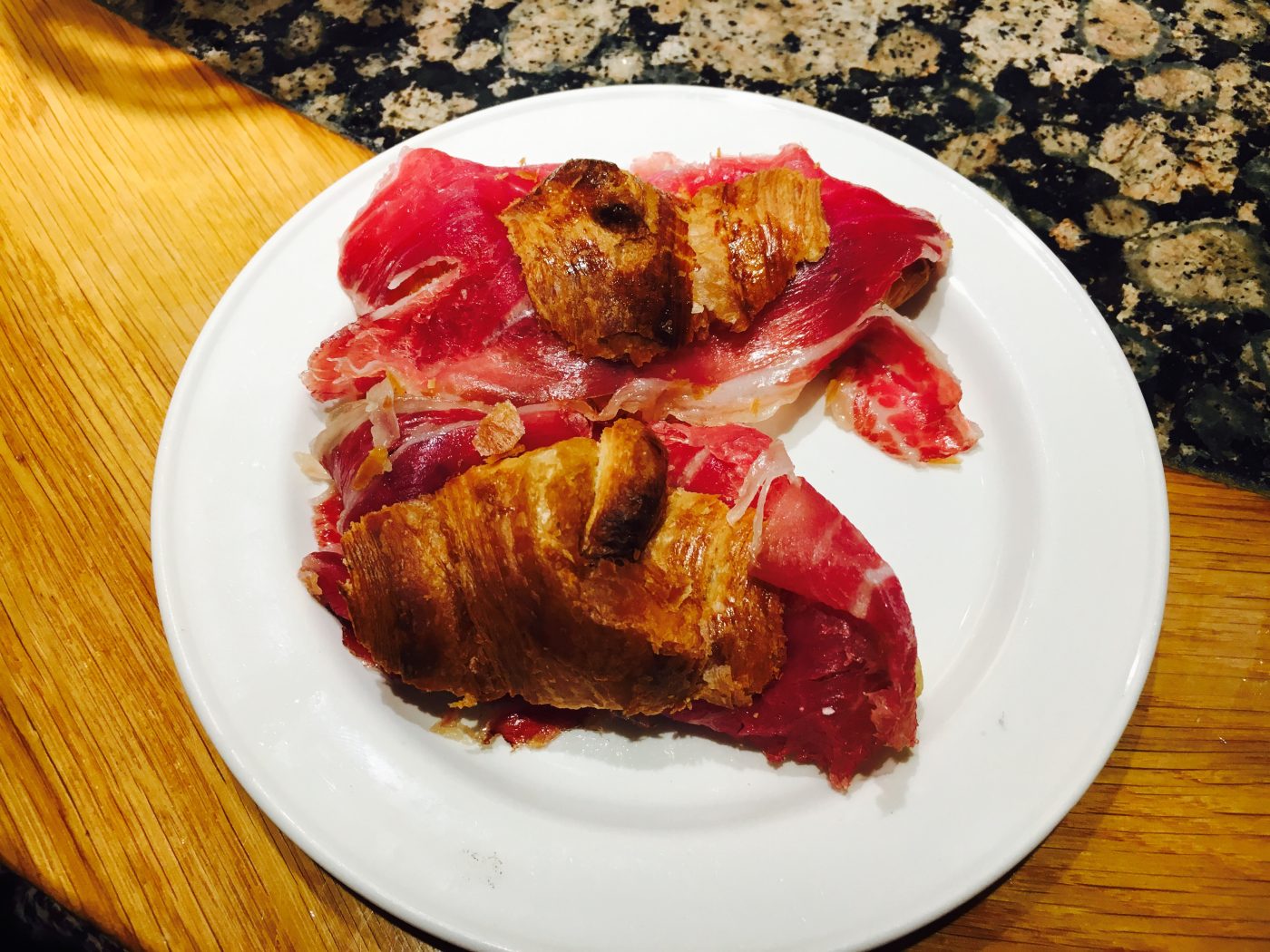
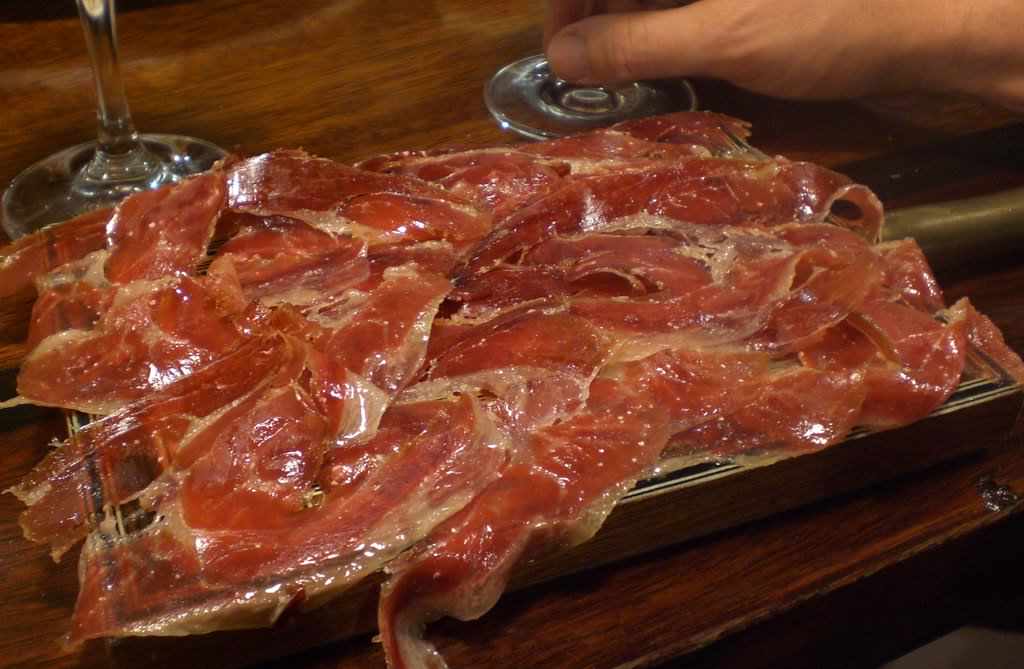
Have you ever wondered how many different Chorizo types there are in Spain? Types of Spanish Chorizo, with their delicious smoked paprika flavours, vary massively. Authentic deep red Spanish Chorizo can range from fresh Chorizo for cooking paellas and stews, roasting, frying or barbecuing to Vela, Cular, Herradura, Chorizo Riojano/Navarra, Sobrasada. All are utterly delicious and have their own unique histories, idiosyncrasies, tastes and stories to tell.
What is Spanish Chorizo?
Before we begin to explore the full spectrum of the different Chorizo types, it is important to understand what exactly Chorizo is and its origins.
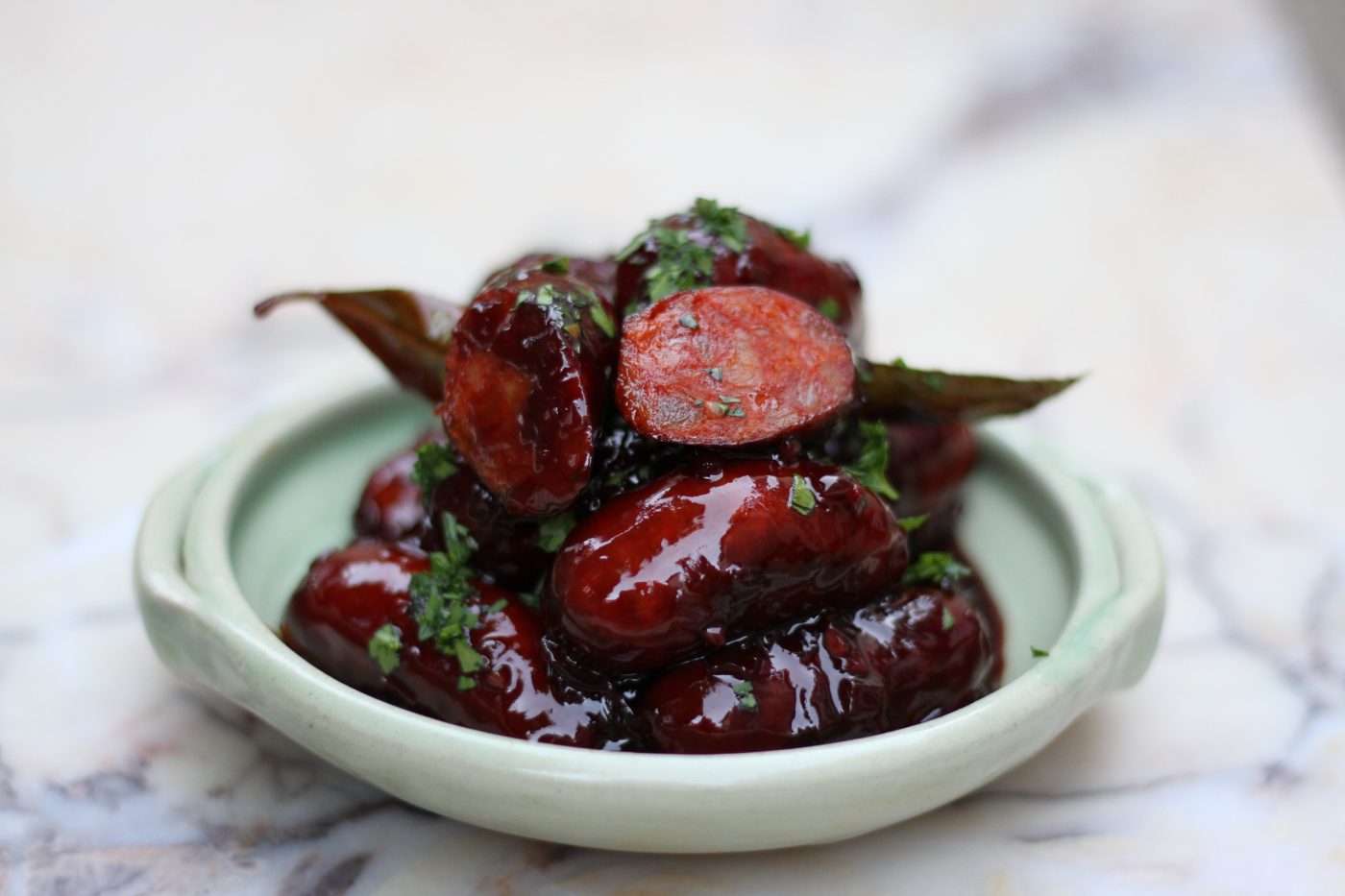
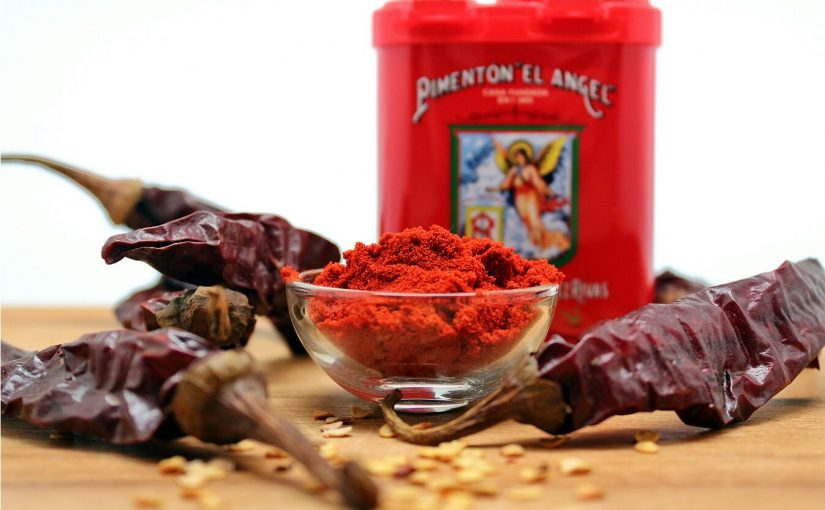
Authentic Spanish Chorizo is a cured pork sausage which is seasoned mainly with sweet or hot smoked paprika, garlic and salt. The paprika gives Spanish Chorizo its vivid red colour and smoky, spicy flavour, whilst curing preserves the Chorizo and can be used to intensify its flavour. You can eat cured Spanish Chorizo sliced as is, or use fresh Spanish Chorizo to cook traditional tapas, stews and rice dishes.
What is the history of Spanish Chorizo?
Before we begin exploring the different Chorizo types, let’s reflect on the origins of Spanish Chorizo. Back in Roman times, sausage-making began in Iberia where salt was used to preserve meat. However, they were band in colour and flavour. Spain had to wait until the arrival of smoked paprika in the 16th century from the Americas before it was introduced to create Chorizo’s deep red colour and distinctive smoky flavour we enjoy today. Curing, seasoning and stuffing minced pork into sausage casings was a way of preserving food to be eaten throughout the winter. Interestingly, paprika itself also has a preservative effect all of its own.
Such was the popularity of Spanish Chorizo, as the Spanish Empire grew, Chorizo-making techniques were exported to the Americas where paprika was originated and was plentiful. So Mexican and Argentinian Chorizo are the distant cousins of the original Spanish Chorizo.
Different Chorizo types
The main different types of Spanish Chorizo are characterised by three things; curing, meat and region of origin. For example, there are fresh, semi-cured and dry-cured Spanish Chorizo sausages, some are made from Iberian pig meat, others with “white pork” from local breeds. In Northern Spain, Riojano from La Rioja, “Chorizo de Pamplona” from Navarra, and Sombrasada from the Balearic Islands are popular as well.
Fresh Chorizo
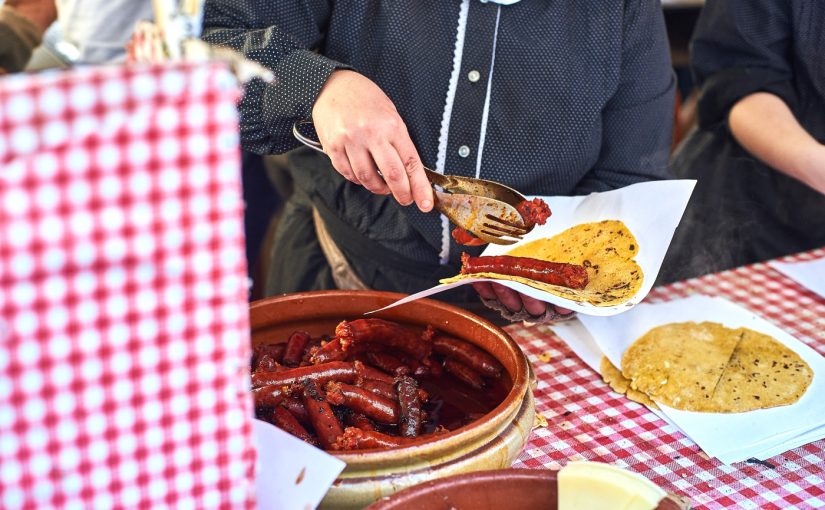
Fresh Chorizo, or “Chorizo fresco”, is, as the name suggests, a raw Chorizo sausage which is soft, juicy and vivid red. These are used exclusively for cooking. A high-quality example is Basco Fresh Cooking Chorizo Picante. This melt-in-your-mouth, soft and flavoursome Spanish Chorizo is truly unique as it is made to our own specification in the Rioja region by a Chorizo producer with over 100 years of experience.
There are two types of fresh Chorizo: spicy “Picante” or sweet “Dulce”. Our fresh Chorizo is the picante variety, cooks in just 8 minutes and is ideal for cooking on the grill or barbecuing. Its secret spice blend, using premium quality paprika, also adds tremendous depth and flavour to paellas, tapas, sauces, soups, stews and pasta dishes. Basco Fresh Cooking Chorizo Picante is available in 1kg and 350g packs, and a mild version of Mini Cooking Chorizo is also available.
Chorizo Vela
Vela, meaning “candle”, which refers to its shape, is a large stick of fully-cured, ready-to-eat Chorizo that is perfect for slicing. Made in La Rioja by Martinez Somalo – a family charcuterie business since 1900. It follows a traditional cured recipe of thick cuts of pork, salt, garlic and paprika. Lean, meaty and with a wonderful fiery red colour and smoky flavour, it is often sliced and served as a tapa with jamon, olives or manchego cheese, and is a key ingredient of an authentic Spanish bocadillo sandwich.
Chorizo Vela is gluten-free and available in both a Picante and Dulce style. Chorizo Vela Picante uses plenty of the spicy, chili-hot version of the Pimenton de la Vera to give it a real kick of chilli, whereas Chorizo Vela Dulce is easier on the fire and spice.
For your convenience, Martinez Somalo also produce ready-sliced Chorizo Vela which is available in both a 500g and 100g pack. These are great for sandwiches and wraps for birthday parties and celebrations.
Chorizo Sarta, Herradura or Horseshoe
This particular Spanish Chorizo has a variety of names which refer to its shape – Sarta meaning “string” or “garland” and Herradura meaning “horseshoe – but they are effectively the same Chorizo. The variety we stock is La Gloria Riojana Chorizo Sarta Picante, again made to an old recipe by family-owned Martinez Somalo.
Fully dry-cured, Chorizo Sarta is formed into a horseshoe-shaped ring tied with string. It requires no cooking or refrigeration and is delicious with Manchego cheese, crusty bread and a glass of your favourite Spanish wine.
Chorizo Cular
Cular is a traditional and natural slow-cured Spanish Chorizo. As it is aged for slower and for longer it develops a much deeper and richer paprika flavour. Basco stocks Martinez Somalo Chorizo Cular, which is made using only select cuts of Spanish pork, seasoned with smoky paprika, garlic, and salt. It is then packed into a natural casing and matured in the La Rioja mountain air, the perfect slow-curing conditions.
To serve Spanish Chorizo Cular, slice it thinly to reveal its beautifully rich marbling, then let it come up to room temperature so its smoky flavour and silky texture shine through. Chorizo Cular is best enjoyed with bold red Spanish wines such as Rioja and accompanied by matured cheeses, crusty bread, or classic Spanish tapas.
Sobrasada
The national sausage of the Balearic Islands, Sobrasada dates back to the 14th century, and is a raw-cured Spanish Chorizo sausage that, unlike other Chorizo, is soft and spreadable like pâté. The Chorizo Sobrasada stocked by Basco is artisan-made by Embutidos Munar – a family business since 1942. 100% natural and gluten-free, it is made with finely ground free-range pork, sea salt and sun-dried paprika from Tap de Corti in Mallorca. The semi-tropical climate of the Balearic Islands does not allow for fully dry-curing, which is why the meat is preserved by mixing it with a specific local variety of paprika and then aged for just a short time.
Sobrasada Chorizo is perfect for cooking with and is often used as a pasta filling, fried with meat or fish dishes or used as a garnish. By far the most popular way to enjoy Sobrasada, though is spread liberally on crusty bread and the toasted to enhance its flavours.
Spanish Chorizo Recipes
When your appetite for Chorizo? Why not try some of Basco founder Javier De La Hormaza’s authentic Spanish Chorizo recipes? Basque-born and a trained chef, Javier is deeply passionate about traditional Spanish classics and, in particular, authentic Basque cuisine. Here are some of Javier’s favourite dishes you can recreate…
Chicken and Chorizo Paella – chicken and chorizo are made for each other. Featuring saffron, you can tweak the flavour by adding sweet or spicy pimentón. Use Bomba, Bahía or Senia paella rice for true authenticity.
Chorizo and Lentil Stew – you’ll love how the earthy, slow-cooked flavours of the lentils are offset by the warming spice of fresh cooking Chorizo. A true winter favourite.
Mussels, Crispy Chorizo and Puttanesca Sauce – Javier’s take on a classic Neapolitan pasta dish featuring fresh mussels, tomatoes, olives, capers, anchovies, pepperoncino and crispy chorizo sausage.
Dover Sole with Clams and Chorizo – impress effortlessly with the ultimate Spanish-inspired fish recipe featuring a whole pan-fried Dover sole, crispy Chorizo, garlic, sherry vinegar and fresh clams.
Shop Spanish Chorizo
Sold on Spanish Chorizo? We deliver all the Spanish Chorizos featured in this guide directly to your door. Simply click here to shop online now.
We interviewed Basco founder Javier De La Hormaza and asked him to share with us the best places to eat in San Sebastian and he did not disappoint. Because San Sebastian is the epicentre of the finest Spanish food, to make things difficult for Javier, we asked him to limit it to just six of his absolute favourite restaurants and bars.
After much deliberation and internal struggles, Javier drew up his shortlist along with a few personal observations on each. Let’s get started.
Rekondo
Nestled at the foot of Monte Igeldo, with stunning views of Donostia bay, Rekondo is one of the absolute best places to eat in San Sebastian. Chef Iñaki Arrieta has been in charge of the Rekondo kitchen for over 20 years and creates masterful dishes using only the finest local Basque country ingredients. For many, eating at this incredible restaurant is a once in a lifetime experience.
“Rekondo has one of Europe’s best wine cellars and is a real special occasion restaurant. The beautiful terrace is one of my favourite spots to dine in San Sebastian. My best food memory of my daughter, Sofia, was when she was 2 years old eating their superb clams in salsa verde! We came back the following year and she asked for them again.”
Rekondo, Paseo de Igeldo 57, 20008 Donostia / San Sebastián
You cannot visit San Sebastian without popping in at Ganbara, meaning “the attic” in Basque, which is odd as it is spread over ground and basement levels. This famous tiny pintxo bar in the “Parte Vieja” old town neighbourhood is undisputably one of the best places to eat in San Sebastian. Founded over 40 years ago by Jose Ignacio and his wife Amaia, this lively pintxo bar and fine dining restaurant has food to die for. Try their signature dish of seasonal wild mushrooms with egg yolk and foie gras, chistorra puff pastry rolls and pan-fried anchovies in garlic and chilli. All astoundingly good.
“Ganbara is probably the most sought after pintxo bar in the old part of San Sebastian. It has a small number of sit-down tables downstairs – you really need to go early or expect to queue.”
Ganbara, Calle de San Jeronim 21, 20003 Donostia / San Sebastián
Overlooking the Urumea River and opened in 2022, Muka is a relatively new addition to the San Sebastian restaurant scene and is situated in the striking Kursaal Congress Centre. The two chefs that run Muka have real pedigree and it shows in the menu and execution. At the centre of this contemporary restaurant is a bar that surrounds the open grill which gives diners a front row view of the chefs crafting inventive dishes over flames. Try razor clams, green sauce and spicy radish or Iberian pork fan with a mushroom marinade. Interestingly, the excellent olive oil served here is made by one of the chefs using different Spanish olives, harvested from tiny plots. A nice touch.
“I have eaten here twice and I’ve been impressed by the great produce with solid charcoal cooking as the focus. It’s reasonably priced, too, especially when you consider that the concept has been developed by renowned Basque chef Andoni Luis Aduriz from the 2-star Mugaritz.”
Muka, Avenida de la Zurriola 1, 20002 Donostia / San Sebastián
Recommended not only by Javier, but the Michelin Guide, too, Juanito Kojua is a Basque restaurant in the very heart of old town San Sebastian with a traditional “txoko” private dining room in its cellar. Established almost 80 years ago, its seasonal menu features 100% authentic Basque cuisine and specialises in fresh seafood. Famous plates include Basque-style hake loin, Donostia-style crab and grilled Bay of Biscay lobster. All three are classics.
“An institution in San Sebastian, even my grandfather used to come and eat at Juanito Kojua when it first opened in the 1950s. It specialises in traditional Basque cooking with wonderfully attentive service. I ate there this summer and we loved it.”
Juanito Kojua, Portu Kalea 14, 20003 Donostia / San Sebastián
Bodegón Alejandro is entirely focused on the authenticity, tradition and the classic flavours of Basque gastronomy. The intimate and cosy dining room is presided over by an enormous and spectacular circular watercolour of San Sebastian, painted in the 1820s. The cooking is equally impressive. From exceptional starters including Arturo Sánchez Iberian ham and Donostia-style spider crab with pil pil foam to mains of fresh chopped squid stew with its own ink and gargantuan beef chops, eating here is a real experience.
“I have eaten here a few times during the years and it never fails. From the seasonal ingredients to cooking expertise and attention to detail are always very consistent. I totally recommend the tasting menu – you will not be disappointed.”
Tucked away in a nook in the old town, with football and rugby shirts signed by Basque stars adorning the walls, Bar Nestor must be one of the best places to eat in San Sebastian. At this traditional Basque restaurant, it’s all about two things – huge beautifully marbled txuleta steak and luscious tortilla de patatas. Javier cannot get enough of both.
“This is the place to go for a txuleta steak. There is only one table, Table 19, and it can be reserved in advance. They only serve steak, green peppers and tomato salad. Last time I went there was a champion sumo wrestler from Japan who ate 2 massive steaks! They also serve their famous tortilla at 1pm and 8pm every day but arrive early or it goes. This is the place we took all our friends and family the day after my wedding and I have visited with many chefs that are Basco customers. So, as you can see. I am very fond off it!”
Bar Nestor, Arrandegi Kalea 11, 20003 Donostia / San Sebastián
If you want to experience the best places to eat in San Sebastian, use Javier’s shortlist as a starter. Then enjoy wandering through Spain’s historic food capital discovering favourites of your own and immersing yourself in Basque food, drink and culture.
Want to know how to prepare padrón peppers the traditional Spanish way? Before Javier takes you through his simple step by step padrón pepper recipe and what to have with padrón peppers, let’s find out exactly what padrón peppers are.
What are padrón peppers?
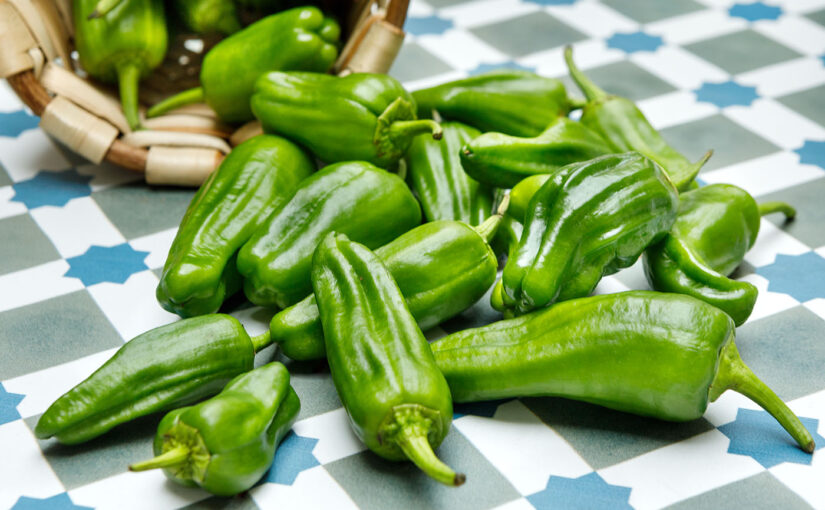
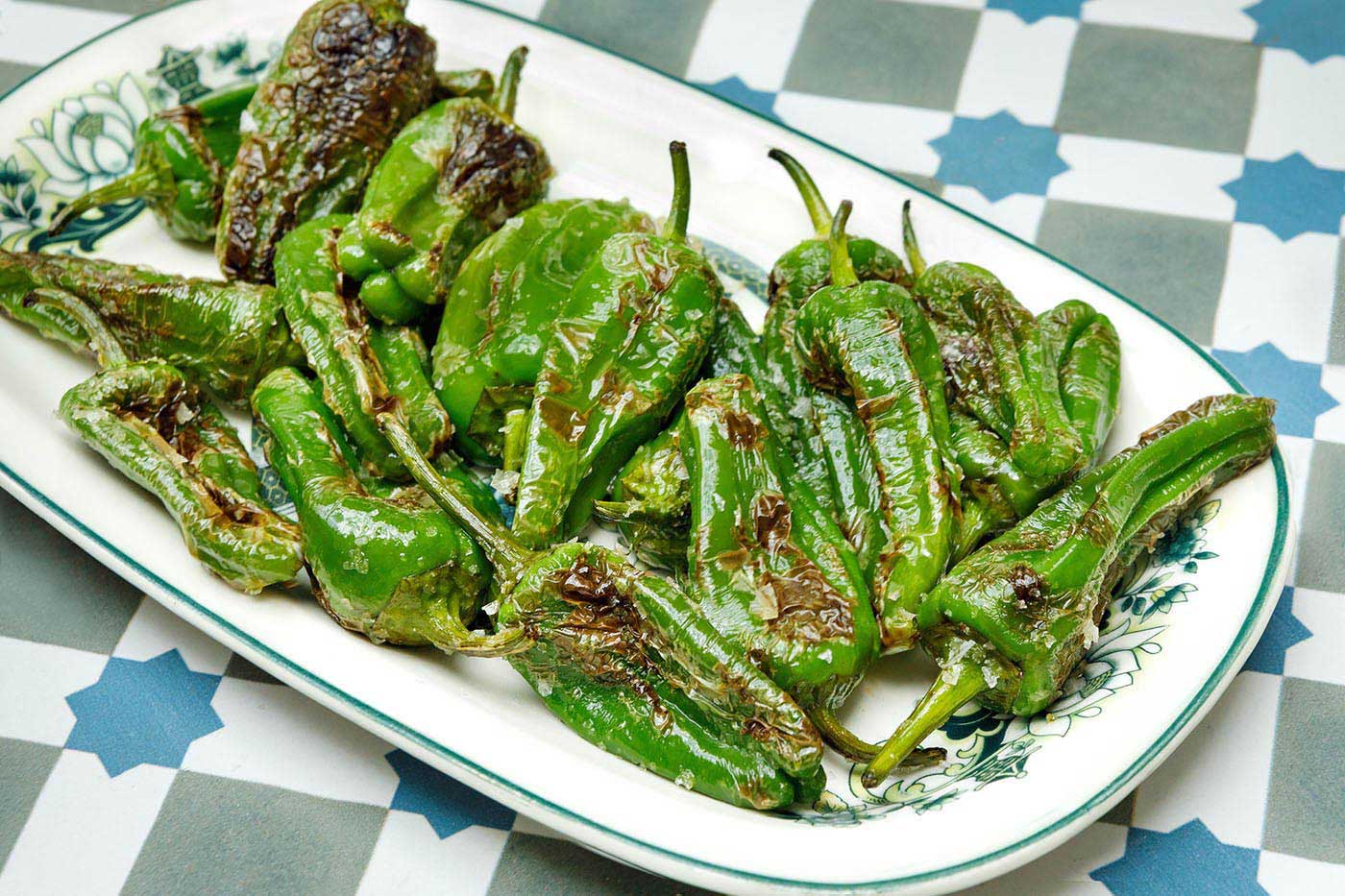
Padrón peppers, known as pimientos de Padrón are wonderful bright little green peppers from the Galicia region of Spain. Fried, sea salted and served in tapas bars throughout Spain, they are big favourites with everyone from locals to tourists.
Most, but not all padrón peppers are mild. In fact, they are famous for their “game of chance” in terms of heat. Some peppers in a batch are mild but others which may be maturer are spicier, so you gamble each time you enjoy one.
The history of padrón peppers
Named after the town of Padrón in Galicia, they were originally brought from Mexico in the 16th century by conquistadores and then grown in a Galician monastery in Herbón.
The Galician climate, with its high rainfall and mild temperatures, enabled the padrón peppers to adapt and evolve into a strain distinct from their South American ancestors. Over time, the peppers developed a milder flavor and became smaller and finger sized.
Not all padrón peppers are the same
There are real padrón peppers and then there are padrón-style peppers. Their origin, cultivation, quality, and taste are poles apart. Basco only stocks real fresh padrón peppers.
In terms of origin, real padrón peppers are grown in Galicia with seeds that are indigenous to the area. This gives them variable levels of capsaicin. Capsaicin is the active compound in chili peppers that creates their characteristic ‘unos pican, otros no’ heat – which translates as “some are spicy, some are not”. Padrón “style” peppers simply do not have this.
Also, real padrón peppers are now protected under a Certified Origin or Protected Designation of Origin (DOP), registered as “Pimientos de Herbón”.
Padrón pepper recipe
Basco founder Javier De La Hormaza is a professional chef from the Basque Country and really knows his padrón peppers. His recipe for this perfect tapas dish is a traditional one which he shares below…
“Quick and easy, this padrón peppers recipe brings a splash of bright green to your meals. Sweet, salty and with the odd hit of spice, I simply blister them in a hot pan with a little olive until they wilt, then scatter sea salt flakes over them. Delicious!”
How to prepare Padrón Peppers
Take 200g of real padrón peppers and make a tiny cut to the tip of each. The reason we do this is that is stops the peppers from exploding during cooking. It also helps to steam the inside and cook evenly.
Next, pre-heat a large frying pan and add 3 tablespoons of olive oil. When it is hot, throw in the padrón peppers and fry on a moderate heat for just 2-3 minutes. Shake the pan regularly so that all sides of the padrón peppers blister and turn brown.
Finally, take the padrón peppers off the heat, and sprinkle liberally with a good quality sea salt flakes.
Javier did say it was quick and easy.
What to have with padrón peppers
Padrón peppers are perfect as a simple appetizer or with other tapas. They are delicious as a side dish or garnish with steak and fish dishes. Traditionally, they are also often served with fried eggs, chips, jamon Ibérico and Manchego cheese.
We only stock real padrón peppers grown by Horsal which arrive weekly direct from Spain for freshness. This cooperative based in Galicia specialises in growing traditional Galician vegetables including their famous padrón peppers. They have a wonderfully sweet taste, with a hint of asparagus.
You can buy Horsal real padrón peppers in 200g packs which contain 24 padrón peppers in each bag and we will deliver them straight to your door.
Ibérico pork, also known as Iberian pork, is one of Spain’s most revered and savoured delicacies. You may have heard of some of the different cuts of Ibérico pork, such as Pluma, Presa, Secreto and Somillo, and you will certainly be familiar with Ibérico ribs, pork belly and pork chops. There are so many other delicious Ibérico pork cuts too.
In this Guide to Ibérico Pork Cuts, we will be exploring each cut, what each tastes like and how you might use the meat – plus some of Basco founder Javier’s favourite Iberian pork recipes.
What you will notice is that virtually every part of these precious pigs is used to make authentic mouthwatering meats and dishes.
First though, we need to establish exactly what constitutes Ibérico pork.
What is Ibérico pork?
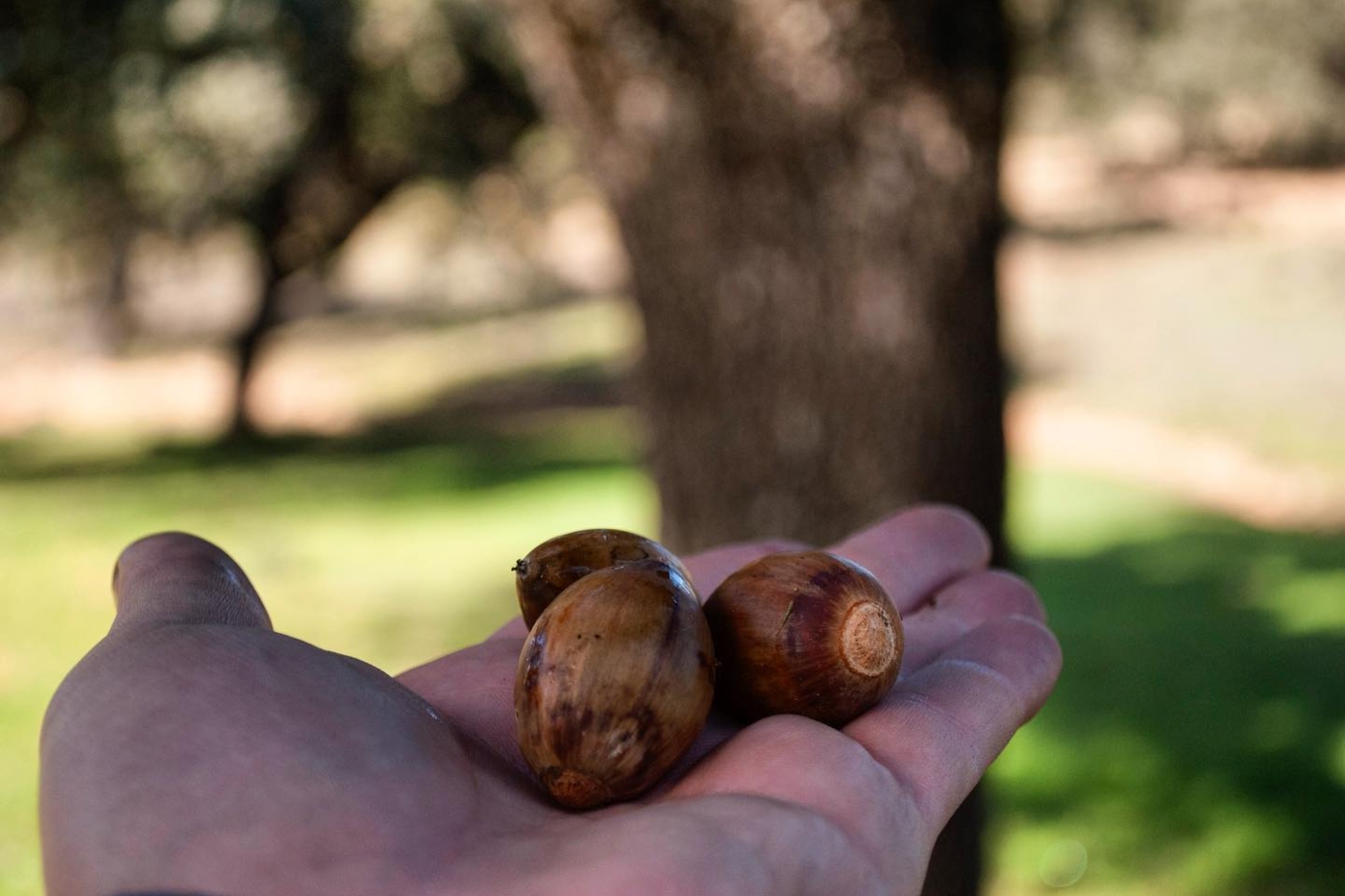
Ibérico pork comes from what can only be described as the Rolls Royce of pigs. These highly prized indigenous black Ibérico pigs are given the free range of “dehesa” oak forests in southwest Spain. Here, they roam free to forage on herbs, grasses and their favourite thing in the world… fallen acorns from mature oak trees. They are allowed to feed for a total of two “montanera” – which is two fattening periods. This diet, and in particular these special acorns, are what give Iberian pork and Ibérico pork cuts their wonderfully distinctive nutty flavour.
The different cuts of Ibérico pork
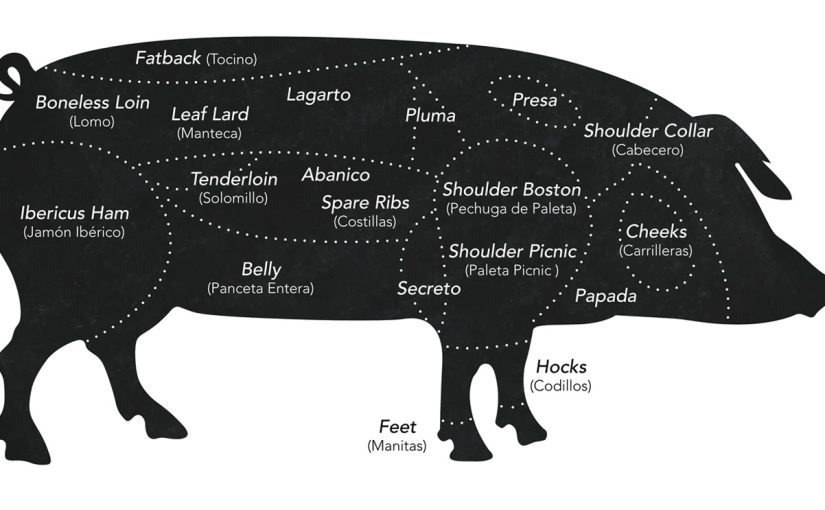
Cut by cut, working from the tail up to the head, we will take you through the idiosyncrasies of all the different cuts of Ibérico pork suggest how you might use them, what they taste like and even suggest a few recipes. Incidentally, our Ibérico pork has won the maximum rating of 3-stars in the Great Taste Awards, not once, but three times, such is its exceptional quality and taste.
Ibérico Ham: Jamón Ibérico
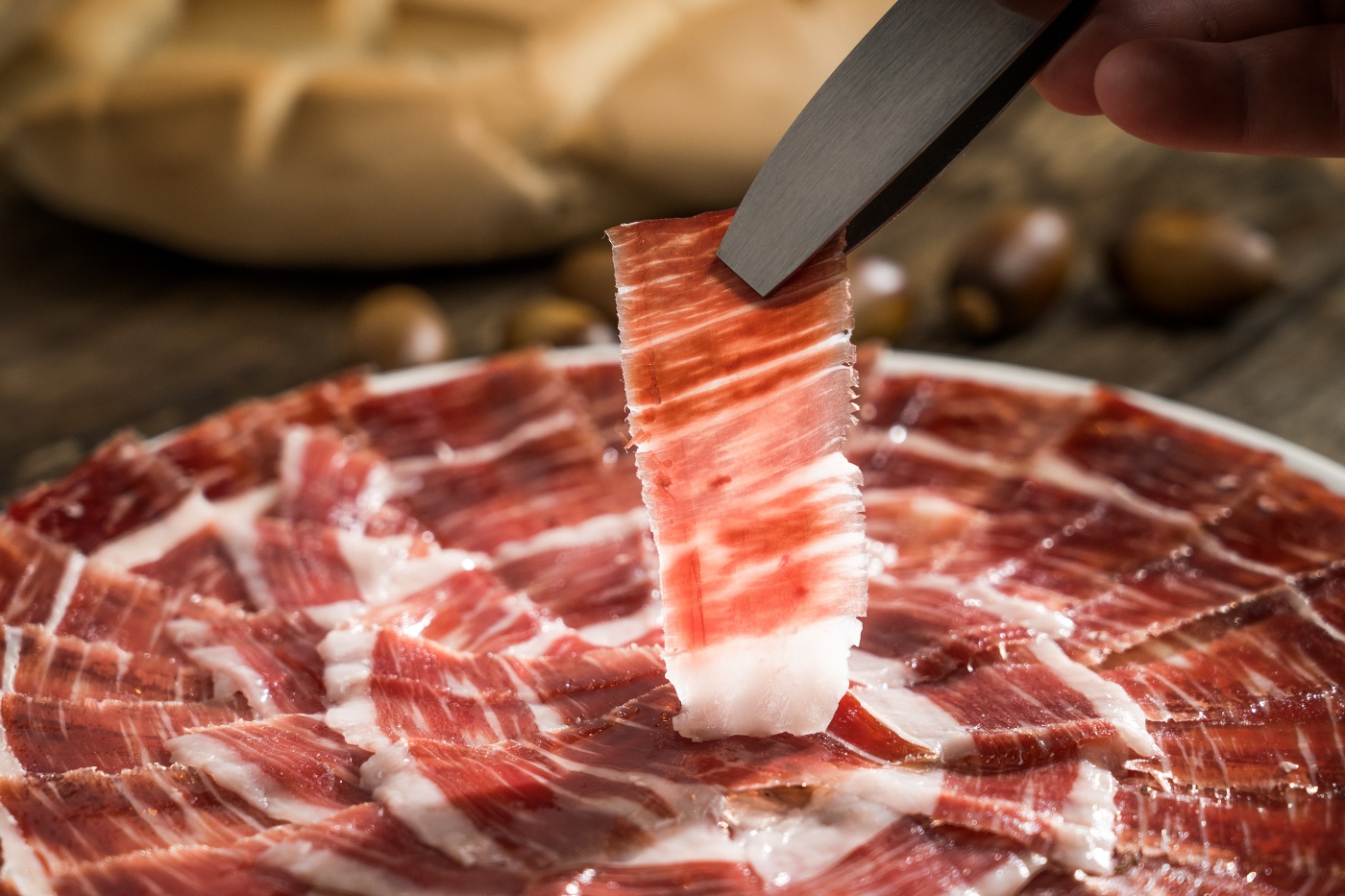
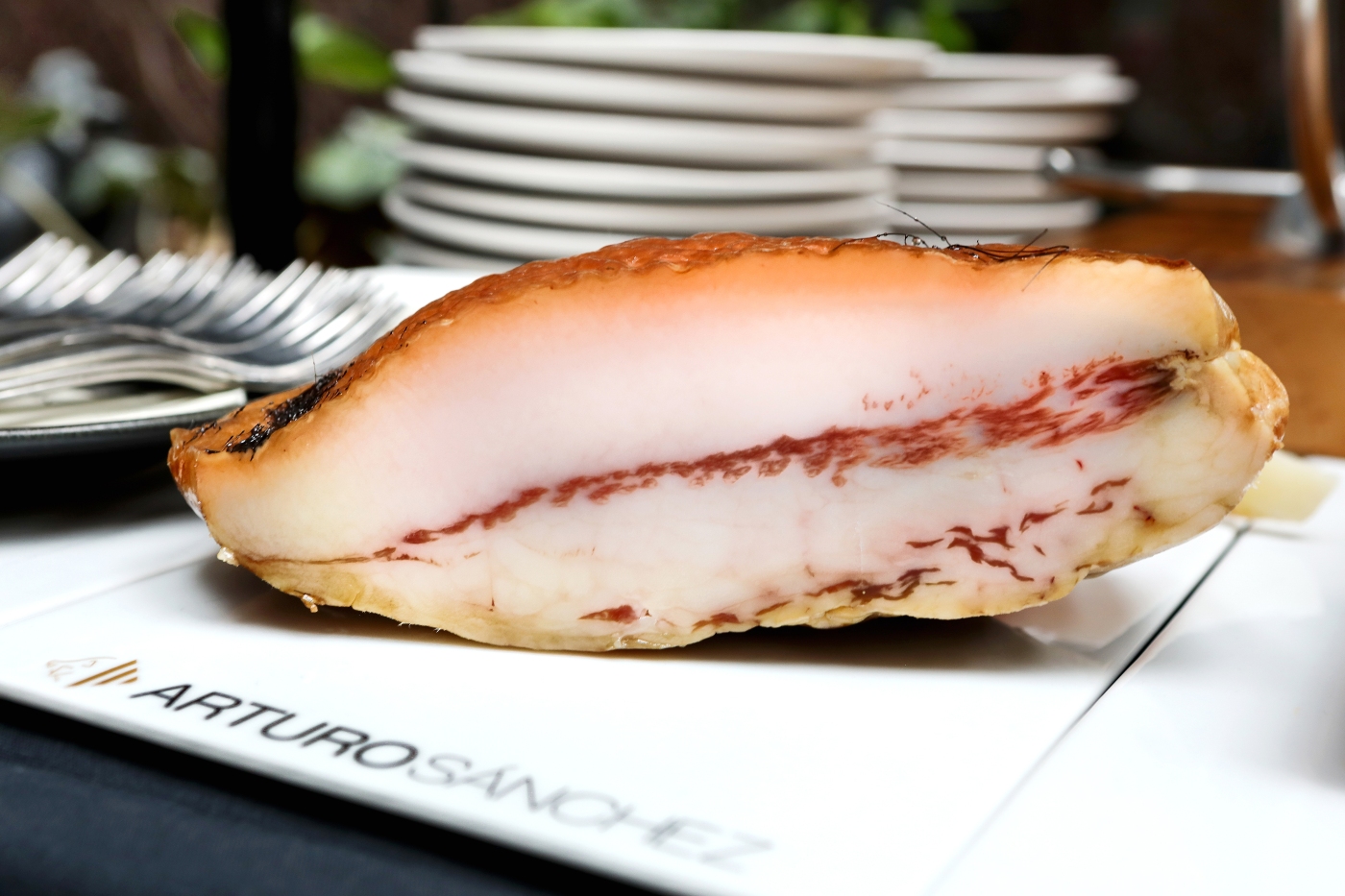
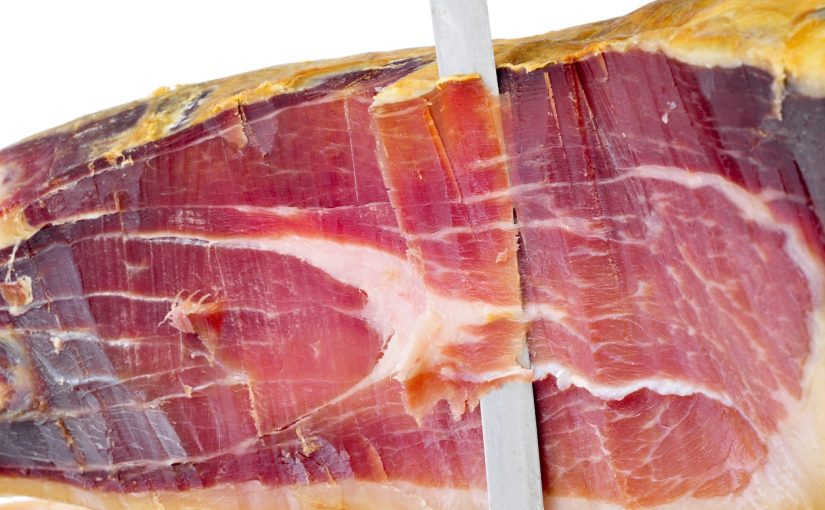
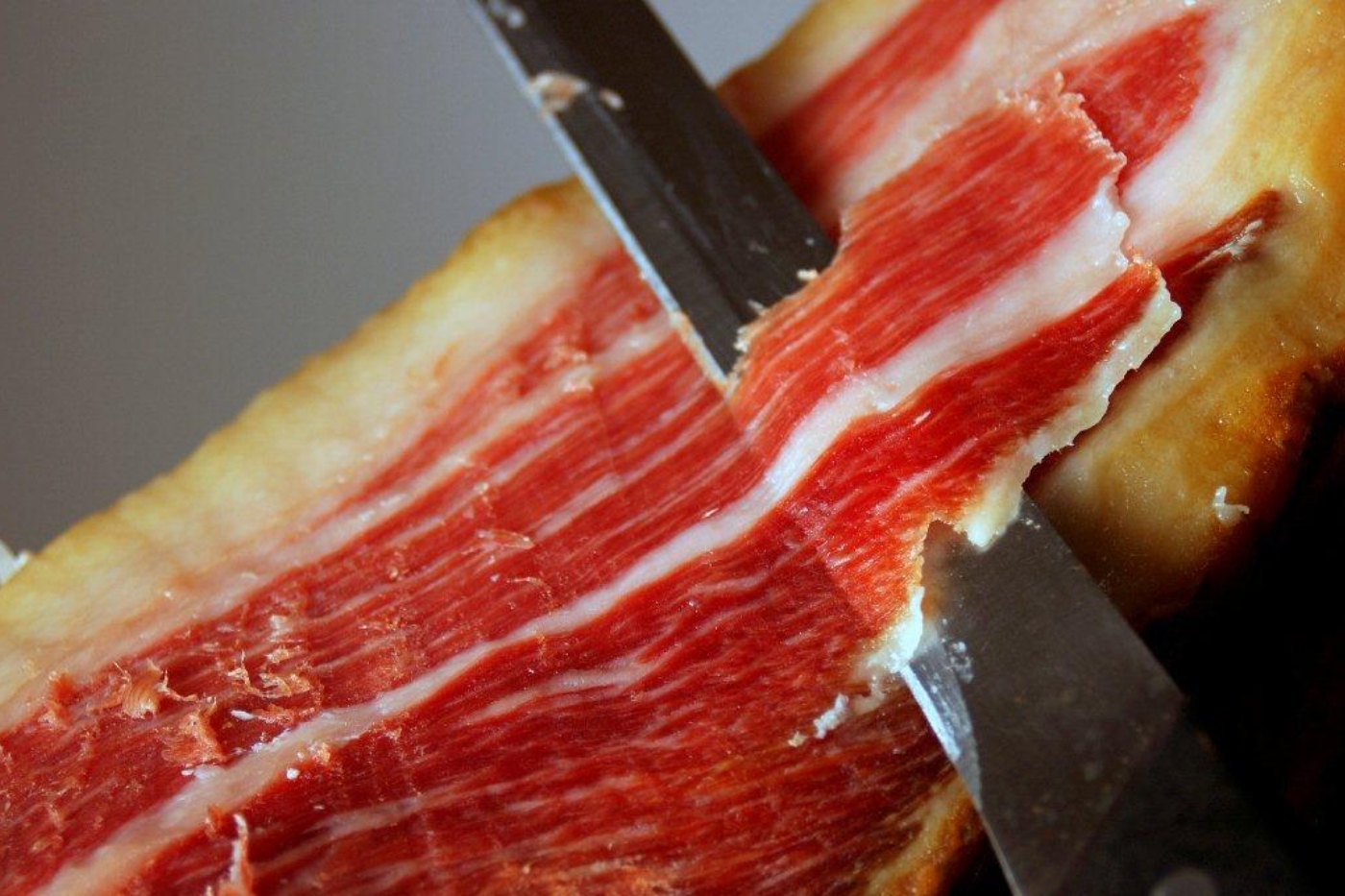
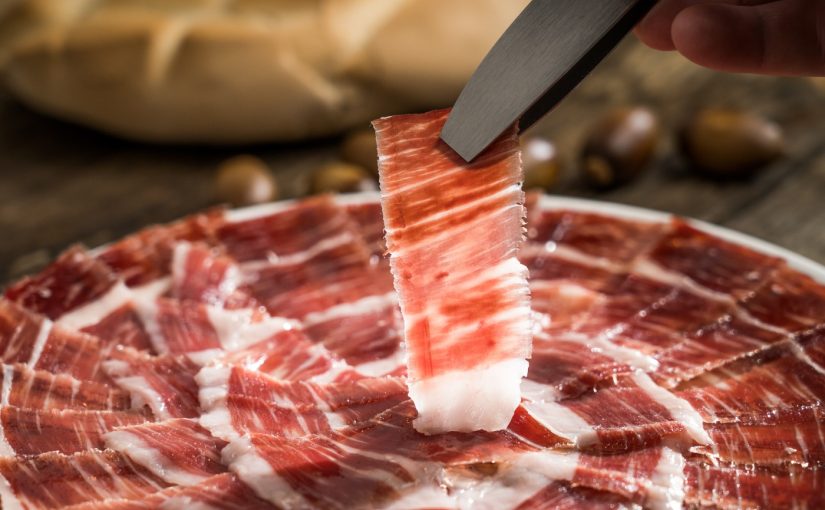
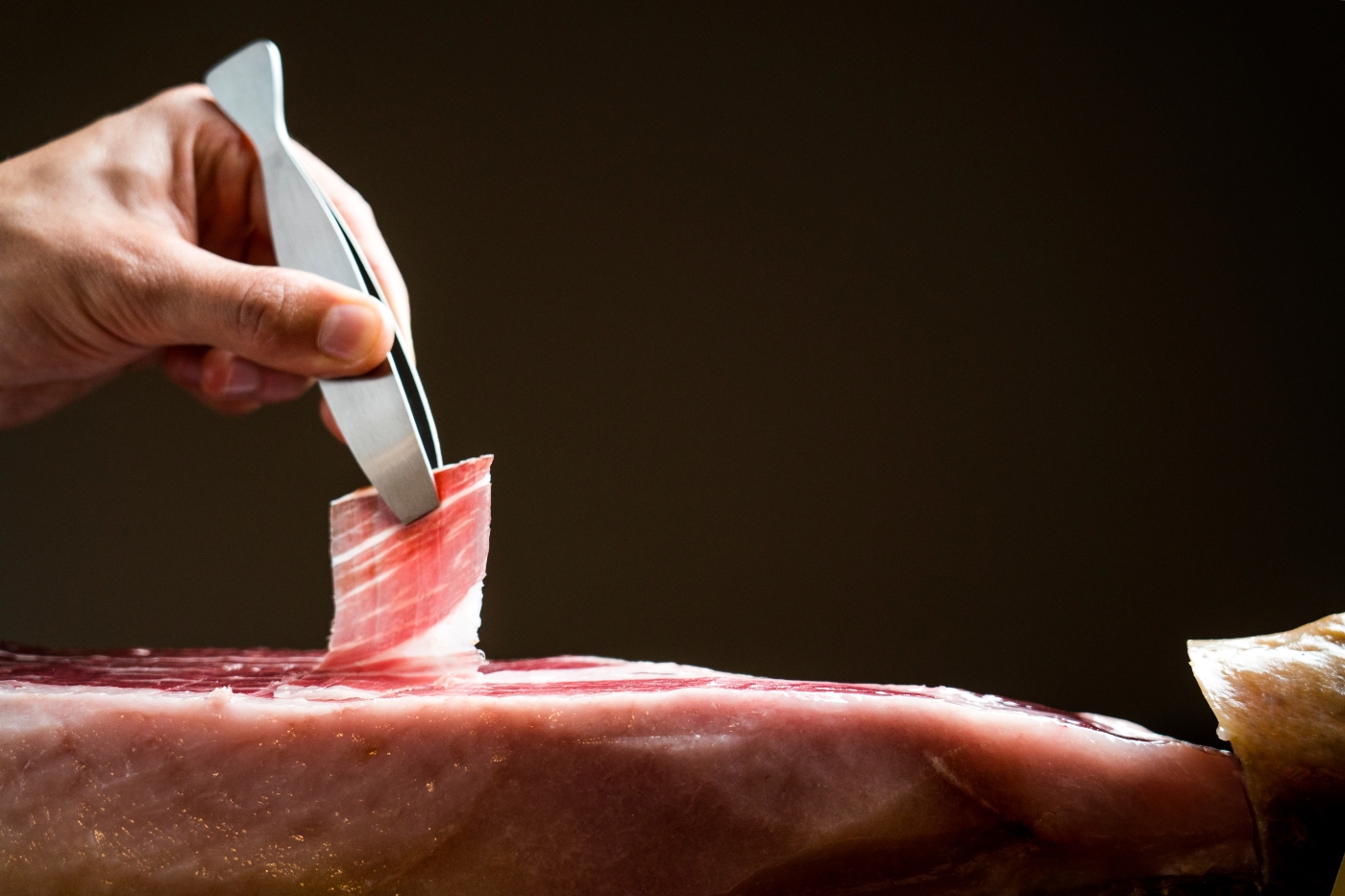
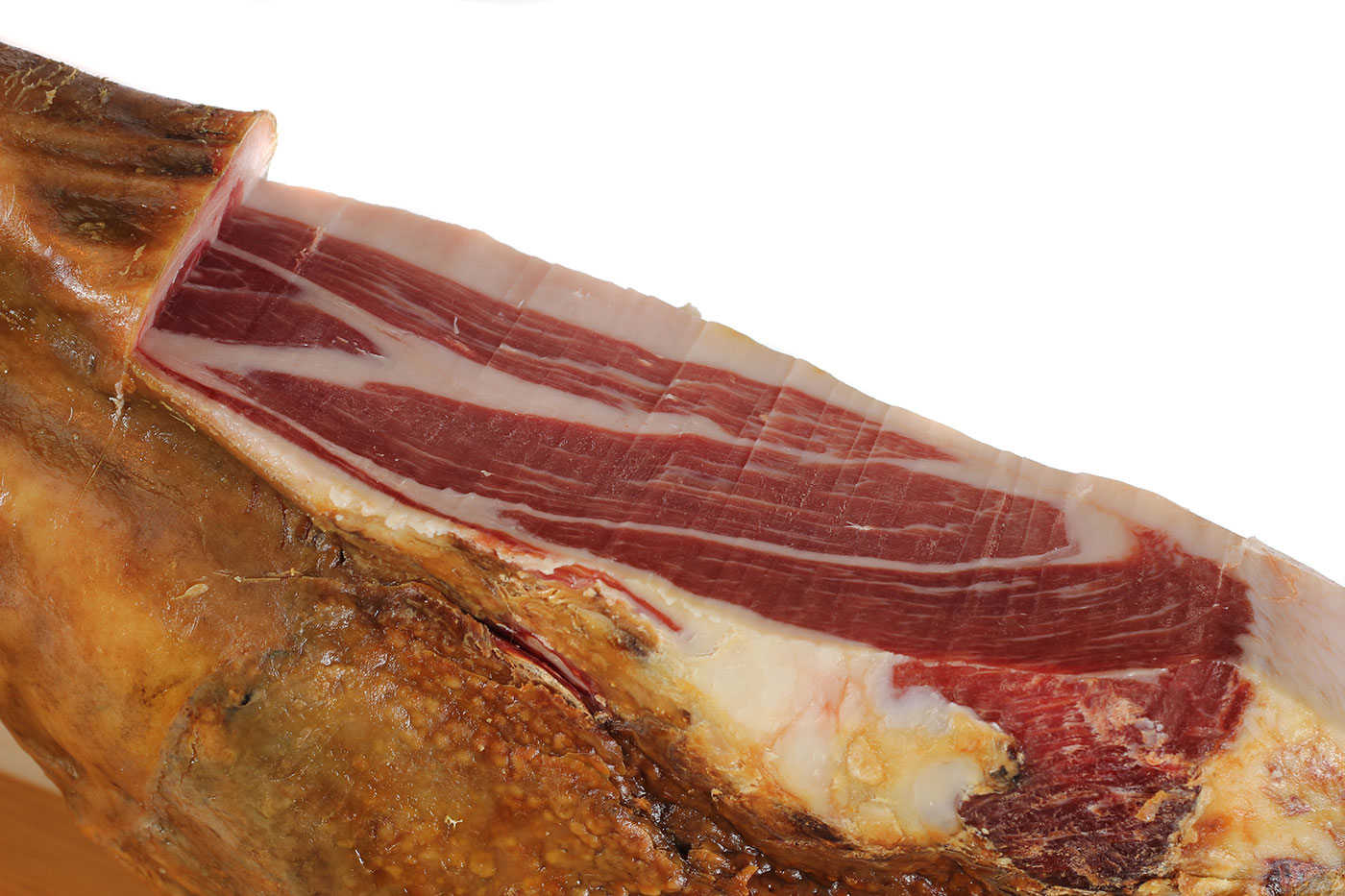
Probably the most famous of all the different cuts of Ibérico pork, Jamón Ibérico comes from the hind leg of the Iberian black pig. The meat is usually cured naturally in mountain air for 24, 30m or 48 months and is available as whole legs or pre-sliced in packs. 48-month cured Jamón Ibérico is known as Reserva. Bellotta is 100% acorn-fed certified, whilst Cebo is 50% certified and cured for 30 months.
Jamón Ibérico has a wonderful nutty taste and is unami-packed. Its texture is silky smooth and has lovely marbled fat. Taste varies subtly between the different types of meat, be it Belotta, Cebo or Reserva.
Jamón Ibérico is usually served on its own in thin slices, really good bread and a glass of Spanish red wine or a glass of chilled dry sherry.
Boneless Loin: Lomo
Ibérico Pork Loin, known as Lomo Ibérico in Spain, stands head and shoulders above standard Spanish pork. Incredibly lean, it is a long premium boneless cut of fresh Ibérico pork taken from the top of the back of the pig. Less fatty than Secreto and Pluma Ibérico pork cuts, Ibérico Pork Loin, it is fine-grained and a rich dark pink in colour.
Despite being so lean, it still has superior flavour and tenderness thanks to the Iberian black pig’s free-range rearing and freedom to forage for holm oak acorns, fragrant herbs and grasses. The exercise and diet these prized pigs enjoy rewards the meat with an elegantly complex flavour coupled with fat that melts in your mouth.
Ibérico Pork Loin is excellent when roasted whole or cut into chops and cooked over a medium heat on a barbecue or pan-cooked. The great thing about Ibérico Pork Loin is that leftovers never go to waste as they are perfect sliced and added to a stir fry. Javier recommends pairing it with either a Rioja Crianza, Mencia or even an Amontillado sherry.
Lard: Manteca
The back fat of Iberian black pigs is not wasted. After rendering, it becomes an Ibérico pork lard which is used as a cooking fat extensively in Spanish cooking, including traditional pastries, mantecados and to preserve meat.
Its flavour is creamy and ever so slightly sweet. In addition to if being a cooking fat, Manteca can also be mixed with spices, including paprika to create a mild and subtly spiced fat which can be spread on bread, sometimes with chunks of chorizo or added to authentic Spanish stews to enrich them.
Lagarto
Found along the spine, between the ribs and the loin, Lagarto are long, thin strips of Ibérico pork. Lagarto means “Lizard” in Spanish and this refers to the shape of these cuts. This area of the pig is also where traditional pork chops are derived.
Lagarto is prized in Spanish cooking for its rich intense flavour, lovely marbling, juiciness and being wonderfully tender as the fat melts away during cooking.
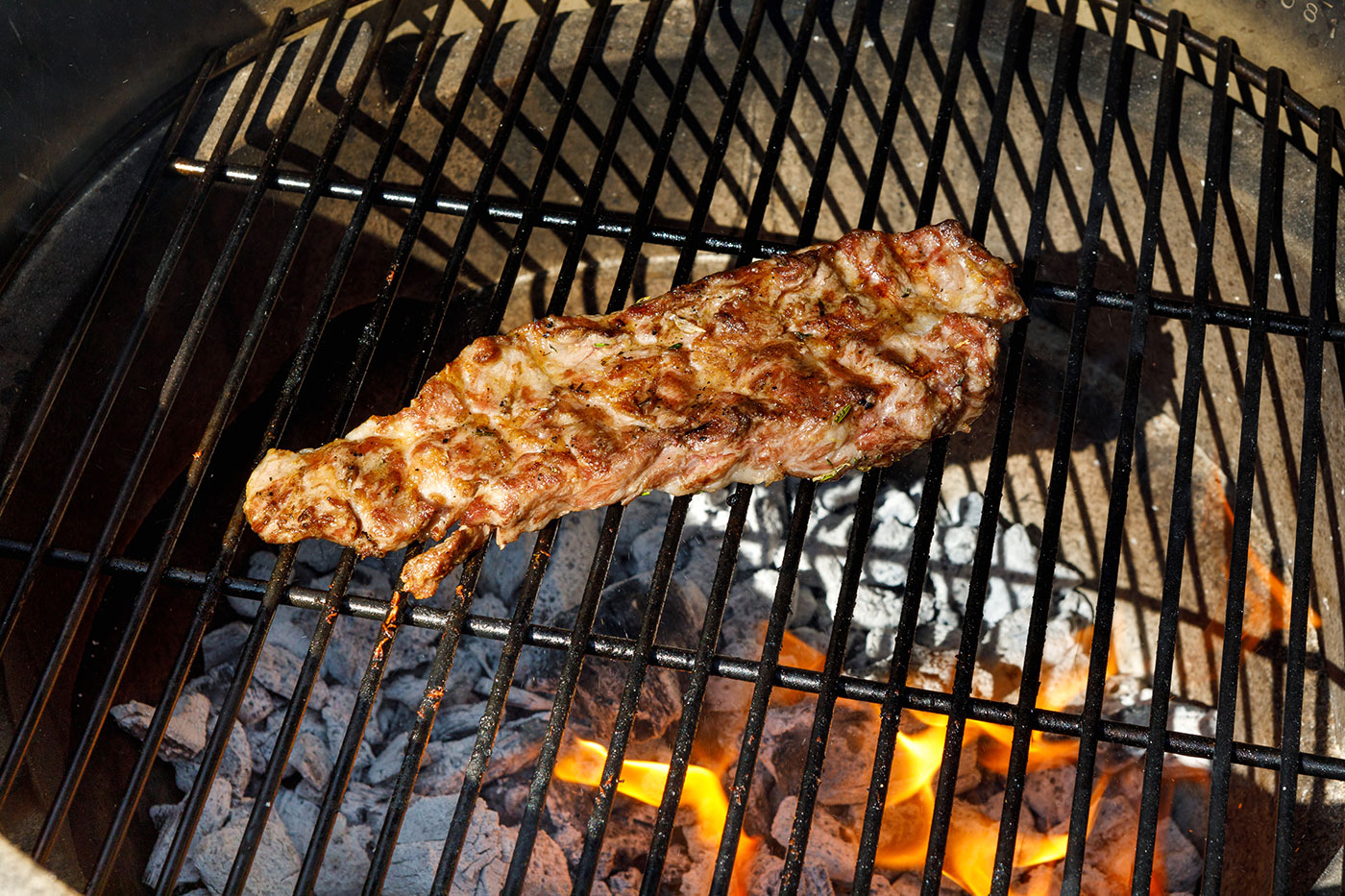
Cooked quickly over a high heat or grilled on a barbecue, Lagarto is tender and deeply flavourful with a slight chewiness.
Ideal for tapas or pintxo, Lagarto is delicious with a simple sprinkle of sea salt and pairs well with a glass of a dry and fruity Albariño or Verdejo, or a light-bodier Tempranillo or a Rioja Crianza.
Fatback: Tocino
Firmer than the belly fat of an Iberian black pig, fatback is the thick layer of fat on its back. In Spain, when the fat is cured it is known as “Tocino”. Aromoatic and flavoursome, due the black pig’s free range rearing and diet, Tocino is deliciously nutty, sweet, silky and buttery. It has plenty of umami and if cured with spices and seasonings, it can have a lightly smoked flavour.
You can use Tocino as a luxurious cooking fat which melts slowly and adds richness or you can wrap it around meat or vegetalbes before roasting. Rendered, the golden fat is perfect for creating confits, frying and flouring stews and beans. You can also use it as a base for soups or pan fry or grill slices.
Cured Tocino can be sliced ultra-thin on warm bread so it almost melts. It works wonderfully this way with with manchego, roasted peppers, figs, honey or sherry vinegar. A glass of dry sherry, Rioja or Cava work particularly well with Tocino.
Tenderloin: Solomillo
Found inside the loin, just under the ribs, this fillet or tenderloin cut of Iberian pork is known as Solomillo in Spain. Solomillo is incredibly juicy, tender and impressively marbled. It is the leanest cut of all Ibérico pork cuts and its taste is complex and wonderfully nutty.
Solomillo Iberian pork is supremely versatile and can be grilled, seared, stuffed or roasted. It is absolutely unrivalled is seared or grilled medium rare, seasoned with salt and pepper and cooked in a hot pan for 10 minutes. Be careful not to overcook if you want to enjoy a juicy Solomillo tenderloin with a fabulously link centre.
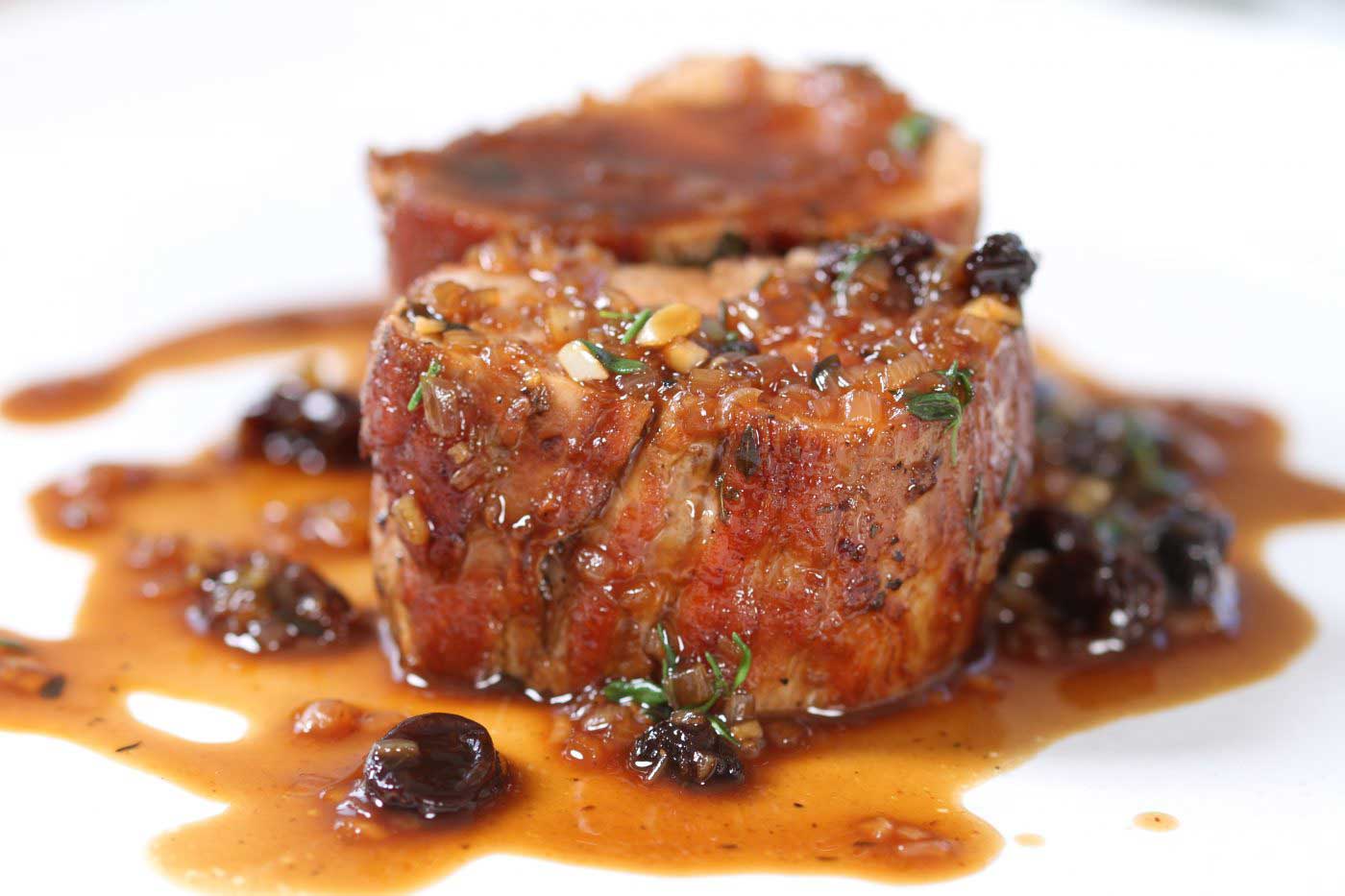
One of our favourite recipes is Ibérico Pork Fillet with Pedro Ximenez Sauce – an impressive dinner party main which you can can find here.
Lagrima
Lagrima, meaning “teardrop” in Spanish, is an unusual premium cut of Ibérico pork that comes from between the ribs and is highly prized in Spanish cooking. It is named after a teardrop because these small strips of baby back rib meat are so juicy, buttery and richly flavourful, they melt like a tear when eaten.
Marvelously marbled thanks to the Iberian black pigs free-range lifestyle, the flavour of Lagrima Ibérica is close to that of beef, but with the delicious complex taste of the pig’s luxurious and natural acorn, herb and grass diet. It is high in umami, so much so, it is sometimes compared to dry-aged beef or premium charcuterie.
Cooking Lagrima Ibérica is incredibly easy and quick. Simply season with salt and pepper, then either barbecue or fry in a pan at a medium heat until its centre is still pink. Leave to stand for five minutes to relax, then slice thinly and enjoy with either a glass of Ribera del Duero or Albariño.
Abanico
Situated on the outside of Ibérico ribs, Abanico Iberian pork is a thin, fan shaped cut of Iberian pork which wraps the ribs. Highly marbled, it is widely revered by chefs world-over. Its name originates from its shape which resembles an Abanico – a Spanish hand fan used by female flamenco dancers.
Rich in flavour, Abanico Iberian pork is beautifully tender and juicy thanks to its marbled fat from the famous black pigs it derives from. Due to its amount of marbling, it almost has the flavour of bacon, but with the complex flavours inherited from its diet of herbs, grasses and acorns.
In terms of cooking, Abanico Iberian pork is a joy. Simply grill it or sear it in a skillet over a medium heat, season and you will be rewarded with one of the most succulent, tender and tasty Ibérico pork cuts. Serve with a Tempranillo or Rioja Reserva.
Pork Rack
Ibérico Pork Rack is taken from the rib area of the loin of the Iberian black pig and is a premium Iberian pork cut. Ideal for a roasting joint or cut into pork chops for barbecuing or pan frying, Ibérico pork rack has the perfect amount of fat and really heavy marbling. So much so, it is often compared to Wagyu beef.
The flavour of Ibérico pork rack is complex. Deeply meaty, it is much richer than standard pork loin. The Ibérico black pig’s natural diet, including acorns, brings a lovely nuttiness to the table. On the mouth, it is beautifully tender but with a lovely chew to it.
Javier suggests dividing into thick chops, and barbecuing to his Barbecued Pork Chop with Mole Sauce recipe. Alternatively, make a special occasion of it and roast it whole as a joint. It comes bone-in for an extra depth of flavour which also elevates gravy made from the rack’s juices. Serve with roasted vegetables and either a good bottle of Ribera del Duero Tempranillo, Rioja Gran Reserva or a Mencía as served at the famous El Capricho Steakhouse.
Spare Ribs: Costillas
Iberian black pigs have majestic rib cages surrounded by fabulously rich meat and flavoursome fat. Ibérico ribs, known as “costillas” in Spain, yield delicious, wonderfully textured meat and are a real barbecue favourite.
Costillas Ibérico ribs and baby back ribs are often marinaded first with rubs or sauces before being cooked over hot coals. Alternatively, they are roasted or slowly braised so the meat literally falls off the bone.
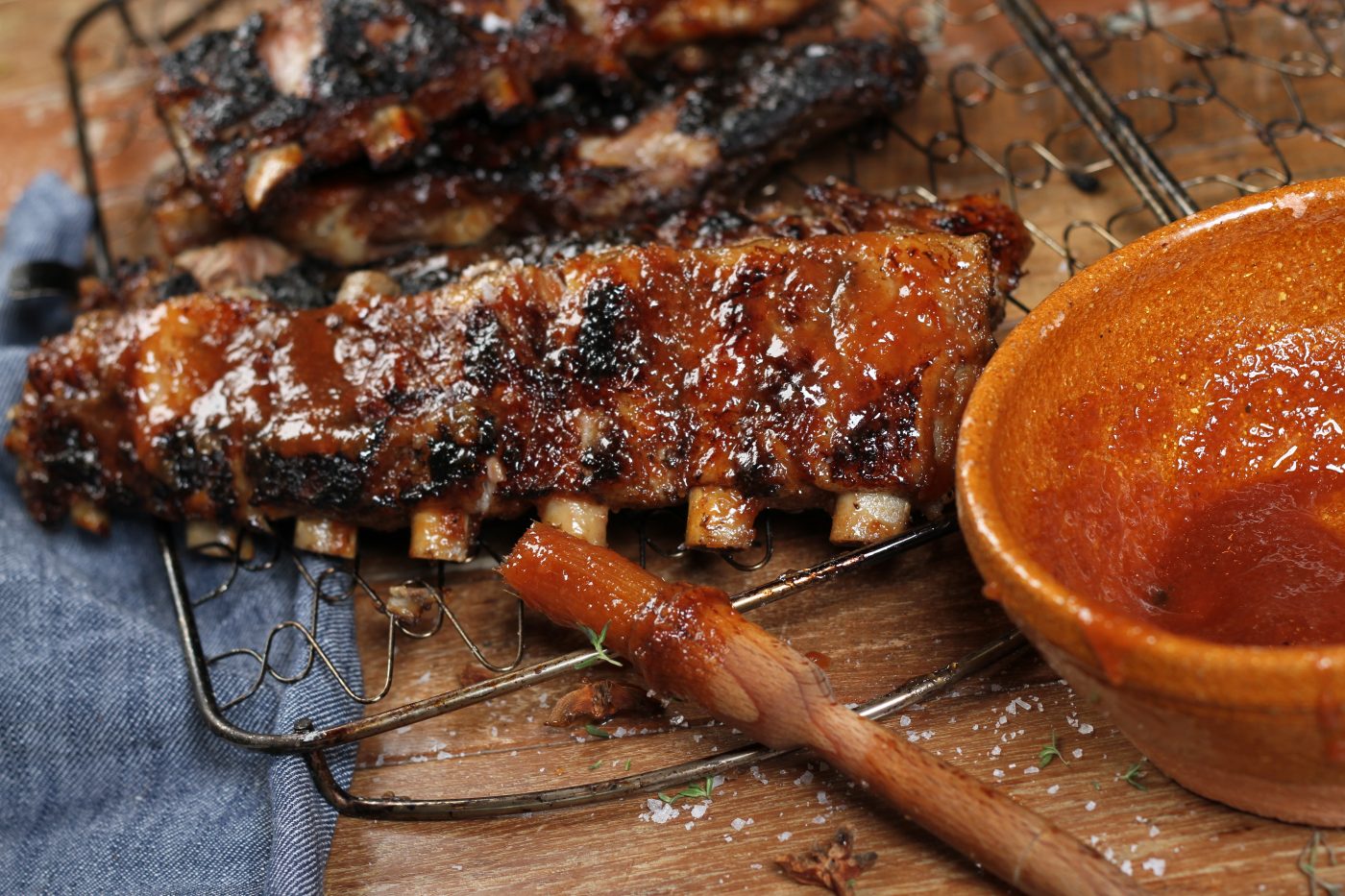
Barbecued Ibérico Pork Ribs with Quince Glaze is a wonderfully sticky Ibérico rib recipe using baby back ribs whch are barbecued. Try Javier’s recipe here. Serve with a salad and a cold Spanish beer.
Pork Belly: Panceta
Derived from the belly of Iberian black pigs, Ibérico Pork Belly, known as “panceta entera” in Spain, is a large cut of pork belly taken from the underside of the pig. It is naturally fatter than other Ibérico pork cuts and being from free-range Iberian black pigs, it is fatter than standard pork bellies.
Rich and fatty, it owes its unique flavour to the Iberian black pigs’ freedom to root for holm oak acorns, wild herbs and grasses.
Similar to Italian Pancetta, Ibérico Pork Belly can be used in various different ways including being roasted, grilled, chopped and added to stews, added to Spanish omelets, paellas, rice dishes, confits and “cocido” Spanish stews. Javier loves how versatile Ibérico Pork Belly is and his recipe for Crispy Pork Belly with Wild Garlic Arroz perfectly demonstrates that. Consider pairing it with a glass of good Garnacha.
Pluma
Plumera Ibérica is one of the classic Ibérico pork cuts found at the end of the loin of black Ibérico pigs, just near the neck. Of all the different cuts of Ibérico pork, Pluma is used by some of the most prestigious and respected Spanish restaurants and pintxo bars.
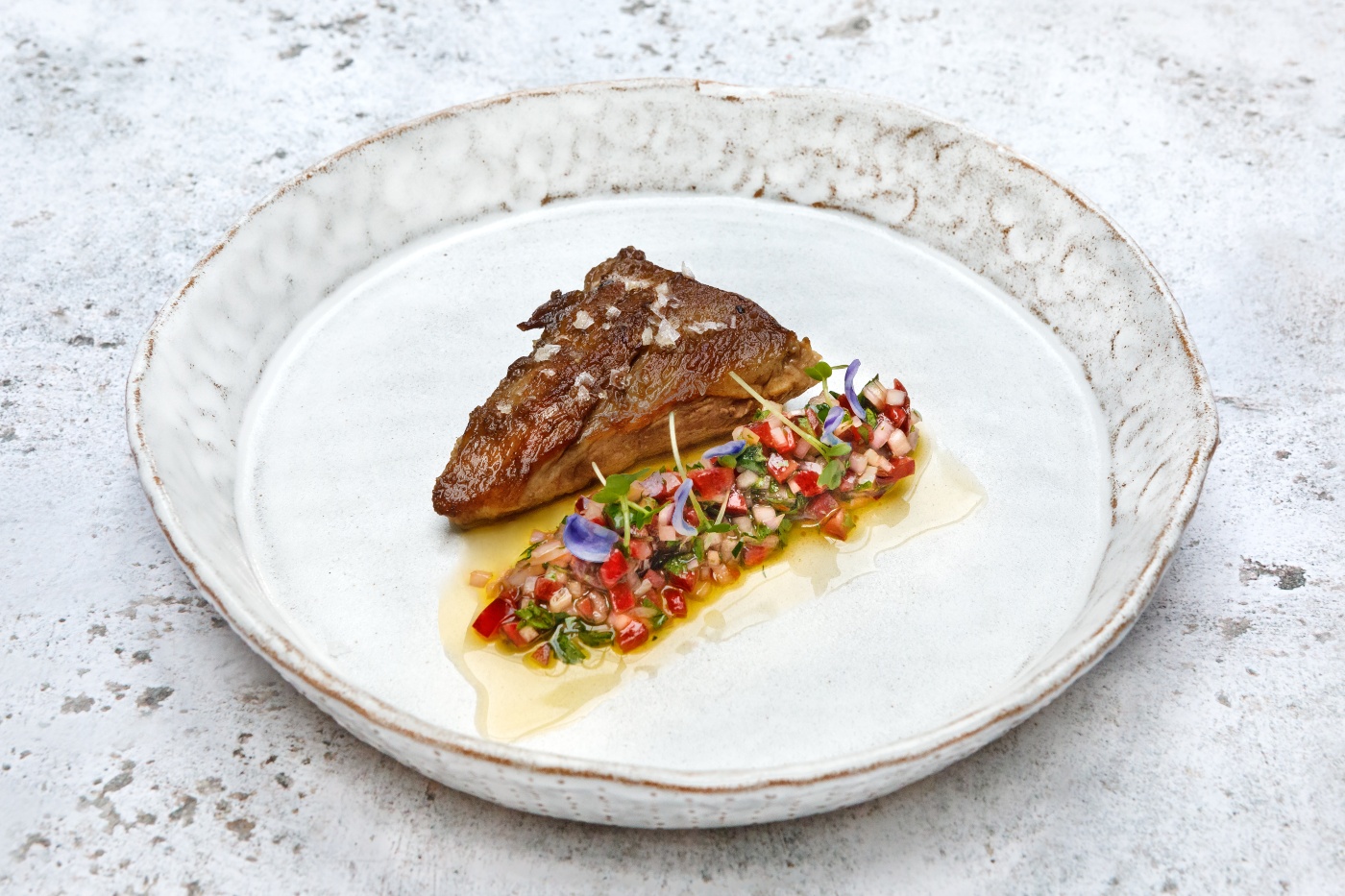
Incredibly tender and sublimely juicy, Plumera Ibérico pork is thin and comparatively leaner than secreto and juicier than Presa and Solomillo. The meat is well-endowed with handsome marbling and is ideal for barbecueing with a chimichurri sauce to Javier’s own recipe. Enjoy with an aged Rioja, Pinot Noir or if you prefer a white wine, an elegant and fruity Albariño.
Secreto
Hidden under fat, between the shoulder and the ribs, you will find Secreto Ibérico. This “secret” thin and flat cut of Ibérico pork is used extensively in contemporary Spanish cuisine and is often compared to Wagyu beef.
Rich, nutty and with a buttery melt-in-the-mouth texture, Ibérico Secreto has a delicious and intense flavour.
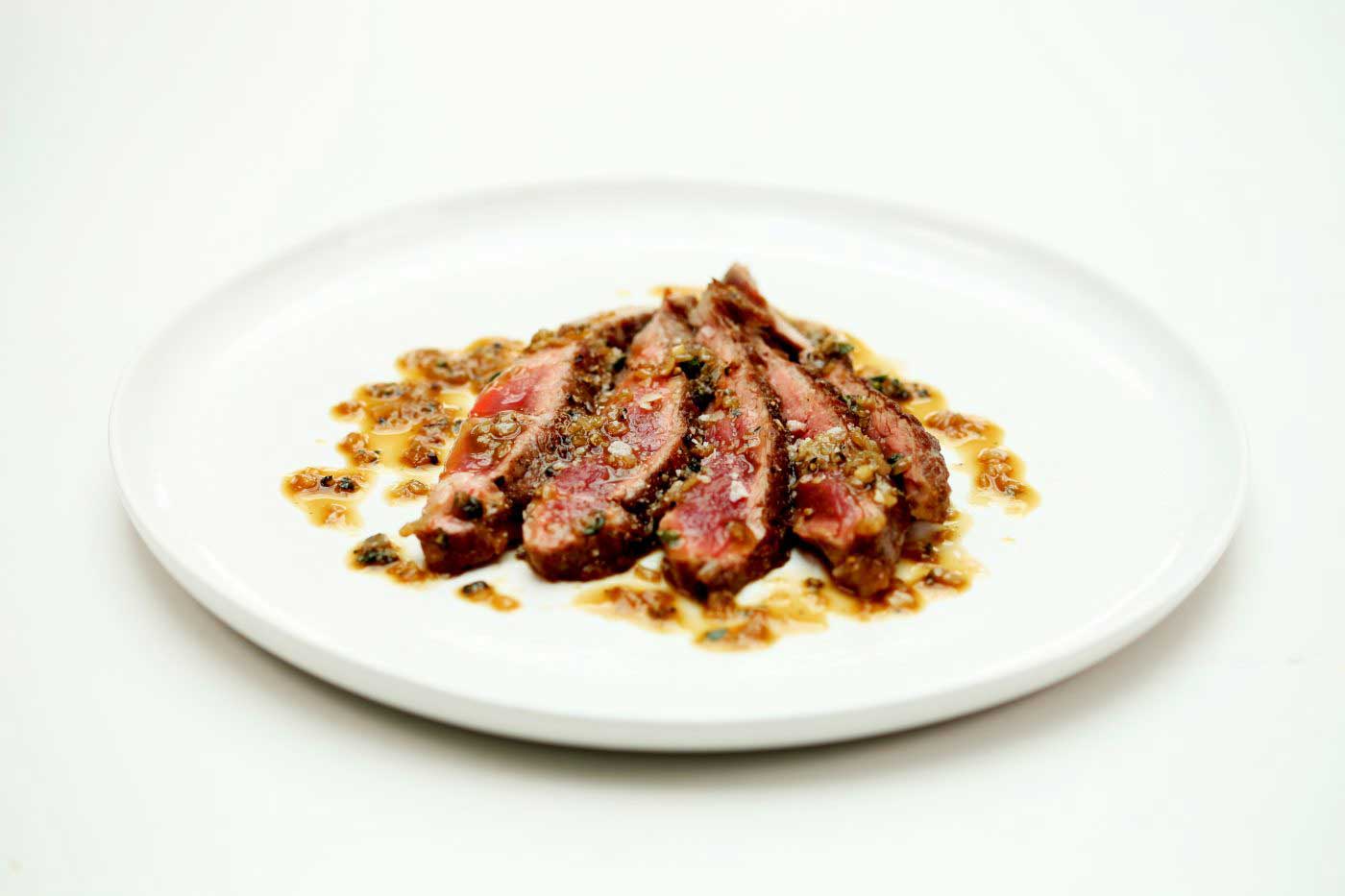
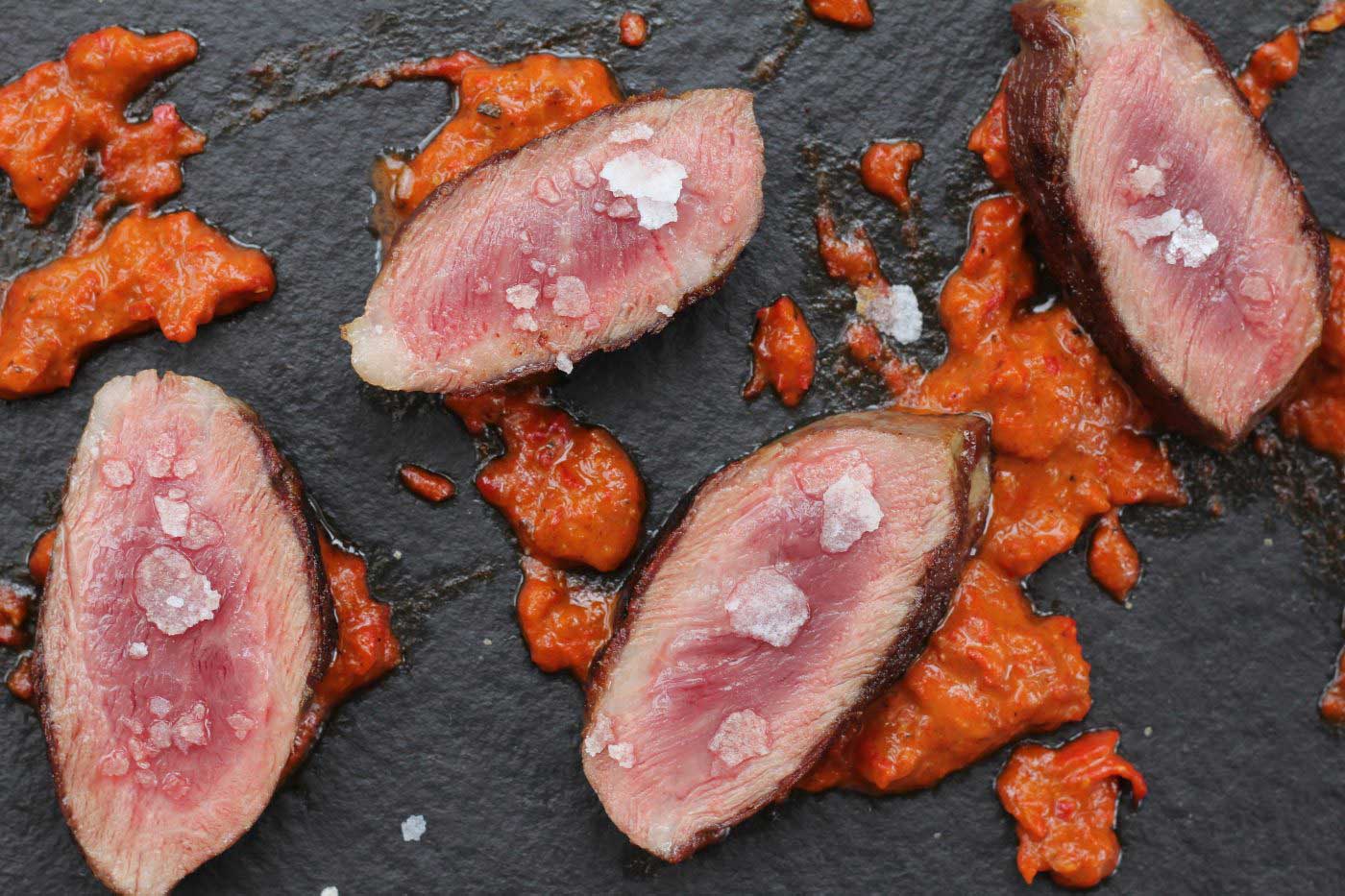
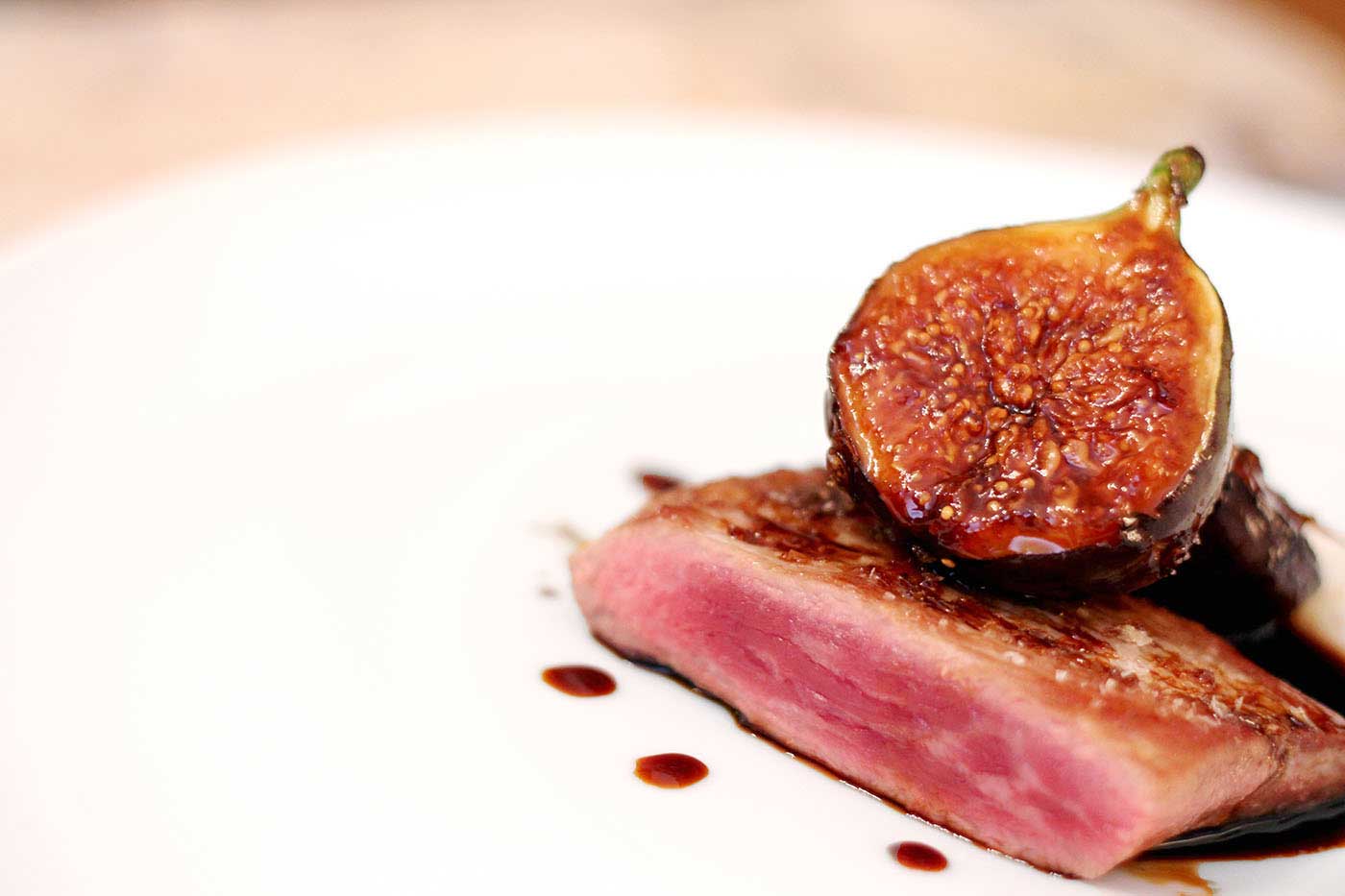
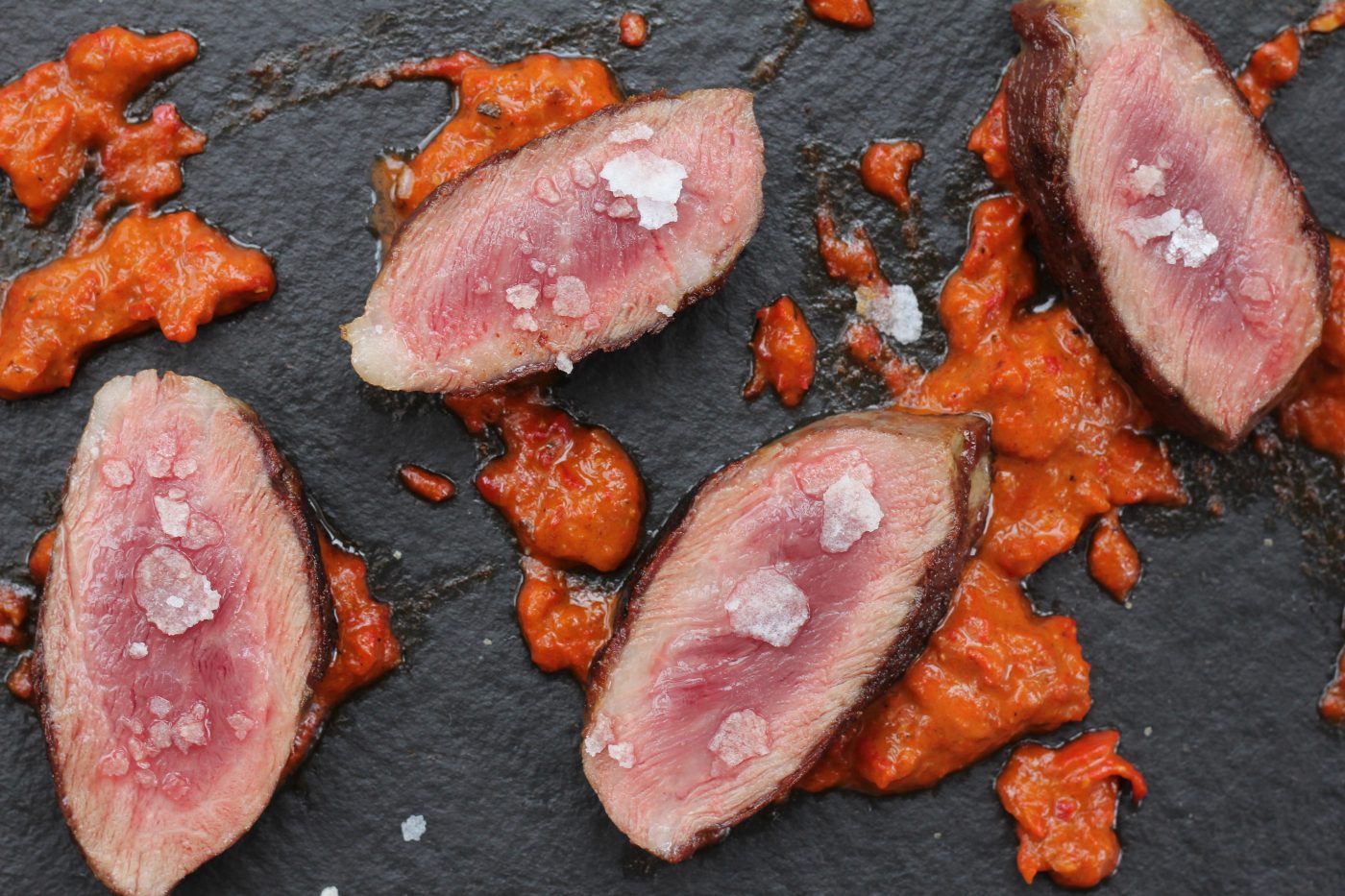
Heavily marbled, Secreto Ibérico pork can be cooked in numerous ways. Cut thin and grilled, the fat just melts away. You can also barbecue or pan sear it, then slice, sprinkle with sea salt and serve with chimichurri. Javier also suggests pan frying it pink and serving with caramelised figs and an aged Oloroso sherry reduction – recipe here.
Shoulder Collar: Cabecero
Also known as in Italy as “capocollo” or “coppa”, Cabacero Ibérico is the pork collar at the shoulder and top of the loin. The third largest muscle on an Iberian black pig, Cabacero Ibérico pork collar is highly marbled and due to its versatility, one of the most popular Iberian pork cuts in Spain.
Perfect for roasting, smoking. Grilling and pan frying, Cabacero pork collar is both tender and rich flavoured when cooked. Javier likes it either roasted low and slow, or cut into steaks and seared in a hot pan to develop a crust. Pair it with good Spanish Rioja or Tempranillo.
Presa
If you are an Ibérico pork fan but also a big lover of beef, Presa Iberica is a thick cut of Ibérico pork, which is found on the shoulder near the top of the loin, that will definitely hit the spot. It is leaner than both Pluma and Secreto Ibérico pork and simply melts in your mouth.
Close in flavour to beef, this highly marbled Ibérico pork has remarkable marbling, is extremely tender and absolutely mouthwatering when cut thick and grilled or pan-seared on a high heat, like a steak, medium rare. The wonderful nutty acorn flavours and subtlety of the herbs and grasses the Ibérico free-range pigs diet shines though.
One of Javier’s preferred ways to cook Presa Iberica is with a Mojo Rojo sauce and is fabulous with a creamy white Chardonnay. You can find his recipe here.
Shoulder: Pechuga de Paleta
Pechuga de Paleta is a cut of Ibérico pork shoulder – in specific, the blade or chuck portion of the shoulder. Of the numerous Ibérico pork cuts, Pechuga de Paleta is popular in Spain due to it being both inexpensive and also extremely flavourful, thanks to its high fat content and acorn, herb and grass diet of the Iberian black pigs.
It can be slow roasted whole or cut into large chunks and braised with vegetable in a stew where it can simmer for hours. Slow-cooking Pechuga de Paleta then shredding the tender meat makes for superb pulled pork. Tempranillo or even a Mencia make great pairings with this roast Ibérico pork.
Shoulder: Paleta
The Paleta, meaning “shoulder” in Spanish is also responsible for Paleta Picnic, which is lower, thinner cut from the front leg, or shoulder, of Ibérico black pigs. Smaller and tougher to cut than Jamón Ibérico, Paleta has less marbling and fat than its rear leg counterpart but it still has a wonderfully rich nutty taste.
Paleta is usually cured for two years, which is faster than Jamón Ibérico, to create Paleta Ibérica de Bellota which is also available boneless. There is also Paleta Ibérica de Cebo which is cured form the meat of cebo de campo ibérico pigs.
Serve Paleta Ibérico ham thinly sliced at room temperature and enjoy with a fine Cava, Fino or Manzanilla sherry or an aged Rioja.
Feet: Manitas
In Spanish, “Manitas’ are pig’s trotters and translates as “little hands” or “paws”. They are a common cut of Ibérico pork in Spanish cooking and they are typically stewed to create a rich sauce with chickpeas and other Mediterranean vegetables.
Hocks: Codillos
Codillos are effectively the hocks or pork knuckles of Iberican black pigs. They produce a wonderful rich flavour and have beautifully succulent meat on them. Codillos are often slow-cooked so that the collagen breaks down and gives unctuous, tender results.
Roasted and seasoned with garlic, paprika, thyme, rosemary and bay leaves, the skin of Codillos becomes fabulously crispy which contrasts with the soft aromatic Ibérico pork meat inside.
Jowl: Papada
The jowl or dewlap of an Iberian black pig is called Papada and is located just on its neck, just under the face. Papada is often cured with salt, spices and paprika and produces something which is not dissimilar to Italian Guanciale.
This delicious Iberian pork cut can be enjoyed on its own, on a charcuterie board or as an ingredient to add depth of flavour to Spanish dishes. It can also be fried until crispy or used in sauces and stews.
Pork Cheeks: Carrilleras
Ibérico Pork Cheeks, known as “carrilleras” or “carrillada” in Spain, are highly prized assets of the Iberian black pig breed, especially in Andalucia, as the meat is so incredibly lean, moist and rich in flavour – almost beef-like. That is all thanks to the Ibérico black pigs liberated lifestyle where it is allowed to roam free amongst cork and holm oak trees feasting on sweet acorns and fragrant grasses and herbs.
Each Ibérico Pork Cheek is a lovely deep red in colour, plump, moderately fatty and the size of a golf ball. This culinary gem of Spanish ingredients is often served in either tapas or pintxo bars.
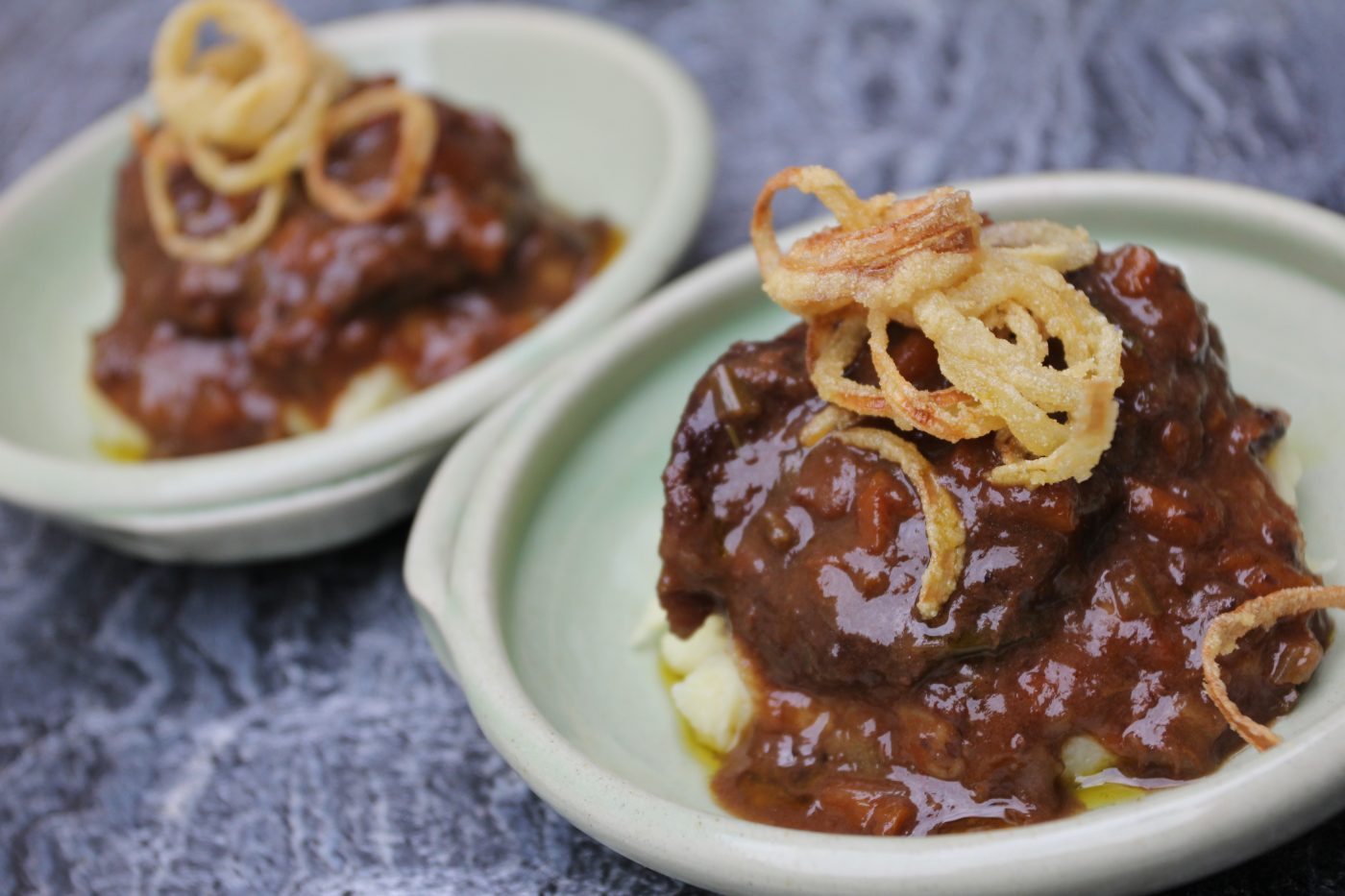
Ibérico Pork Cheeks are often braised or slow-cooked in Pedro Ximénez wine or Spanish sherry to create an exquisitely deep flavour and tender meat. However, Javier loves creating Ibérico Pork Cheek Burgers with Brandy BBQ Sauce – try it for yourself with this recipe. Serve with a big Spanish red such as a Cabernet Sauvignon Merlot.
Where can I buy Ibérico pork?
Now you know all there is to know about Ibérico pork and its different cuts, from Pluma and Presa to Solomillo and Secreto.
Basco imports free range Ibérico pork cuts freshly every week from the Dehesas of Southwest Spain and has won the coveted and highest accolade of 3-star Great Taste Awards not once, but three times. This is testament to the quality and taste of all our Iberian pork.
The Basque Country is widely regarded to be one of the absolute best types of gastronomy in not just Spain, but also the world. A fabulous, historic and thriving Basque Country food culture has attracted the largest amount of Michelin star restaurants in the world for the size of the region.
In this Basque Country food guide, Basque-born Basco founder and professional chef Javier De La Hormaza shares 12 recipes for some of the best food in Basque Country. Twelve tempting and simple to cook recipes for Javier’s top pintxos, starters, stews, fish, meat and desserts.
Before we reveal Javier’s delicious dozen and take you on a Basque Country food tour, let’s quickly examine why the gastronomy of the region is so incredibly tasty and popular.
Basque Country food
The people of the Basque Country are the oldest surviving ethnic group in Europe who pre-date the Roman Empire and over that time, their cuisine has developed into something magical. Basque Country food owes its tremendous diversity to the geography of the region. Situated in the western Pyrenees, straddling the border between France and Spain on the coast of the Bay of Biscay, Basque Country food draws on local ingredients from both the land and the sea.
Álava, Guipúzcoa, and Vizcaya are the three provinces of the Basque Country and each has its own quite distinctly different cuisine. San Sebastián and Bilbao are famed for their vibrant culinary scene, particularly its seafood and pintxos, which are effectively Basque tapas or finger food. Basque Country food tours in both of these great cities should be on every food lover’s bucket list.
Javier’s Top 12 Basque Country food recipes
Let’s get down to business. Here are the mouthwatering tasters and links to easy-to-follow recipes from the Basque Country founder of Basco…
Basque Country Pintxo Recipes
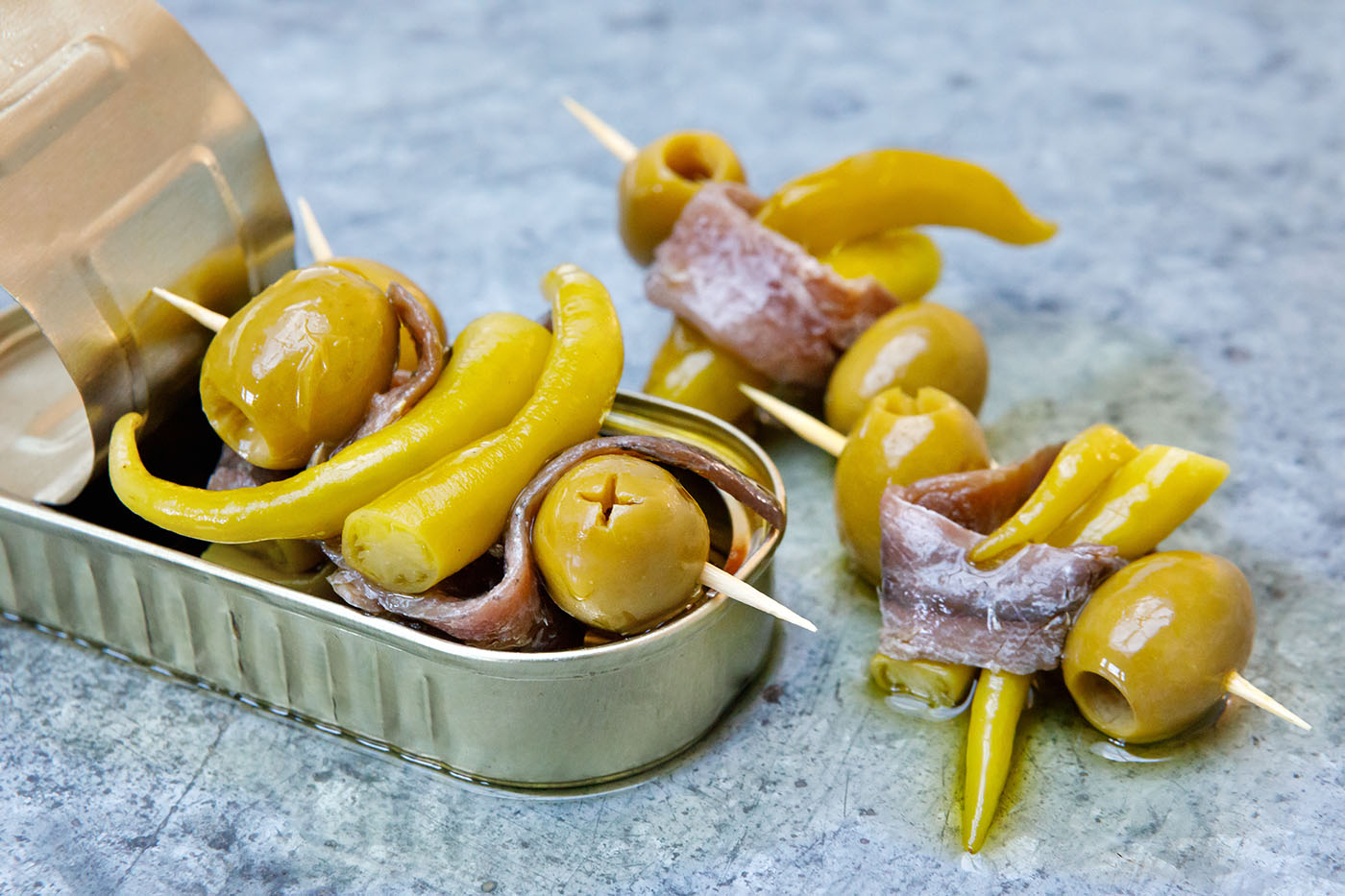
Gilda Pintxo – available in virtually every pintxo bar in San Sebastián, all Basque country food tours should include sampling the Gilda Pintxo. Named after the Rita Hayworth film “Gilda”, it combines wonderful briny flavours of pitted manzanilla olives, Cantábrico anchovies and Guindilla pickled peppers. Salty, spicy and the perfect pintxo.
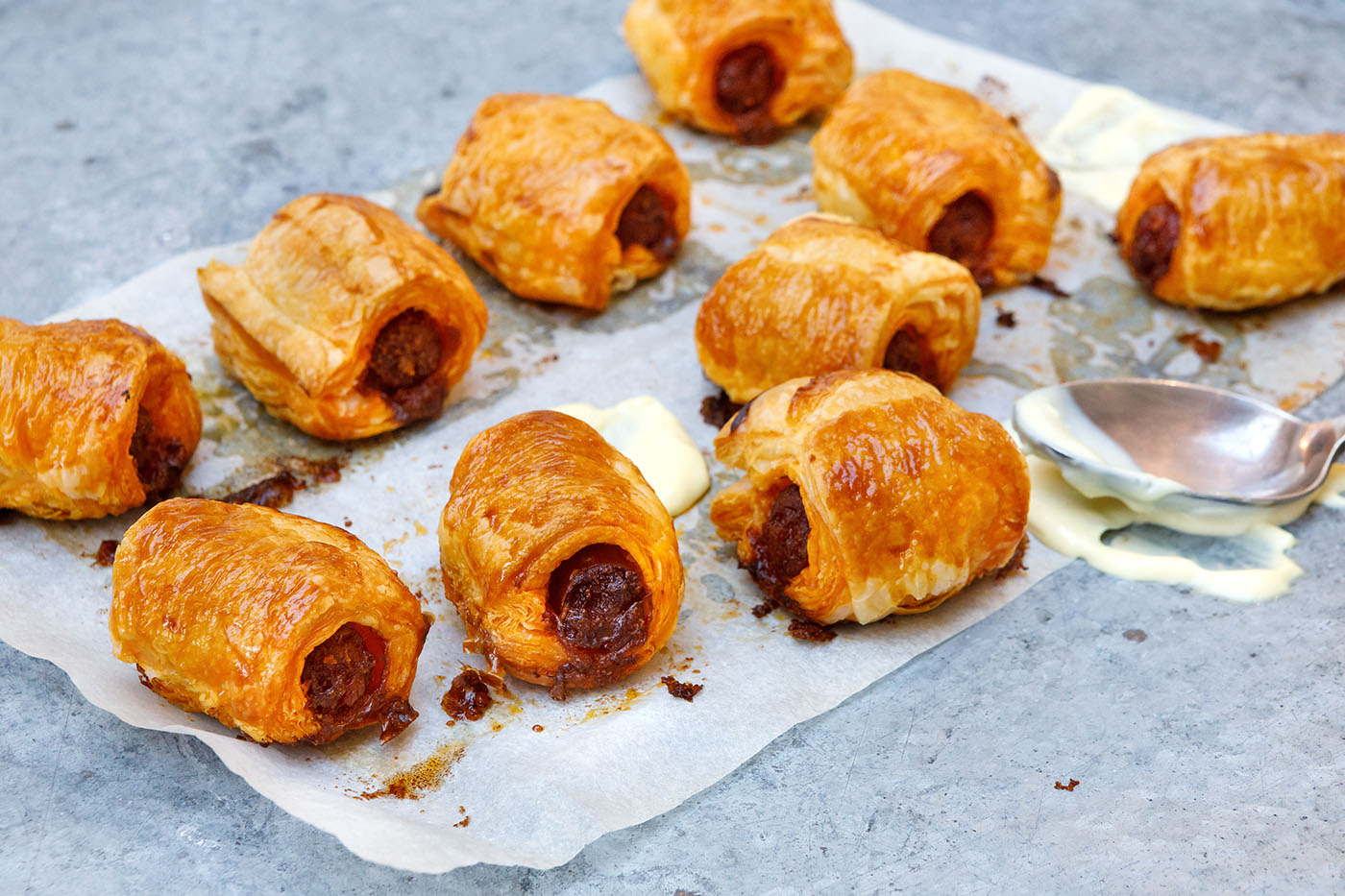
Chistorra Sausage Rolls with Lemon Aioli – Chistorra is a piquant free-range pork sausage from the Basque Country and Navarra which is perfect for creating pintxo sausage rolls with a kick. Encased in a light all butter puff pastry this Basque Country food is wonderful offset by a creamy yet tangy lemon aioli.
Basque Country Starter Recipes
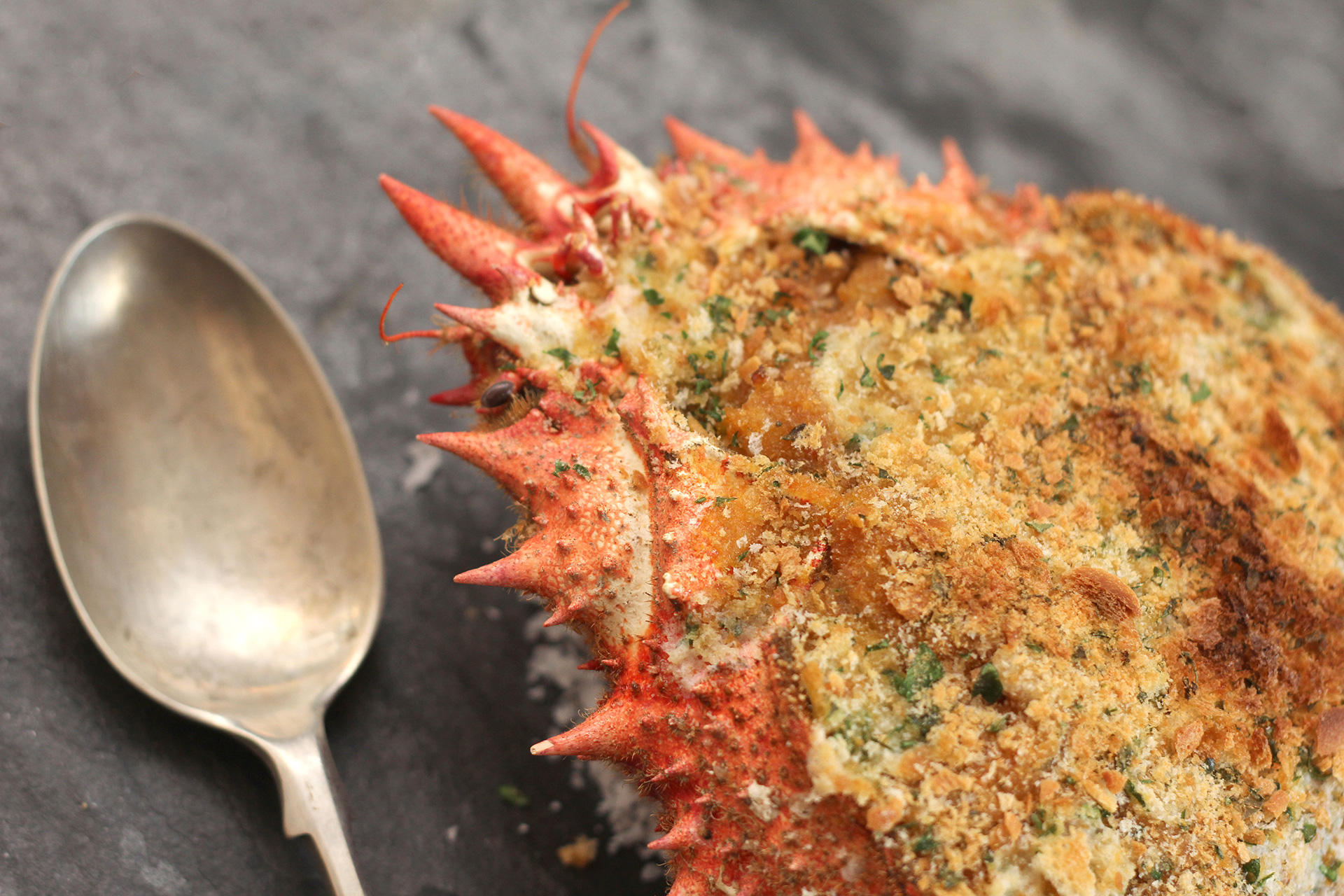
Baked Spider Crab – this traditional Basque Country starter is as delicious as it is impressive. Native to San Sebastian its star ingredient one of the most enjoyed crustaceans in Basque Country food culture…the spider crab. Together with tomatoes, onions, leeks, cognac and spider crab meat are served in the shell and topped with breadcrumbs.
Saute Baby Eels ‘Bilbao’ Style – “angulas” are Spanish baby eels and this dish is undoubtedly one of Bilbao’s greatest Spanish seafood starters. Cooked individually in an earthenware dish with garlic, and guindilla chillis, they have a wonderful subtle taste with a slightly crunchy texture.
Basque Country Stew Recipes
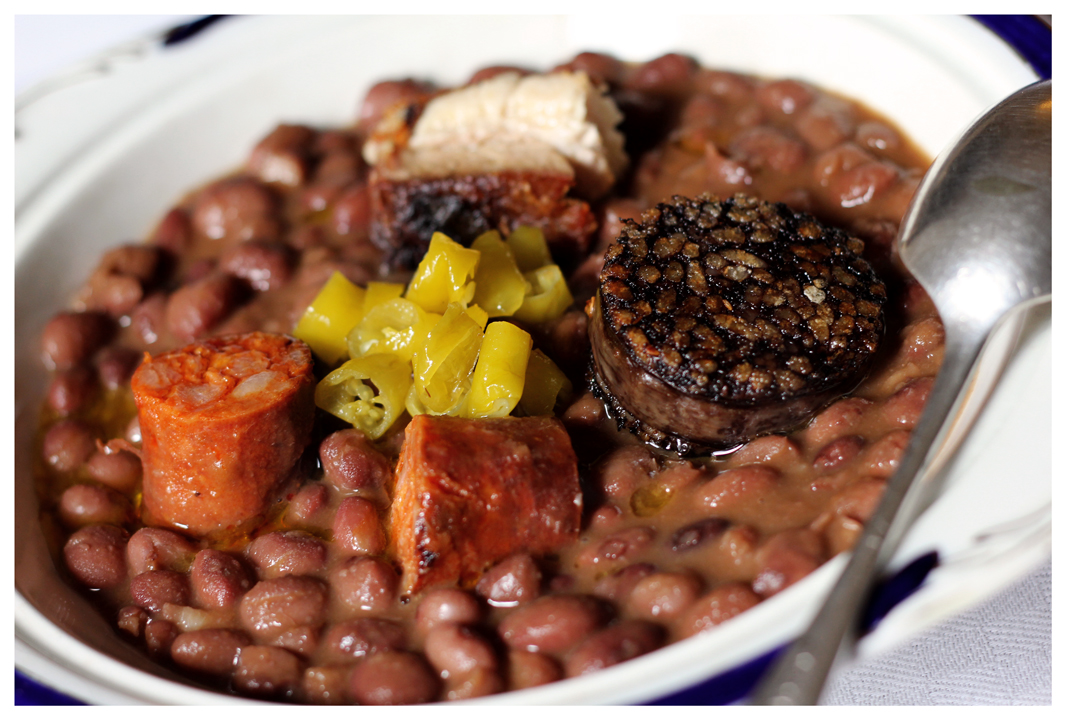
Alubias De Tolosa Stew – this incredibly simple Basque Country food uses black beans from Tolosa – little black pearls. Pork ribs, pork belly, cabbage, cooking chorizo and Spanish blood sausage called ”morcilla” and guindillas give it a meaty, spicy, unctuous and beautiful creamy, buttery texture and distinct colour.
Marmitako – this classic Basque Country food is a tuna stew was thought to be originally created by thrifty fishermen who used left over fish and potatoes to feed the crew. Over the years, the recipe which uses fresh tuna, has been embellished and Javier’s includes green, red onions and choriceros peppers.
Basque Country Fish Recipes
Bacalao Al Pil Pil – this name of this traditional Spanish dish is actually derived from the bubbling sound made when cooking as you move the earthenware dish in circles to emulsify the sauce. Ingredients of this Basque Country food include salted cod, guindilla chilli, garlic and olive oil. The result is deliciously silky sauce and wonderful flavoursome cod.
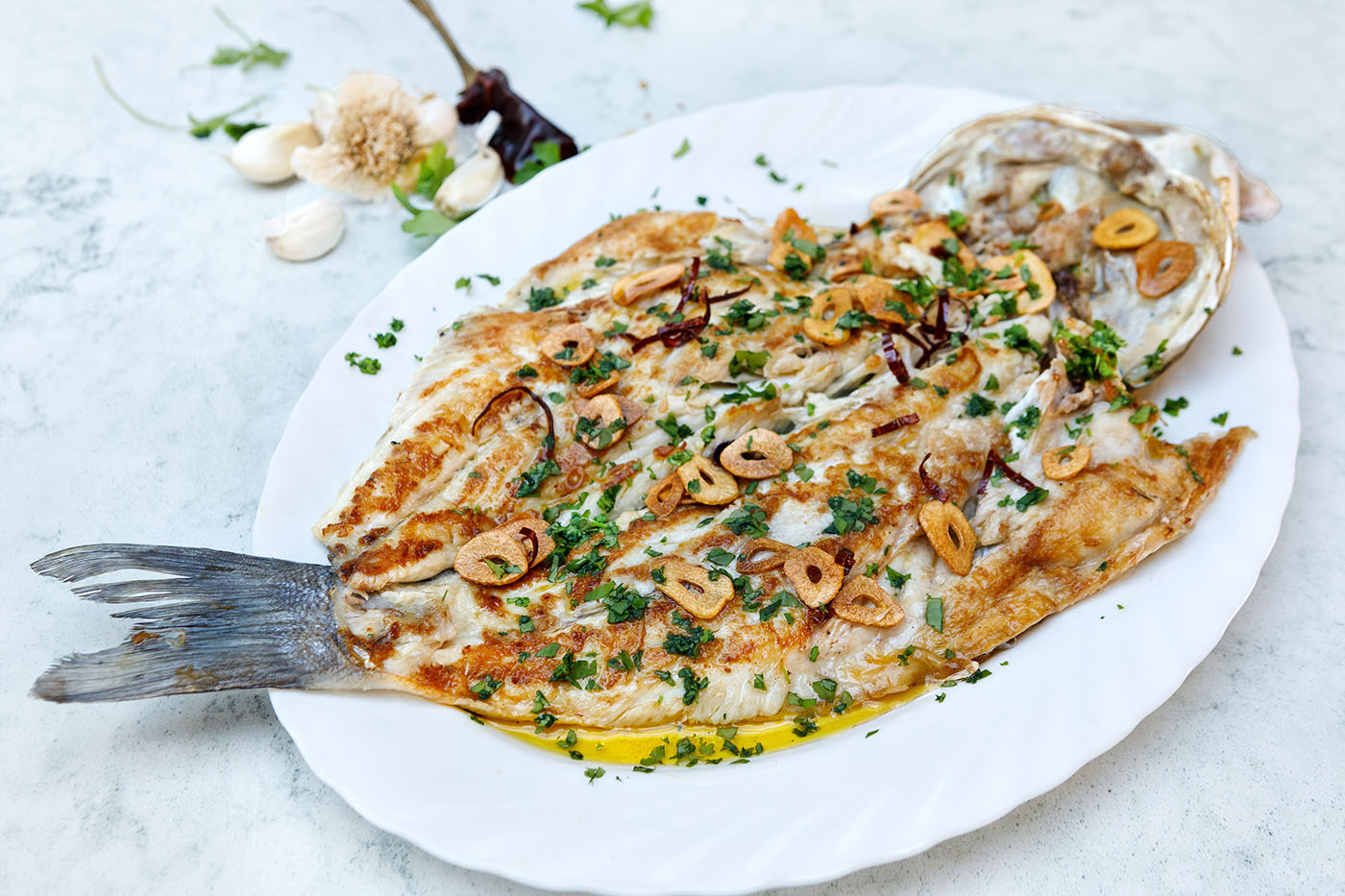
Sea Bass Bilbaína – sea bass is a fabulous fish and a Basque Country food that often appear son the menu. For this recipe, the sea bass is butterflied with the head kept on. Carefully barbecue the sea bass and then drizzle with the bilbaína sauce – oil infused with chilli and garlic. A splash of cider vinegar and some parsley finishes it perfectly.
Basque Country Meat Recipes
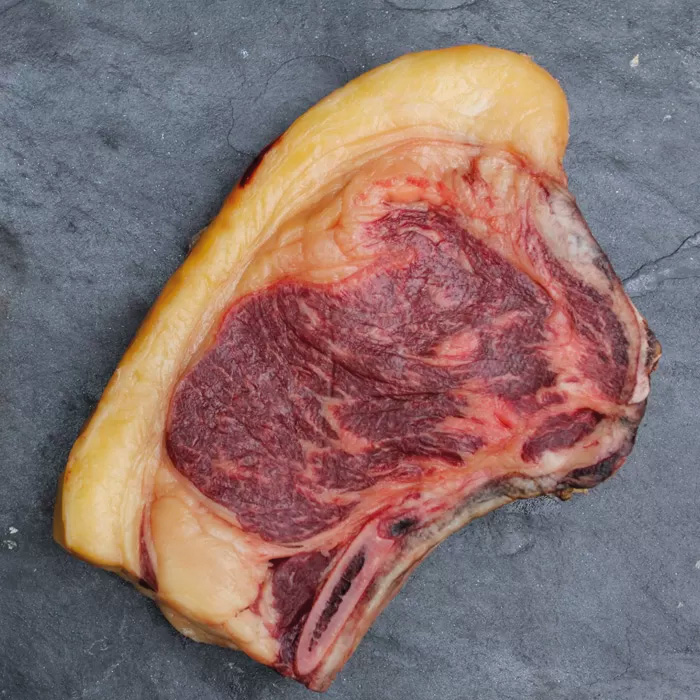
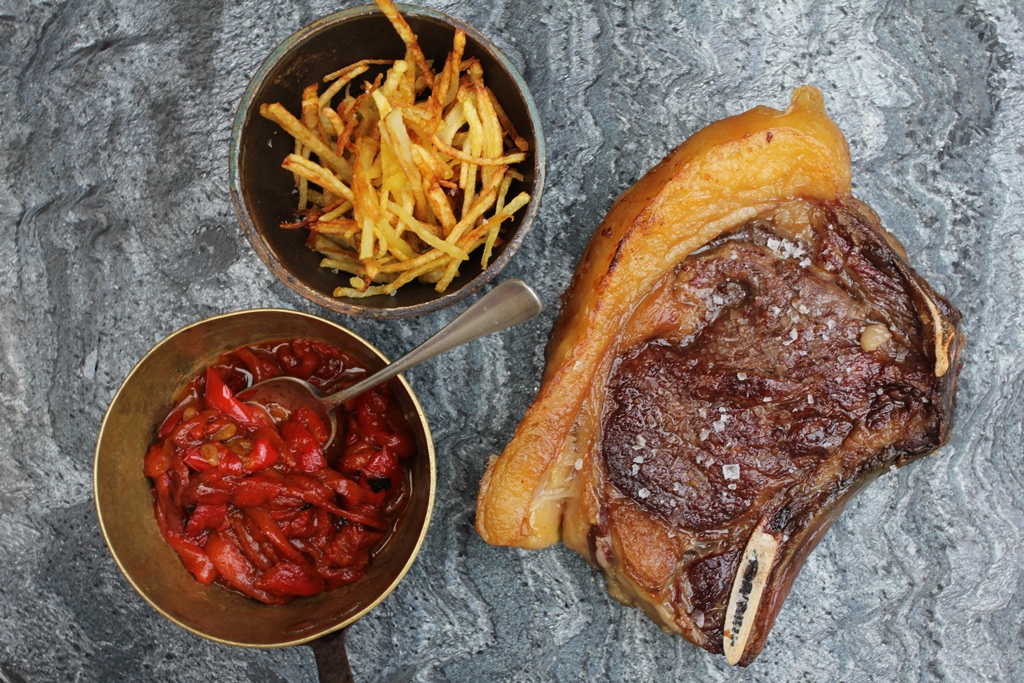
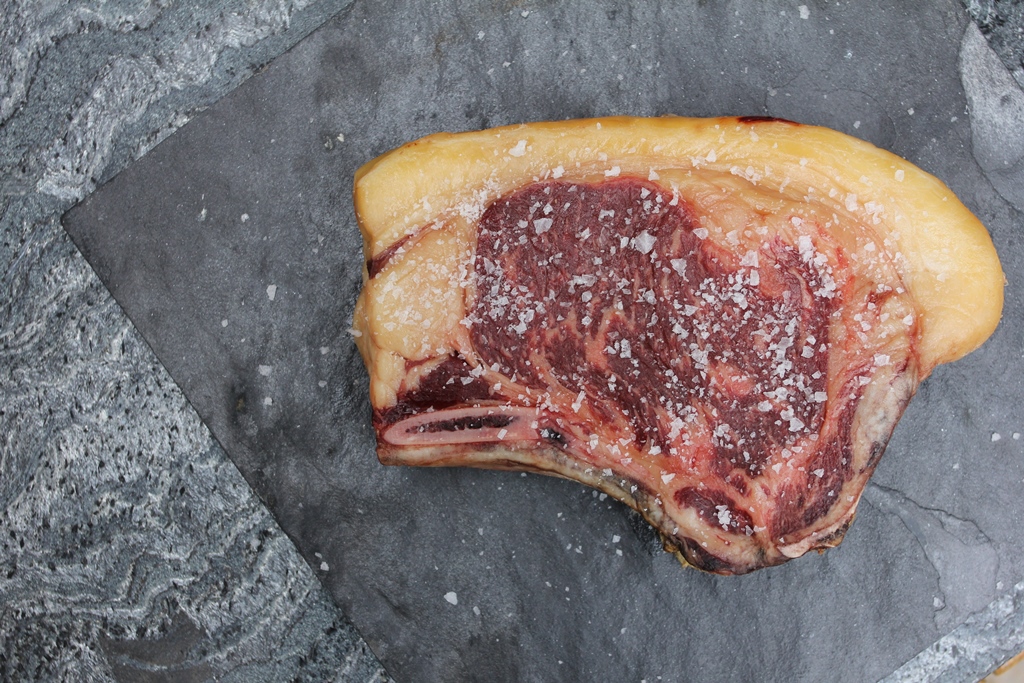
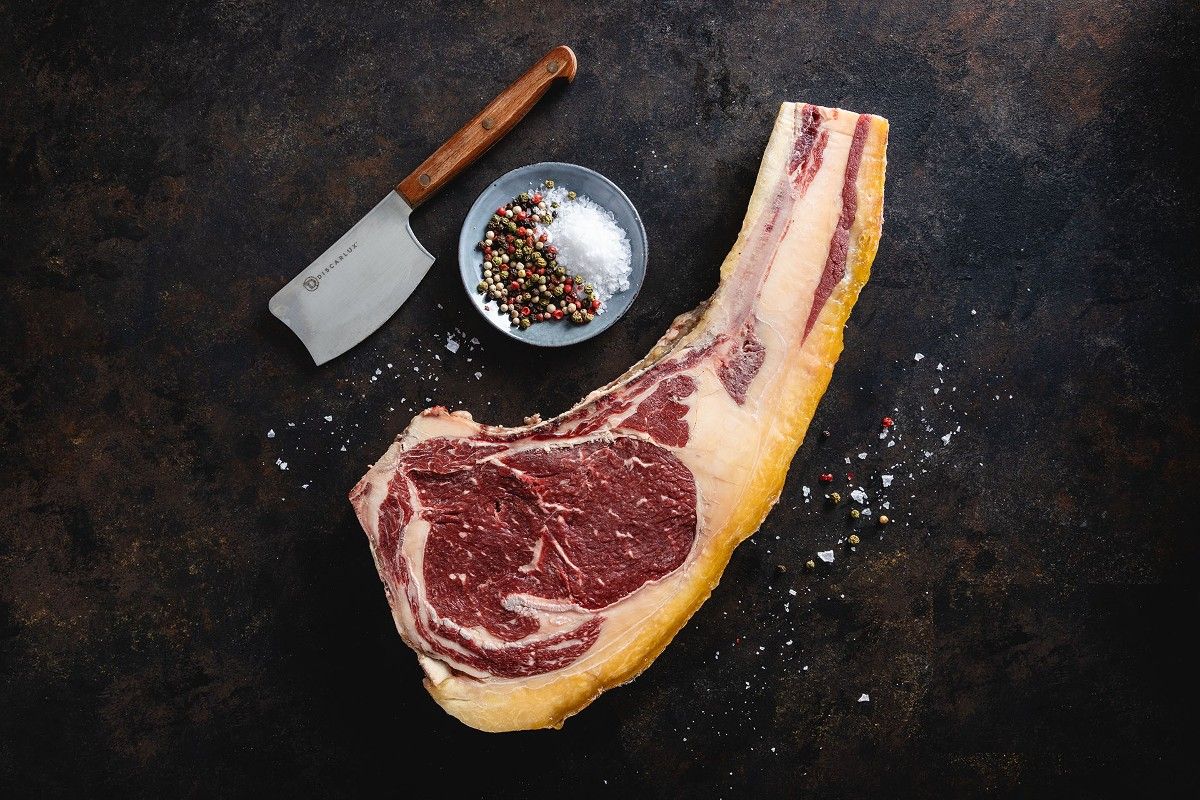
Basque Txuleton Steak – the Spanish are big lovers of beef and steaks don’t come much bigger than the Tuxelton steaks. These huge, thick bone-in rib steaks originate from the Basque Country and are traditionally from old cows, particularly Rubia Gallega breed or Basque dairy cows. The recipe serves barbecued Tuxleton steak with matchstick fries and roasted red peppers.
Chicken Basquaise – a favorite in the Basque region of France, where it originated, this chicken dish is exceptionally good with a delicious pepper sauce. Famous for its vibrant colors, it is thought to represent the Basque flag with the white of chicken, red tomatoes and pepper, and green peppers. This Basque Country food is a symbol of Basque culinary identity and reflects its connections to French cuisine.
Basque Country Dessert Recipes
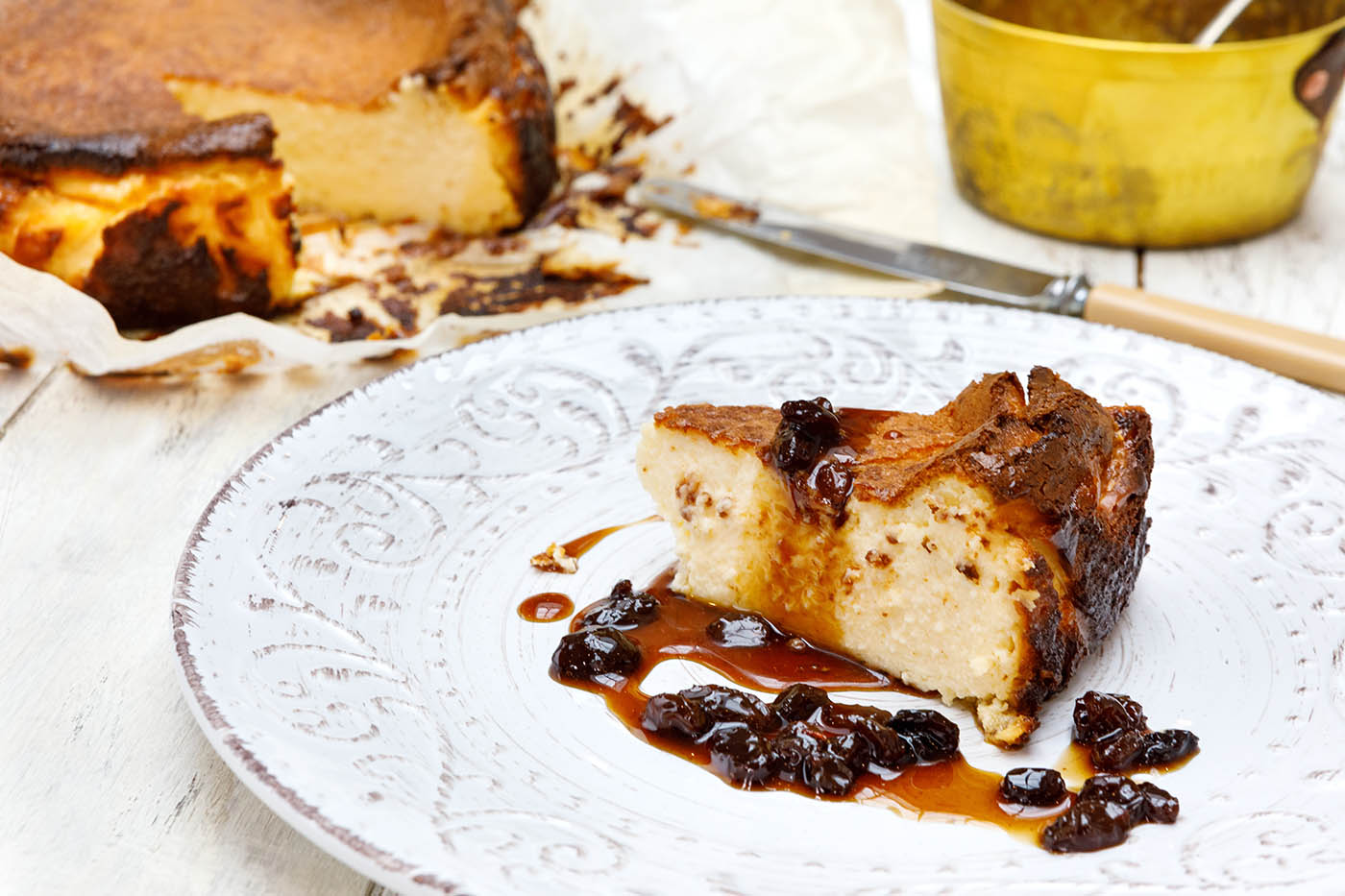
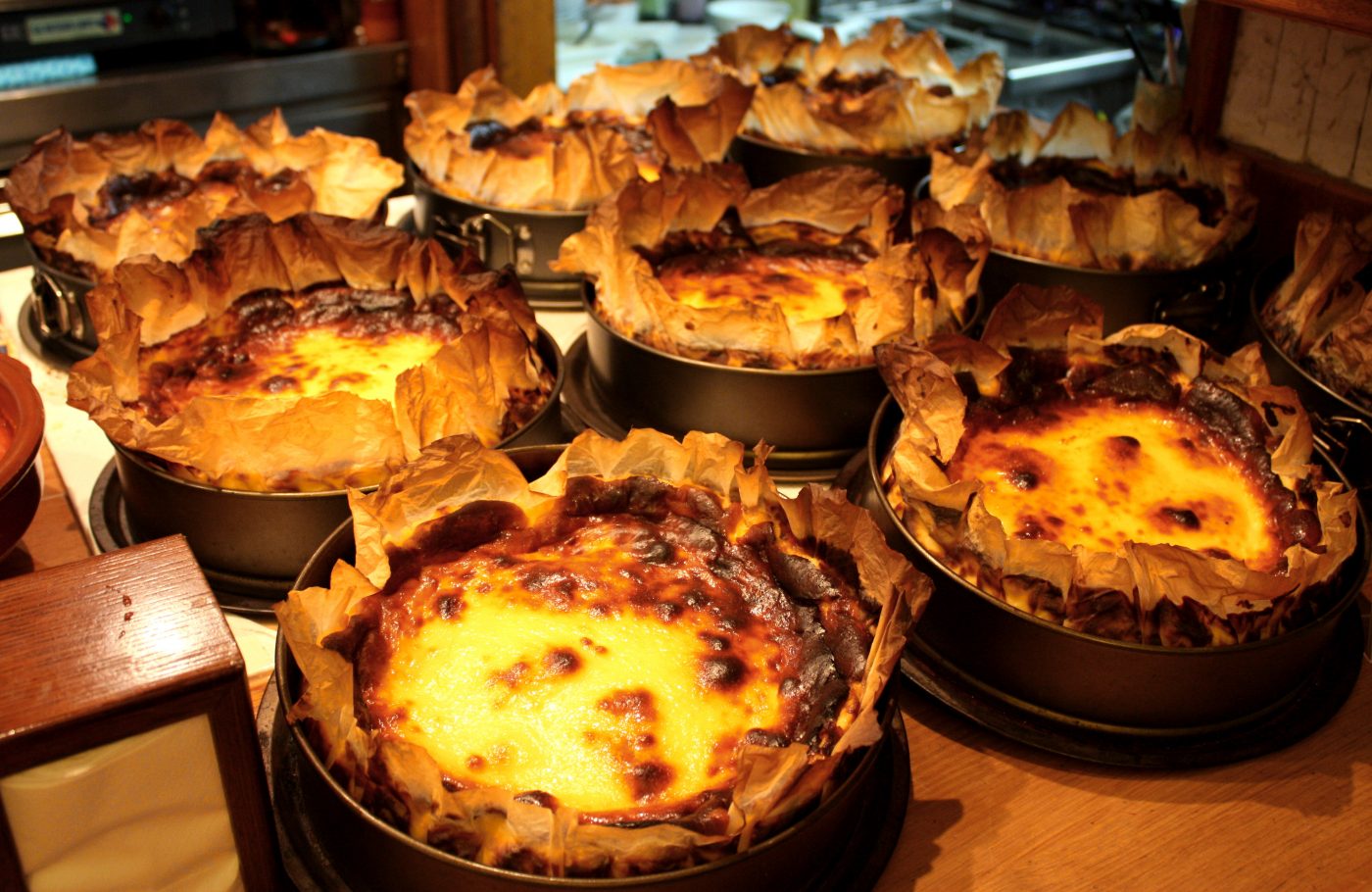
Basque Cheesecake – this rich and creamy cheesecake with a wonderful baked top is an icon of Basque Country food culture. Originating from a small restaurant in San Sebastián, the cheesecake is baked at a very high temperature which scorches and caramelises its top adding real depth to the flavour. It is surprisingly simple to make if you follow Javier’s authentic recipe.
Pantxineta– one of the traditional desserts of the Basque Country, the Pantxineta is a delicate combination of puff pastry and cream with almonds and originates from San Sebastián. The pastry is baked to create a golden crunchy texture and the crème pâtissière inside brings a smooth and creamy sweetness. Javier’s recipe adds an extra dimension with a coulis of raspberries and raspberry liqueur.
Want more Basque Country recipes?
Feel free to browse Javier’s online collection of Basque Country food recipes whenever you wish.
Spain is renowned for its excellence in rearing and curing some of the finest ham in the world, including the utterly delicious jamón Serrano. But what do you know of this delicacy? What is Serrano ham? Is Serrano ham healthy and how is it cured? Do you know how to preserve Serrano ham, how to carve jamón Serrano and how long you can keep a Serrano ham? How does it compare to jamón Iberico and Proscuitto?
There is a lot to learn about jamón Serrano, so we combined our knowledge with the deep expertise of Ivan San Martin from Martinez Somalo – producer of one of Spain’s finest jamón Serrano, which is stocked by Basco.
Introducing Ivan, our jamón Serrano expert
To bring extra knowledge and expertise to this guide, we consulted at length with Ivan San Martin from leading jamón Serrano producer Martinez Somalo. Ivan supplies Basco with all jamón Serrano which we regard as some of the best in Spain.
This family business has been based in La Rioja since 1900, and they are a member of the Consorcio del Jamon Serrano Espanol – the professional association that guarantees authentic Spanish jamón Serrano quality and international distribution.
What is jamón Serrano?
Jamón Serrano is a type of salt-cured ham that is traditionally from Spain, which was originally dried with dry, cool mountain air. The meat comes from white pigs and first arrived in the Iberian Peninsula during the time of the Phoenicians around 1100 BC.
Deep red with streaks of white fat, the meat has a wonderfully salty and nutty flavour that becomes more savoury and complex as it is aged.
The name Serrano originates from “Sierra” which is Spanish for mountain, so jamón Serrano means “mountain ham”.
Jamón Serrano official classification
The hallmark of jamón Serrano is “Guaranteed Traditional Speciality” classification – ETG in Spanish. This identifies jamón that has been made with the traditional ingredients, or following a traditional process for their preparation. Legally, you cannot call it jamón Serrano unless the ham has official ETG certification.
Ivan explains further: “Jamón Serrano is classified in three types; Bodega, Reserva and Gran Reserva. All Jamón Serrano stocked by Basco that is made by Martinez Somalo is ETG accredited and either Serrano Reserva or Serrano Gran Reserva grade.”
Jamón Serrano pig breeds and rearing
Jamón Serrano comes from white pigs. In the case of Martinez Somalo jamón Serrano, Ivan clarifies “our breeds of free-range white pigs include Pietrain, Landrace, Large White and Duroc. We allow them to move independently on our farms where we carefully look after their health, giving them plenty of water, high standards of cleanliness and feed them a diet of cereals.”
How to preserve Serrano ham: Curing
Jamón Serrano gets its fabulous flavour not only from the free-range lifestyle and diet of the white pigs, traditional curing methods play an equally important part.
How to preserve Serrano ham produced by Martinez Somalo is a three-step process:
Salting: Each ham is buried in containers packed with salt and kept at a steady temperature of approximately 0ºC. The number of days it is salted for is a simple formula – a take the kilogram weight of the pig and add one.
Post-salting: Once the ham has completed the salting stage, it is cold-dried for around 6 months. It starts at a low temperature and high humidity. Gradually, the temperature is increased and the and the humidity decreased.
Ageing: After six months, the ham has undergone most of its weight loss. Finally, the ham undergoes a heat-ageing process which can last from 6 to 18 months.
“Serrano ham must be cured with patience in the traditional way. The perfect choice of the raw material, compliance with the drying times, and the correct temperatures at all times make Martínez Somalo Serrano ham such a special product,” reveals Ivan.
Jamón Iberico vs jamón Serrano
There are numerous different types of ham in Spain, so let’s start by comparing jamón Iberico vs jamón Serrano and see their differences.
Pig breed: Both breeds of pigs can be differentiated by their hooves. Jamón Iberico pigs are black pigs and have black hooves – interestingly, to ensure authenticity, Iberian ham must have a seal with a specific color on the hoof. Jamón Serrano pigs are white pigs and have hooves which are the same colour as the rest of the pig.
Diet: What the pigs eat directly influences the flavour and aroma of the meat. Free range Iberico black pigs such as those that create Arturo Sánchez jamón Iberico (which is also stocked by Basco) enjoy a diet of acorns, grasses and herbs. Jamón Serrano free range white pigs enjoy a diet of cereals.
Meat colour: Jamón Serrano is lighter and pinker in colour than jamón Iberico which is redder and shiny due to its marbling of fat and its longer curing time.
Curing: Both jamón Serrano and jamón Iberico share a similar curing process, where they differ is the time devoted to the different stages. Depending on the ham, from start to dfinish, Martínez Somalo jamón Serrano takes 10 to 24 months. Jamón Iberico takes at least 24 months, even longer, depending on several factors, including whether it is Iberian free-range or not.
Flavour: The diet of acorns and aromatic herbs combined with good infiltration of fat into muscles makes jamón Iberico juicy, intensely flavoured and uniquely flavoured. Jamón Serrano typically has a milder lighter flavour.
Jamón Serrano vs Prosciutto
Both jamón Serrano and Prosciutto are dry-cured hams but there are numerous differences, some large, some subtle.
Origin: Jamón Serrano is from mountain regions of Spain including the Sierra Nevada whereas Prosciutto is from Italy – specifically regions including Parma and Daniele.
Pig breed: Both jamón Serrano and Prosciutto are derived from similar breeds of white pigs. These include Landrace, Large White and Duroc.
Diet: White pigs that create jamón Serrano and Prosciutto share a similar diet of cereal grains, however, some Proscuitto also requires whey from the production of Parmigiano-Reggiano cheese.
Meat colour: Compared to Prosciutto, jamón Serrano meat is slightly darker and has a firmer, drier texture. Prosciutto is a paler pink with ivory coloured fat and a softer silkier texture.
Curing: Prosciutto is cured for longer than jamón Serrano in a more humid climate with well-ventilated ageing rooms for up to 36 months. Jamón Serrano is dried naturally in dry air and for 10 to 24 months.
Flavour: Jamón Serrano is really savoury, slightly nutty and slatier than Prosciutto in flavour. Prosciutto is much milder, sweeter and delicate with a buttery taste.
Is Serrano ham healthy?
Like any food, if it needs to be part of a balanced diet. But is Serrano ham healthy? “Jamón Serrano contains high-quality protein and essential amino acids. It is also rich in micronutrients including zinc, iron, selenium and vitamins B1, B6 and B12. Low in carbs, jamón Serrano has minimal processing as it is naturally cured,” said Ivan. It does, however, have high salt content and contains saturated fats.
How to carve jamón Serrano
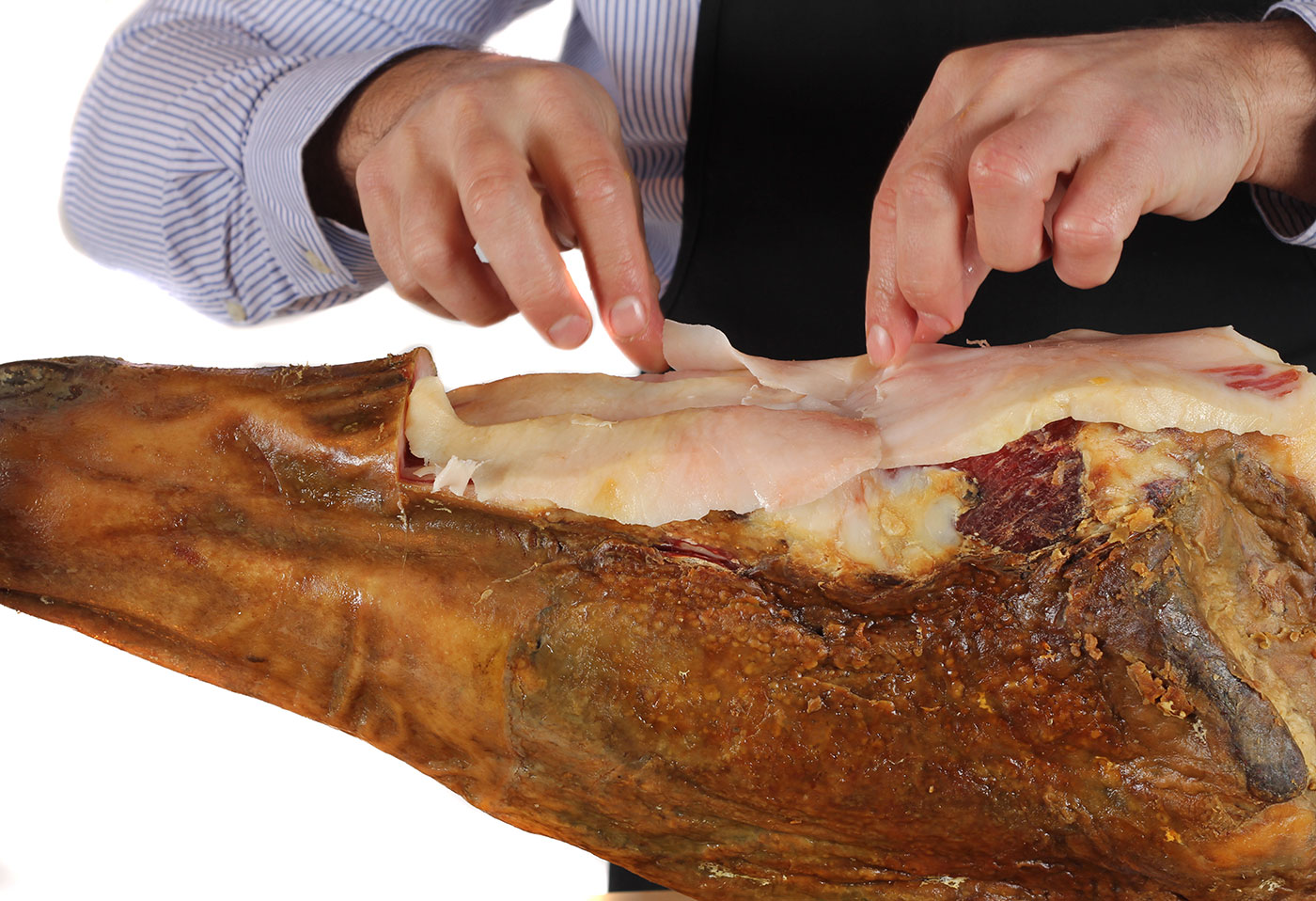
Jamón Serrano is available sliced in convenient packs but you can also buy whole ham legs. These work out more cost-effective, have a longer shelf life, use less packaging and is fresher, so the ham has a better flavour. Want to know how to carve jamón Serrano? Here’s Ivan’s quick guide:
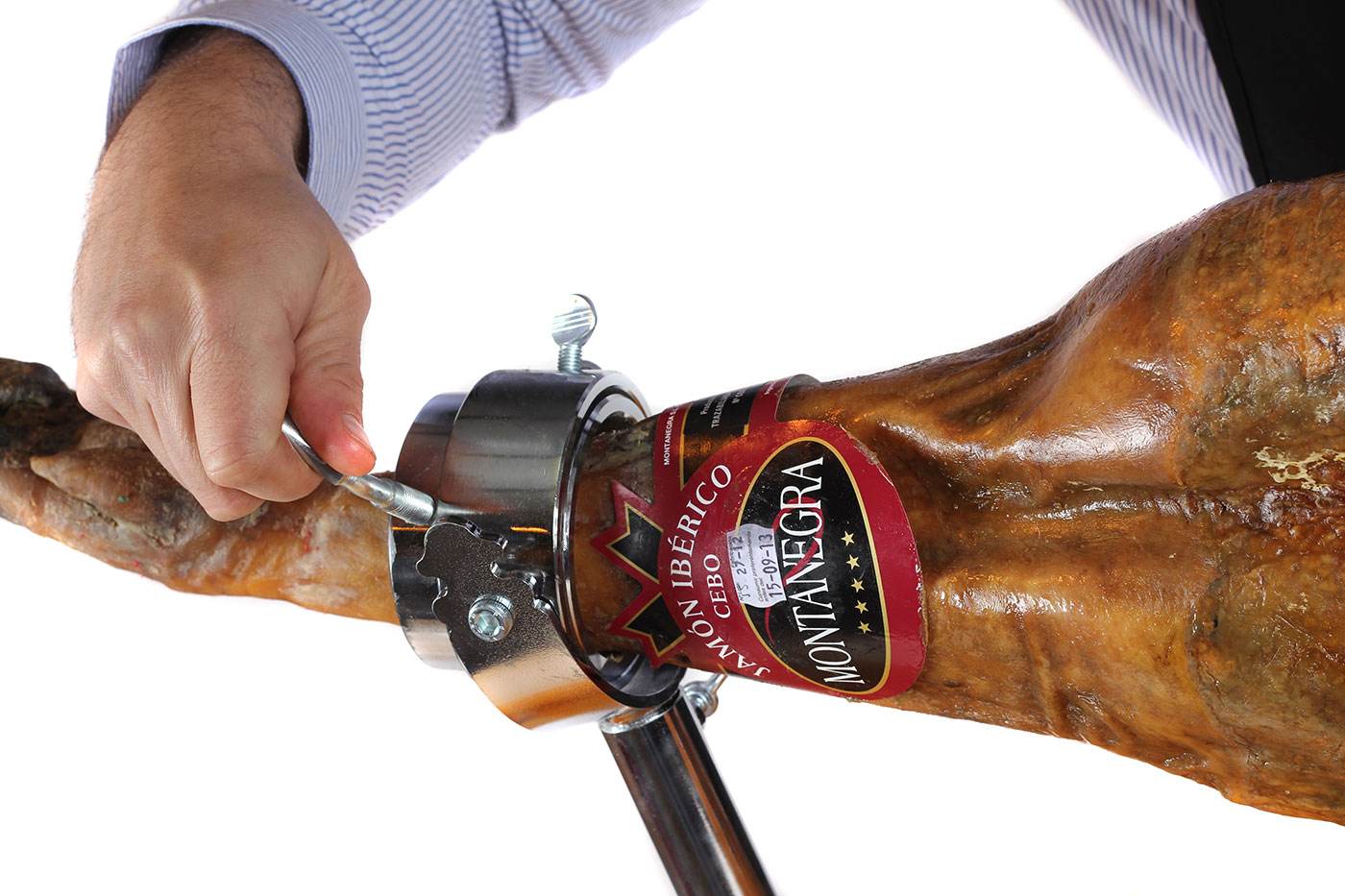
Tools & environment: You will need a proper ham stand, a sharp jamón knife and wide bladed life plus a cool, dry well-ventilated space to store your ham. Ensure the ham is securely in place on its stand.
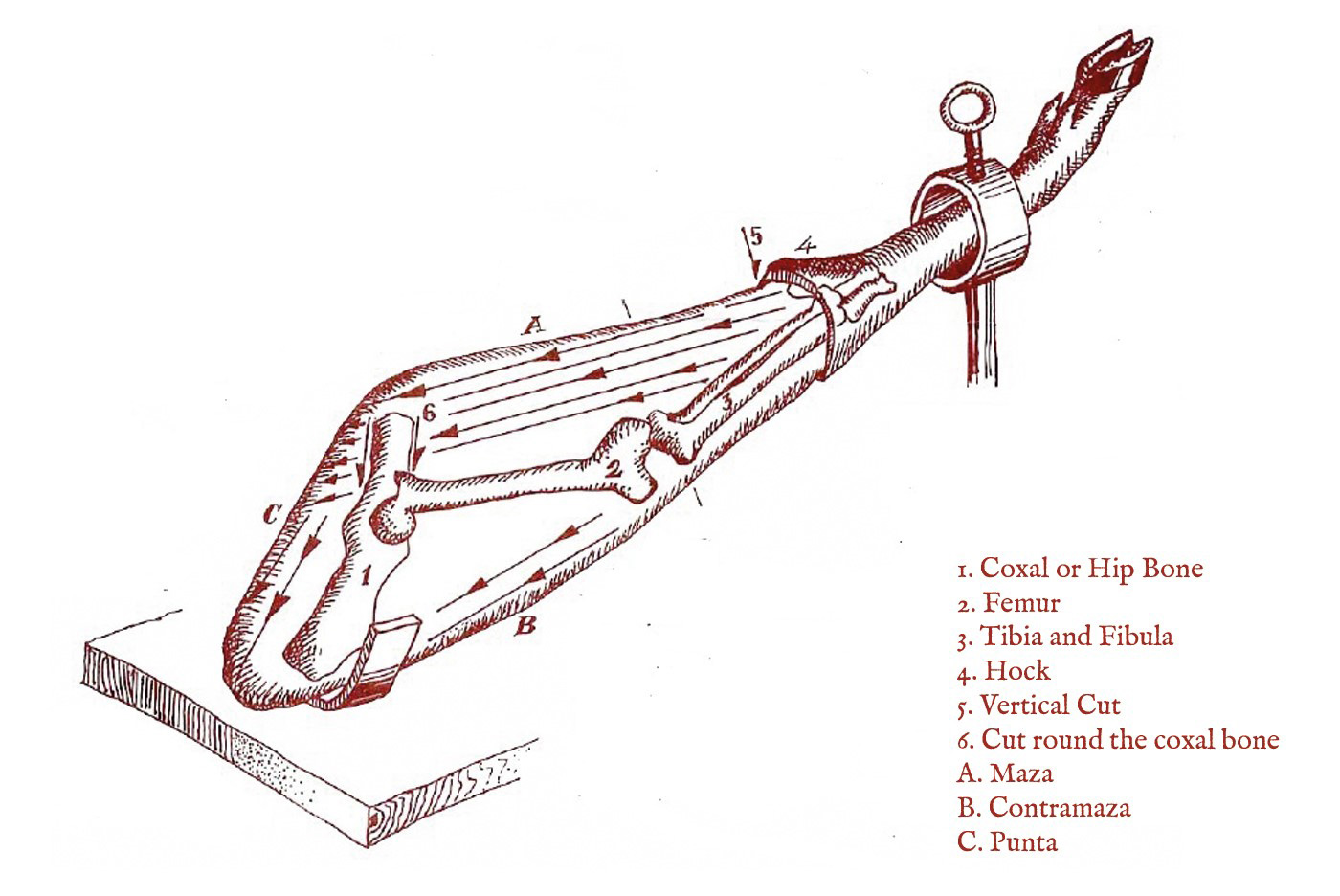
1. Prepare the ham: You will need to use a wider bladed knife to remove the outer fat or rind from the ham. Start from the area closest to the hoof. Make the first cut in the upper part of the leg in the shank area. With the knife at an angle, make a deep cut perpendicular to the leg, just below the hock. A few fingers below this cut, make another wedge-shaped cut to remove the fat and tendons.
2. Remove the rind: Carefully remove the rind and yellow fat from the ham, but only remove the part you plan to cutso as not to dry out the rest of the meat.
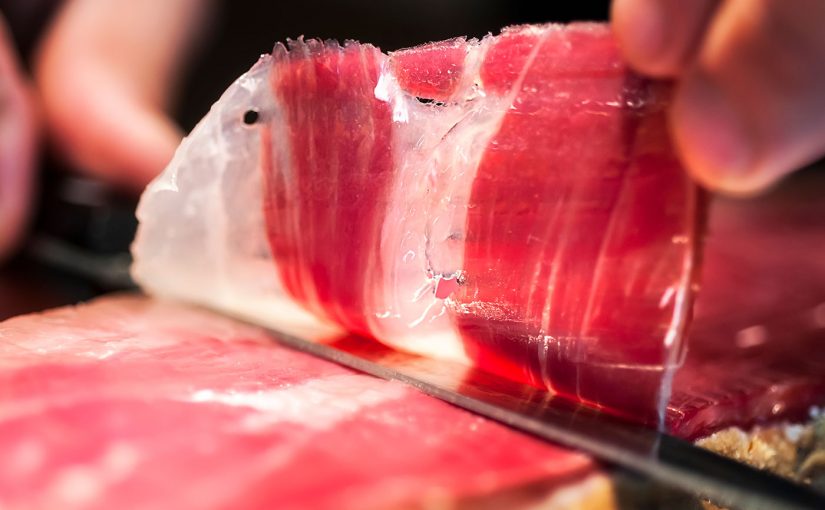
3. Cut slices: Use the jamón knife cut thin slices of ham from hoof to the tip of the ham. When you have finished cutting through the “babilla” side, turn the leg over and take slices from the “maza” side. When you can’t cut any more slices of ham, cut small cubes from the most difficult meat to slice for recipes. Save to bone too to make broths.
How long can you keep a Serrano ham?
Because jamón Serrano is cured, it can have a relatively high shelf life.
Sliced Serrano ham has a 6-month shelf life from the date of purchase, if unopened. Once opened keep wrapped and stored in the refrigerator. Eat within one week.
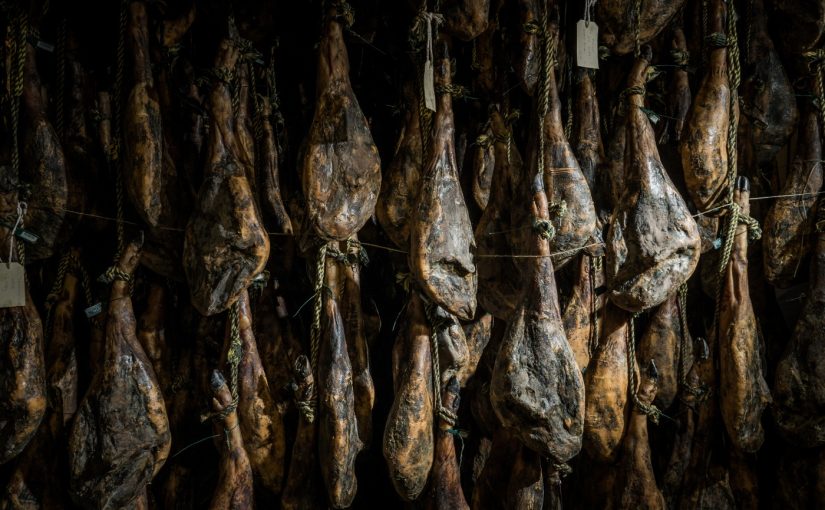
Whole Serrano ham legs that are unopened should be store in a cool, dry place. Hanging actually improves the flavour of the ham if you hang it. You can hang a Serrano ham for up to 12 months before you first start to slice it. A jamón Serrano leg can last up to 6-8 weeks – even longer – if properly stored and cared for. After slicing ham, cover the exposed meat with a piece of the original fat, cover with a breathable cotton or linen cloth then store in a cool dry place, avoiding any direct sunlight.
Jamón Serrano recipe ideas
The traditional way to eat jamón Serrano is in tapas. Try it combined with chorizo, cheese and olives – accompanied of course by a delicious Spanish red wine or a cold Spanish craft beer.
Basco founder Javier De La Hormaza is a Basque country chef and would like to share three of his favourite jamón Serrano recipes. All are easy to prepare and utterly delicious, bringing out the wonderful and unique flavour of jamón Serrano.
Huevos a la Flamenca – this delicious Andalucian baked egg dish combines the flavours of smoked paprika, garlic, tomatoes, onions and roasted red peppers with spicy chorizo and crispy jamón Serrano.
Salmorejo – this wonderfully healthy and tasty cold creamy tomato soup, also known as ardoria or ardorío, originates from Andalucia. Garlic, hard boiled eggs, crusty bread and Serrano ham work so well with tomato.
Spanish jamón Ibérico, (Ibérico ham), is world-famous for its supreme quality and sublime taste, but what are the subtle differences when the two most prized varieties go head-to-head: Bellota vs Cebo. This guide aims to give you total understanding of jamón Ibérico de Bellota and jamón Ibérico de Cebo. It reveals exactly what is Iberico de Bellota and what is Ibérico de Cebo. We also explain exactly how to store jamón Ibérico de Bellota and jamón Ibérico de Cebo. So, let’s define both varieties before we compare jamón Ibérico de Bellota vs Cebo.
WHAT IS JAMÓN IBÉRICO DE BELLOTA?
Jamón Ibérico de Bellota is an exquisite delicacy and a true gastronomic jewel of Spanish cuisine that is revered worldwide. Some of the absolute best is produced by charcuterie specialist Arturo Sánchez and has been since 1917, which is why BASCO selected and stocks this prestigious established brand. What defines jamón Ibérico de Bellota and shapes its wonderful and uniquely nutty flavour is the breed of pig, its environment, diet, lifestyle, rearing and the curing process.
BELLOTA PIGS
The pigs that create jamón Ibérico de Bellota are special. Very special. They are rare “pata negra” pigs, meaning “black hoof” – the legendary native Iberian breed of black pigs whose origins are thought to be from the Neolithic period. These black pigs have healthy appetite, put on weight well and build up high intramuscular and epidermal fat, which gives jamón Ibérico de Bellota its special taste. Arturo Sánchez black pigs are 100% pure Iberian breed.
JAMÓN IBÉRICO DE BELLOTA ENVIRONMENT
The pure breed black pigs reared for Arturo Sánchez jamón Ibérico de Bellota are not intensively farmed using modern techniques, they are given free range of the very best “dehesa” fields. Dehesa are pastures that form the cultural landscape of southern Spain and are used predominantly for grazing. This natural wildlife habitat is also home to endangered species such as the Spanish imperial eagle.
JAMÓN IBÉRICO DE BELLOTA DIET
Along with the Iberian black pigs’ free-range lifestyle, their appetite for acorns, grasses and herbs are what shape the flavour of their meat. The wooded pastures of north of Seville and the south of Extremadura these pure breed pigs graze on feature holm oak and cork oak trees. These yield fabulously flavourful acorns which the pigs have a huge appetite for. It is this diet that gives jamón Ibérico de Bellota its distinctive aroma and unique taste. Interestingly, “Bellota” means acorn in Spanish.
JAMÓN IBÉRICO DE BELLOTA CURING
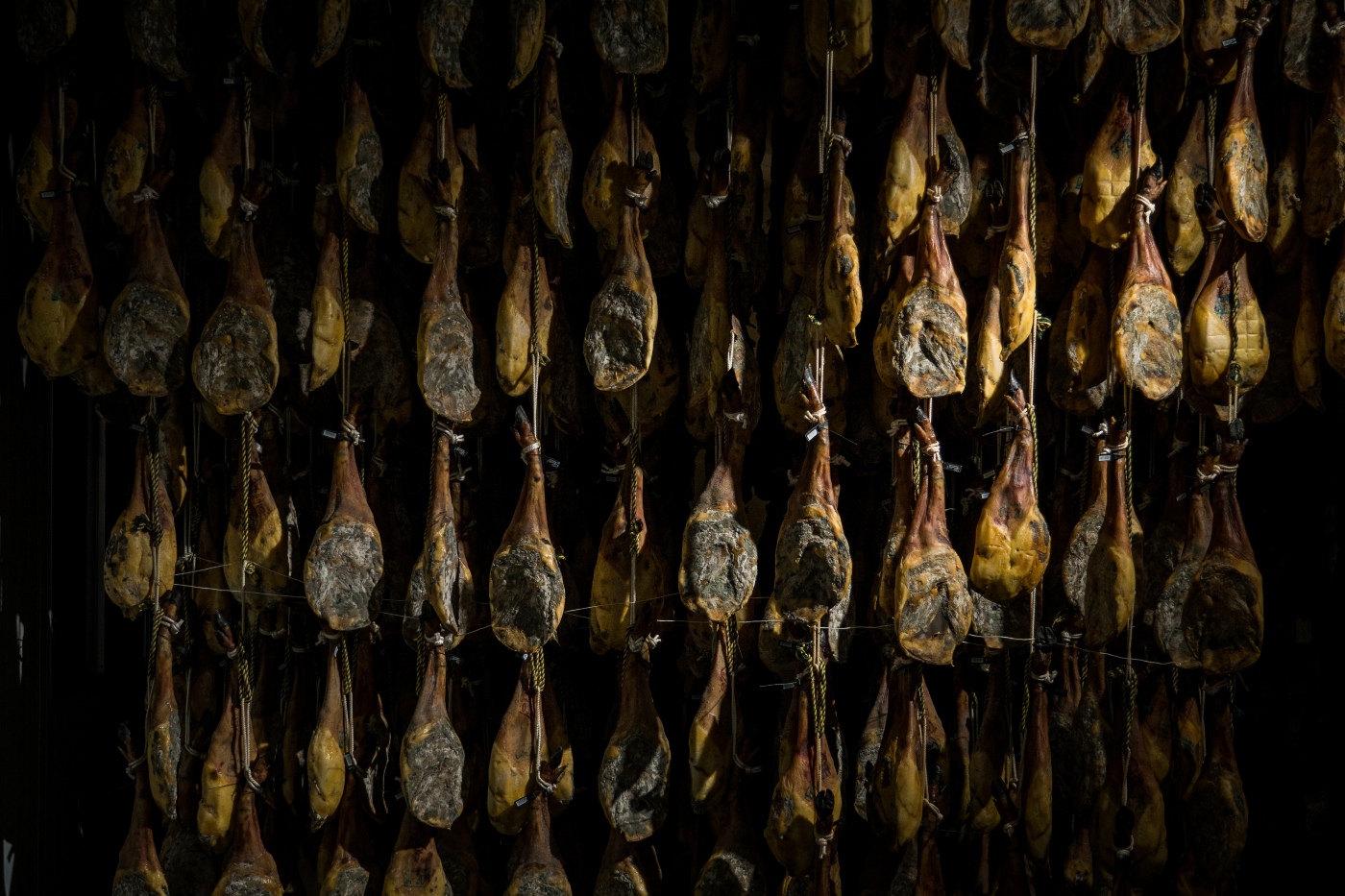
These 100% Iberian acorn-fed black pigs graze for two “montaneras” until they reach two years of age. Over that time, their muscles and bones develop completely and put on heart-healthy fat with an oelic acid content only second to olive oil. Curing takes place over 2 years in Guijuelo in natural drying sheds where the winds of the Béjar and Gredos mountains flow through.
WHAT IS JAMÓN IBÉRICO DE CEBO?
Jamón Ibérico de Cebo is similar to jamón Ibérico de Bellota in that both come from pata negra pigs however, there are some distinct differences. The rearing and curing periods are shorter than jamón Ibérico de Bellota and they have a different diet, too. There are also two different types of this ham – cebo and cebo de campo.
CEBO PIGS
The breed of pigs used to create jamón Ibérico de Cebo is pata negra pigs, however, they are not the same as the 100% Iberian pure breed bellota black pigs.
JAMÓN IBÉRICO DE CEBO ENVIRONMENT
Jamón Ibérico de Cebo black pigs come in two classifications – Ibérico de Cebo and Ibérico de Cebo de Campo. Cebo pigs are not free-range, however Cebo de Campo pigs have the freedom to roam natural wooded dehasas and feed. Arturo Sánchez jamón Ibérico de Cebo pigs are the free-range Cebo de Campo variety and are allowed to reach 14 months of age, rather than the industry standard of 10 months. These extra 4 months allow the aroma, flavour and appearance to really develop.
JAMÓN IBÉRICO DE BELLOTA DIET
The second main difference in the bellota vs cebo comparison is the diet of the black pigs. As opposed to the 100% Iberian breed of acorn-fed belotta pigs, both cebo and cebo de camp pigs are fed on a diet of cereal grains. Their diet does also include acorns and grasses, but the bulk of what they are fed is grains. This gives cebo meat a different flavour to that of jamón Ibérico de Bellota.
JAMÓN IBÉRICO DE CEBO CURING
Arturo Sánchez jamón Ibérico de Cebo is cured for a minimum of 30 months – 6 months more than jamón Ibérico de Bellota. As the seasons change from the cold of winter through spring and summer, 40% of the fat melts away, enveloping the ham in flavour. As the second year passes, the ham undergoes complex changes that produce incredible layers of flavour. The result is a tender and delicious ham, deep red in colour with a very mild saltiness.
JAMÓN IBÉRICO DE BELLOTA AND CEBO PRODUCTS
We stock a wide variety of different Arturo Sánchez jamón Ibérico De Bellota and Cebo products. Both are available in the following formats:
Whole hams
Boneless hams
Sliced hams
Whole charcuterie
Sliced charcuterie
With Basco jamón Ibérico, if the word bellota is not in the title of an Arturo Sánchez jamón, then it will be Cebo de Campo.
HOW TO SERVE IBÉRICO HAM
The temperature you serve Ibérico ham at is crucial as it makes a huge difference to the flavour. Never serve cold straight form the fridge. Why? Because the meat needs to reach a target temperature of between 20-24°C before slicing and serving. As we recommend storing whole hams at room temperature, that is not a problem, however, whole or sliced charcuterie should be taken out of the refrigerator a few hours before serving.
Temperature is vitally important when serving Ibérico ham and charcuterie. A pack eaten straight from the refrigerator will not taste anywhere near as good as one that is brought up to room temperature. It’s like a fine wine needs to be opened and allowed to breathe before savouring it.
Here is the science… at room temperature, the high content of oleic acid within Ibérico ham and charcuterie melts and softens, making the meat sweat and become shiny. This is the sign that the ham or charcuterie is ready to enjoy.
If you are in a rush, or it is a cold winter’s day, simply warm a plate and lay the cold slices of Ibérico ham or charcuterie on it to bring it up to temperature. Alternatively, to speed up the process, you can run sealed packs under a warm water tap.
HOW TO STORE JAMÓN IBÉRICO DE BELLOTA AND CEBO
Whole hams: Store whole jamón Ibérico De Bellota or Cebo in a cool dry place and it can last 12 months if unopened. Once you peel the outer layer of skin, cover the meat with thin slices of fat and cling film to avoid air drying it. An opened ham can last up to one month if covered properly. Open in sections to prolong its life.
Boneless hams: Keep boneless jamón Ibérico De Bellota and Cebo refrigerated between 0 and 6ºC for up to 12 months unopened. Once opened use within 1 month if wrapped in cling film.
Sliced hams: Keep sliced jamón Ibérico De Bellota and Cebo refrigerated between 0 and 6ºC for up to 12 months unopened. Once opened use within 1 week.
Whole charcuterie: Keep jamón Ibérico De Bellota and Cebo whole charcuterie refrigerated between 0 and 6ºC for up to 12 months unopened. Once opened use within 1 month.
Sliced charcuterie: Keep jamón Ibérico De Bellota and Cebo sliced charcuterie refrigerated between 0 and 6ºC for up to 12 months unopened. Once opened use within 1 week.
IN SUMMARY: BELLOTA VS CEBO
Now you know all about Arturo Sánchez jamón Ibérico de Bellota and their jamón Ibérico de Cebo, here is a brief summary of the differences between them:
Arturo Sánchez Jamón Ibérico de Bellota pigs are fed on a diet of acorns – Arturo Sánchez jamón Ibérico de Cebo pigs have a diet of predominantly cereal grains.
Arturo Sánchez Jamón Ibérico de Bellota black pigs and Arturo Sánchez Cebo de Campo black pigs are given free range of deshas – other jamón Ibérico de Cebo pigs are not free range.
Arturo Sánchez Jamón Ibérico de Bellota pigs are raised for a minimum of 2 years and enjoy two montaneras – Arturo Sánchez jamón Ibérico de Cebo pigs are raised for a minimum of 14 months (the industry standard is 10 months).
Arturo Sánchez Jamón Ibérico de Bellota hams are cured over 2 years in natural drying sheds by mountain winds – Arturo Sánchez jamón Ibérico de Cebo hams are cured for a minimum of 30 months.
Risotto vs paella – what exactly is the difference? Well, you won’t be surprised to hear there is not just one difference between risotto and paella rice, there are numerous fascinating ways in which they differ.
In this guide, we’ll look at many things including paella rice vs risotto rice, paella origin and the different varieties of paella rice. Plus, we’ll give you some delicious paella recipes, from Basco founder Javier, for free.
Is paella rice the same as risotto rice?
In a word… no. Both are indeed varieties of rice, however, they are quite different. Let’s first look at what each type of rice, their history and where they come from so we can see how risotto vs paella stand.
What rice is paella rice?
Paella rice is Spanish and paella origin is quite interesting. Paella is a rice dish that originates from the Valancia region and is one of the community’s identifying symbols. Folklore says that the word paella came from the Spanish “para ella” which means “for her” in Spanish after a lady first prepared the dish for her lover. How romantic. However, the fact is that it was first grown by the Moors in the Albufera wetlands in the eighth century.
Paella rice is a short-grain rice that absorbs liquid very well, but stays quite firm and doesn’t split during cooking. Paella rice is less starchy than risotto rice. Saffron added during cooking is traditionally what gives paella its golden colour.
What rice is risotto rice?
Risotto rice is Italian, not Spanish. It’s origins are believed to be in the northern regions of Italy including Lombardy, Piedmont and Veneto. Traditionally, it was a simple and humble dish of rice sautéed in butter, sausages, bone marrow and onions with a broth featuring saffron. “Risotto” comes from the Italian word “riso,” meaning rice and “otto” indicates it as a little rice. “Risott” also means rice dish.
Risotto rice has a short to medium grain size with a rounded shape. Risotto rice absorb liquids well and releases starch to create the creamy texture of risotto.
Paella rice vs Risotto rice varieties
There are numerous different types of paella and risotto rice and each has its own particular characteristics and uses. We’ll start with paella rice.
Varieties of Paella rice
Senia rice – short grain rice, similar to Bomba, which absorbs the average amount of liquid to give a creamy texture.
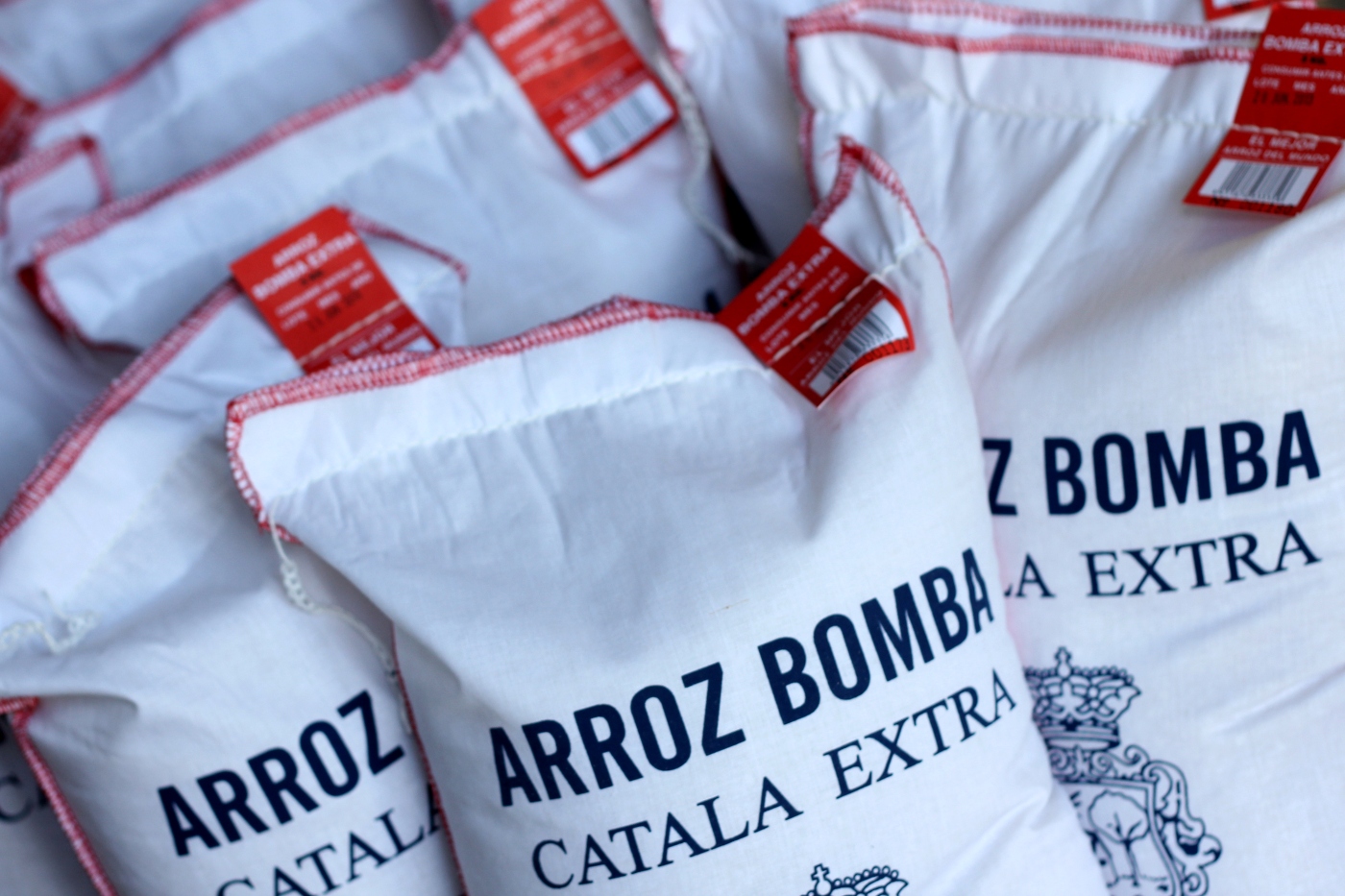
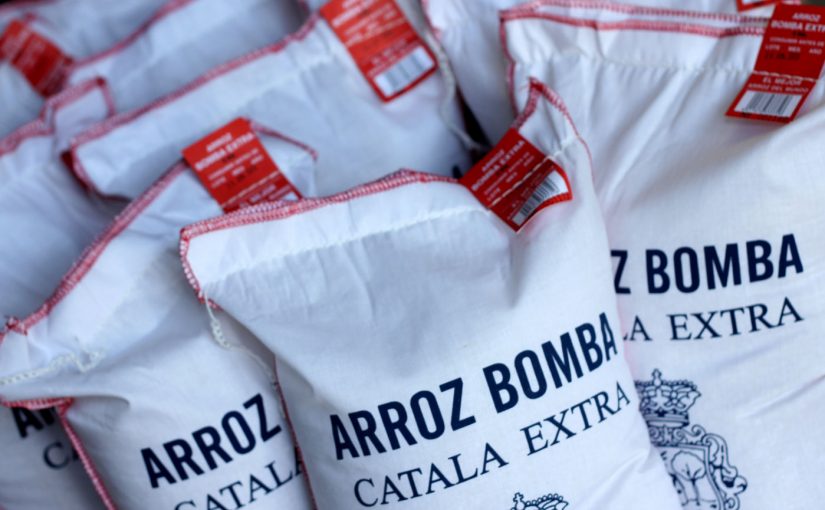
Bomba rice – aka Valencia rice, is a short, almost round, grained rice which absorbs over three times its volum of water. Loved by Spanish cooks, it absorbs more flavour without sticking.
Albufera rice – is a mix between Senia and Bomba varieties which absorbs great flavour whilst being resistant to overcooking.
Calasparra rice – this short-grained rice is grown around the town of Calasparra in Murcia. It absorbs 2.5 to 3 times its weight in liquid yet keeps a firm texture after cooking.
Bahia rice – a short-grained, quick-cooking rice that absorbs liquid well and doesn’t become sticky – perfect for paella.
Marisma rice – a premium short-grain rice that absorbs flavours well and has a firm, creamy texture when cooked.
Varieties of Risotto rice
Arborio rice – a really popular short-grain rice that absorbs large amounts of liquid and vreates a relatively creamy risotto with a hearty texture.
Carnaroli rice – a larger grain rice with nice plump grains that yields a lovely creamy risotto with a little bite.
Vialone Nano rice – a short and thick grain rice usually used for more liquid risottos with seafood.
Baldo rice – a medium-to-long grain rice from either Italy or Turkey that is slightly translucent, absorbs flavours well and creates a creamy yet firm risotto.
Roma rice – rice with large rounded grains and a high starch content that produces soft and very creamy risotto.
Maratelli rice – a semifino rice native to Vercelli, Italy. Similar to Bomba rice, but less expensive, it has resistance to overcooking.
Interestingly, risotto rice varieties are categorised by their length and range from the shortest “comune” to the longest “superfino”.
Can I use paella rice for risotto?
Apart from the size of the grains, the one thing that distinguishes paella rice from risotto rice is the starch content. The higher the starch content, the creamier your dish will be. Therefore, as risotto rice has a higher starch content than paella rice, and paella is a much drier dish than risotto, we strongly advise that you stick to paella rice for paella recipes.
The difference between risotto and paella cooking
There are actually multiple differences between paella and risotto. The pan you use to cook them, the heat source, boiling and frying, the ingredients – so let’s take a look at the main ways in which they differ.
Pans – when cooking paella you use a special paella pan which is wide, shallow and made of polished or coated steel with two side handles. Risotto is made in a standard pan.
Cooking – paella is traditionally cooked over a fire, whereas risotto is cooked on a stove.
Stock – when cooking paella, you add the rice to boiling stock, but with risotto, you fry the rice first before gradually adding the stock.
Stirring – risotto demands regular stirring and paella needs much less.
Sticking – when cooking paella, it creates a crispy, caramelized crust called ‘socarrat’ on the bottom of the paella pan which is the hallmark of a well-made paella. With risotto, it needs constant stirring to avoid sticking.
Ingredients – paella tends to include multiple ingredients, mixing meat with seafoods, however risotto tends to be singular in its flavours and key ingredients.
Paella recipes
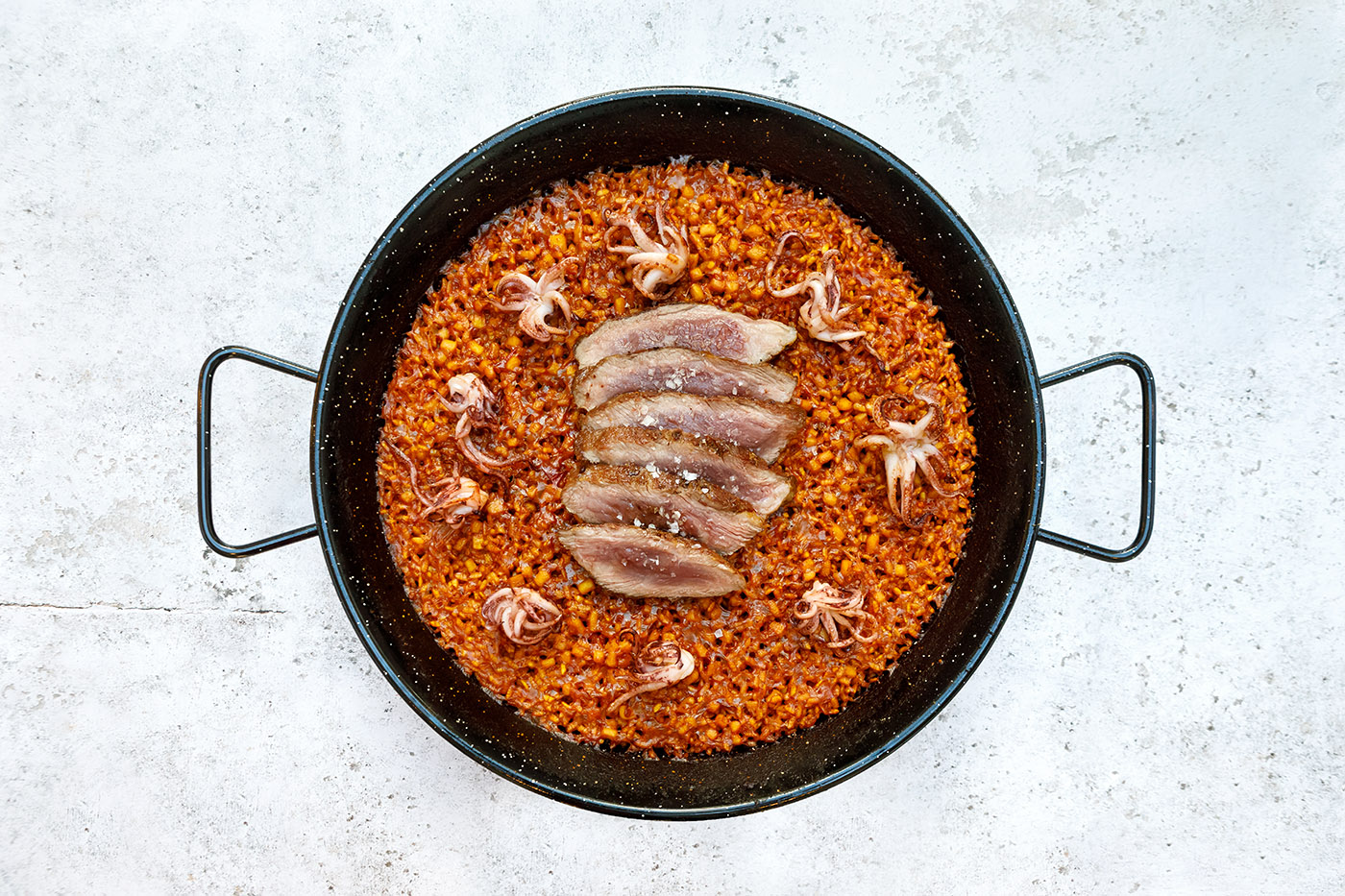
Basco founder and Basque chef Javier is happy to share with you several of his absolute favourite paella recipes. From squid to spiced duck, seafood to chorizo, enjoy making these mouthwatering paella recipes at home…
Seafood Paella – fresh tiger prawns, monkfish, squid and mussels; it looks stunning and it is the perfect seafood paella recipe to feed a crowd at a dinner party.
Chicken & Chorizo Paella – chicken and chorizo sausage are the two most popular paella ingredients. Combine with paella rice, smoked paprika and Spanish saffron for this classic.
Sobrasada & Squid Paella Rice – a perfect balance of land and sea through the mellow sweetness of the squid and the rich and earthy flavours of the sobrasada sausage.
Chicken & Prawn Paella – featuring corn-fed chicken thighs, meaty tiger prawns and saffron – a real crowd pleaser.
Vegetarian Paella – a wonderfully flavourful freshly made vegetarian paella recipe that’s the ideal mid-week meal.
Bomba Rice with Clams & Girolles – this recipe takes “arroz blanco”, a typical Spanish dish, and adds sweet clams or cockles along with meaty girolle or chanterelle mushrooms.
Paella Rice with Carabinero Prawns– featuring Carabinero – the most sought after prawns in professional kitchens worldwide – combined with aromatic saffron and smokey Spanish paprika.
You’ve no doubt have heard of croquettes, but what are croquetas? Are they related in some way? Are they the same thing, but spelt and pronounced differently? This short guide explains their origins and differences, contains interesting facts, explores different popular varieties, reveals how to make them, and more.
Croquetas are not simply delicious tapas, they are something bigger – a symbol of Spanish culture. Traditionally, they epitomise the Spanish trait of being resourceful by transforming left over ingredients into something special in its own right. Pour a glass of wine and savour the story of Spanish croquetas.
Are croquetas Spanish or French?
Croquetas are very much Spanish and croquettes are unmistakably French. Which came first though? Well, it is believed that in the 16th century, croquettes were first conceived in France, but it was around 200 years later before they became popular when a chef served croquettes to George IV and the Grand Duke of Russia. Spain got a real taste for croquettes in the 19th century, using local ingredients to create the country’s unique varieties. Today, croquetas are one of the country’s favourite dishes.
Croquetas vs croquettes
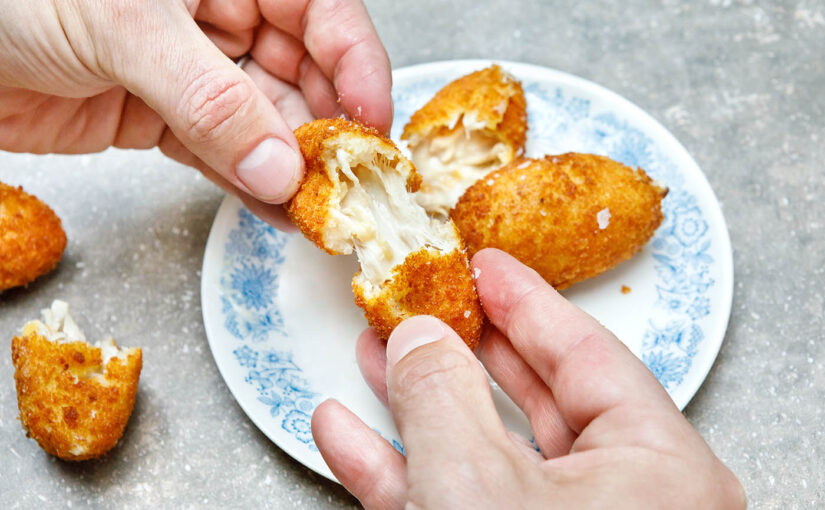
Spanish croquetas and French croquettes might look extremely similar, but one bite into them immediately reveals their key difference. Yes, both have a crunchy deep-fried outer of breadcrumbs and similar size and shape, however, that’s where the similarity ends. Traditionally, French croquettes have a potato mash-based filling, sometimes mixed with other ingredients, whereas importantly, Spanish croquetas are typically made with a thick and creamy béchamel sauce mixed with other tasty fillings. French croquettes fillings include potato with ham, cheese, meat or vegetables. Spanish croquetas can be filled with anything from salt cod, squid or crab to cheese, porcini mushrooms, chistorra sausage, chicken or Serrano ham.
What are the best Spanish croquetas?
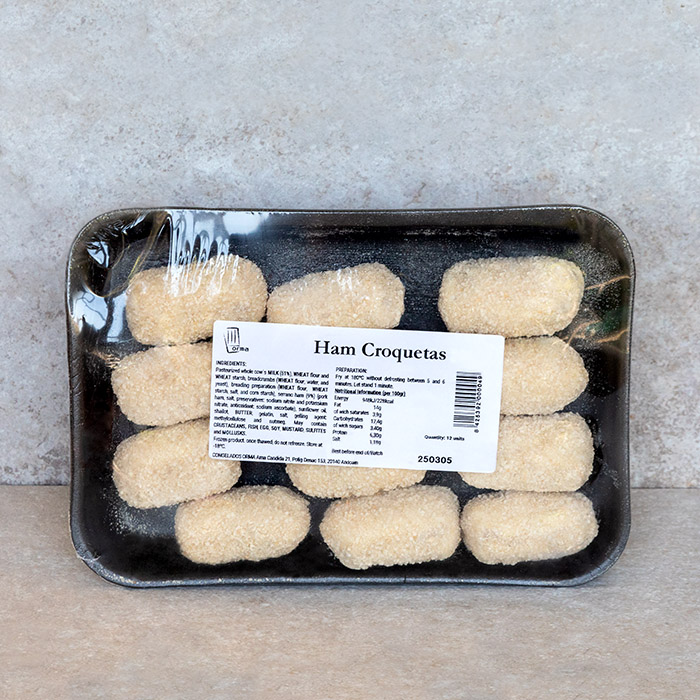
Many Spanish tapas restaurants and pintxo bars create their own croquetas in-house to their own recipes. However, if you want to buy croquetas to cook at home, one artisan producer stands out – Congelados Orma. Based just outside of San Sebastien, which is widely regarded as the “Food Capital of Spain”, Congelados Orma hand rolls all the croquetas stocked by Basco.
We spoke with Hibai San Sebastian, Commercial Director of Congelados Orma to get the inside story on their history and delicious croquetas.
“The founder of Orma, Iñaki, originally ran a bar in the old town of Donostia-San Sebastian, which was renowned for its authentic artisan croquetas and pinchos. A regular customer was so impressed with the croquetas that he bought them for his regional supermarket chain and had the idea of freezing then selling them in his stores. Then in 1970, the Orma commercial kitchen was born” explains Hibai.
“Our croquetas are made in the traditional artisanal way. The main ingredient for the bechamel sauce is fresh milk from our farmhouses which reminds us so much of the smell of grandmothers’ kitchens. Then we mix it with the best quality, minced, raw natural ingredients, such as cod, ham or mushrooms, without adding any additives or preservatives.”
The filling is coated in egg then rolled in breadcrumbs before being immediately frozen to retain their freshness. Our customers then simply fry them in oil and enjoy their homemade texture and natural flavors. Delicious.
Where are Spanish croquetas eaten?
Croquetas can be found gracing the menus of tapas and pintxos bars throughout Spain and the counters of pintxos bars which are unique to the Basque Country. They can be served hot, often room temperature but rarely cold and are usually enjoyed with a Spanish beer or wine. Locals often enjoy them either on their own, with a garlic mayonnaise, smoked paprika alioli, salsa, nacho cheese or a dipping sauce. There are also restaurants that specialise exclusively in croquetas called “croqueterias”. Here in the UK, they are available in tapas bars, frozen from Spanish food specialists or you can make them yourself.
How to make Spanish croquetas yourself?
With the right recipe and ingredients, it is possible for anyone to create authentic Spanish croquetas. Professional Basque Country chef and Basco owner Javier De La Hormaza has a wealth of delicious Spanish recipes in his arsenal. Two are signature Basque croquetas recipes which he is happy to share:
Croquetas de Bacalao – this traditional croquetas recipe’s filling combines a rich and creamy bechamel with salt cod trimmings. You can find Javier’s recipe here.
Croquetas de Pollo – make delicious croquetas with the leftovers of a roast chicken dinner, in particular, the leg and thigh. Recipe here.
Where to buy Spanish croquetas
Outside of Spain, you are reliant on a reputable importer like Basco. We have an excellent relationship with Hibai and Congelados Orma. Their croquetas are a world away from the frozen potato croquettes you find skulking at the bottom of supermarket freezers. Congelados Orma croquetas are 100% authentic and on the menu at some of the best pintxos bars in San Sebastian, which is precisely why we at Basco stock them.
Javier at Basco selected them personally and loves them because they are made entirely by hand, not with potato, have a thick bechamel made from the local regional milk and are utterly delicious. Each individual croqueta is individually hand rolled and coated in breadcrumbs using the best fillings ingredients. Basco makes it so simple too by delivering them direct to your door to easily cook from frozen in minutes.
“Extremely delicious, everyone loves croquetas from Basco… as good as my grandma’s croquetas.”
Artisan Porcini Croquetas, Sara Selga-Ferrer
“I have tried making Croquetas and buying them from other sources, Basco foods are by far the best. Easy to cook and absolutely delicious. Did not get better in Spain’s tapas bars. My vegetarian daughter loves them too. Always have to have some in stock when she comes home.”
Artisan Cheese Croquetas, Jeanette Durman
“I have now had all of the croquetas from Basco and each time I try a new one I say “this is the best yet”. The fact is they are all superb.”
Bored of the same turkey dinner every Christmas? Shake it up and fire up your BBQ and try one of the best and simplest Spanish Christmas food recipes on the planet. Starring our Whole Suckling Pig, this classic is brought to life by the larger-than-life Marcus Bawdon of “Country Woodsmoke BBQ UK” fame who was delighted to share his recipe with us.
Who is Marcus Bawdon?
Marcus Bawdon lives in Devon and was a vegetarian for 14 years who secretly dreamt about the prefect steak cooked over an outdoor fire to perfection. He is Mr BBQ. He established his excellent website and blog in 2011 which includes some delicious Spanish Christmas food recipes, teaches thousands at his UK BBQ School, has written three books including Food & Fire and is BBQ Consultant of The BBQ Mag. He has thousands of followers and subscribers on YouTube, Instagram and X – plus he has largest UK-based outdoor cooking group on Facebook. So, who better is there to give you Christmas BBQ ideas and cook our Whole Suckling Pig than Marcus?
Why a Christmas BBQ?
Why would you have a BBQ Christmas dinner? It’s a perfectly good question and it’s one we put to Marcus. “I’ve done it for the last 14 year” revealed Marcus, “I just love the flavour and fun”.
Marcus hits the nail on the head. A BBQ Christmas dinner makes so much sense. It’s inarguably different, tremendous fun and it enables you to create incredible smoky flavours you simply can’t achieve in a normal oven.
If Christmas dinners are far too contrived and formal for your liking, a Christmas BBQ is the answer. Alfresco cooking is so effortlessly sociable. It really pulls together friends and family, making it an occasion to really remember.
Forget being couped up inside a stuffy overcrowded house, nodding off and missing all the fun. Grab a cosy blanket, hunker down around the barbecue and help yourselves to a heartwarming glass of mulled wine that’s gently warmed by the flames. Watch your dinner cooking before your eyes and take in the sights, sounds and smells of barbecue cooking.
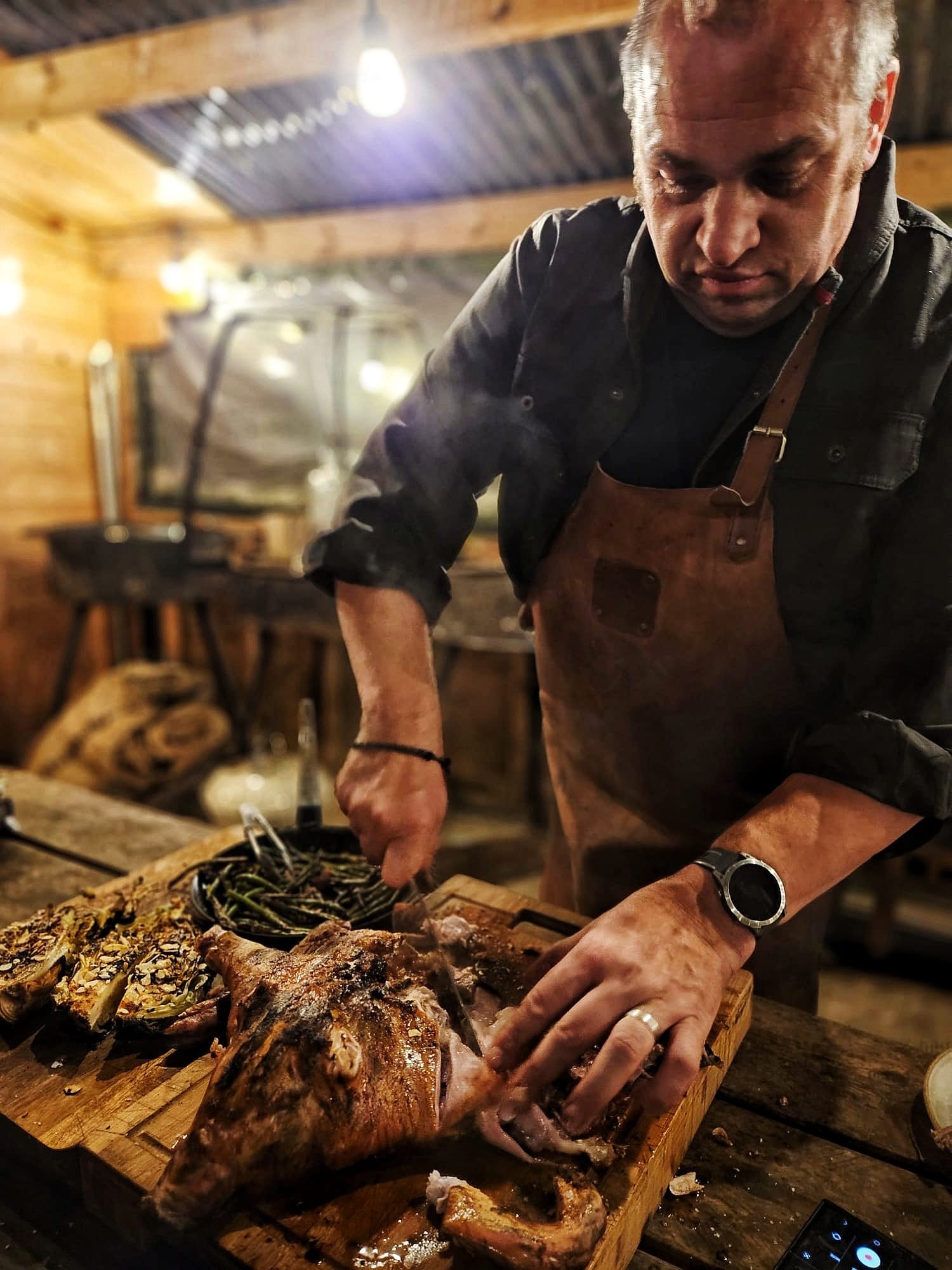
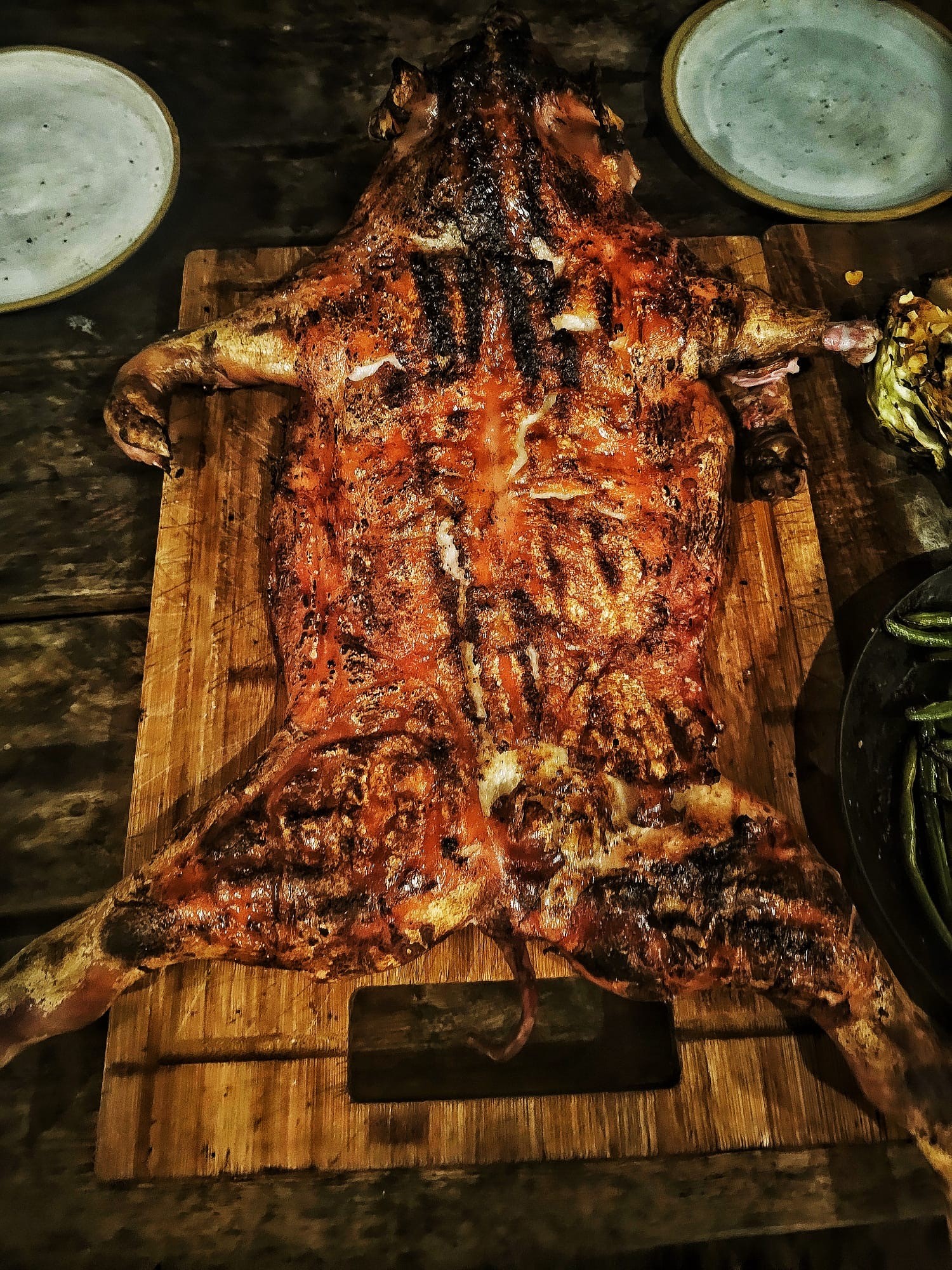
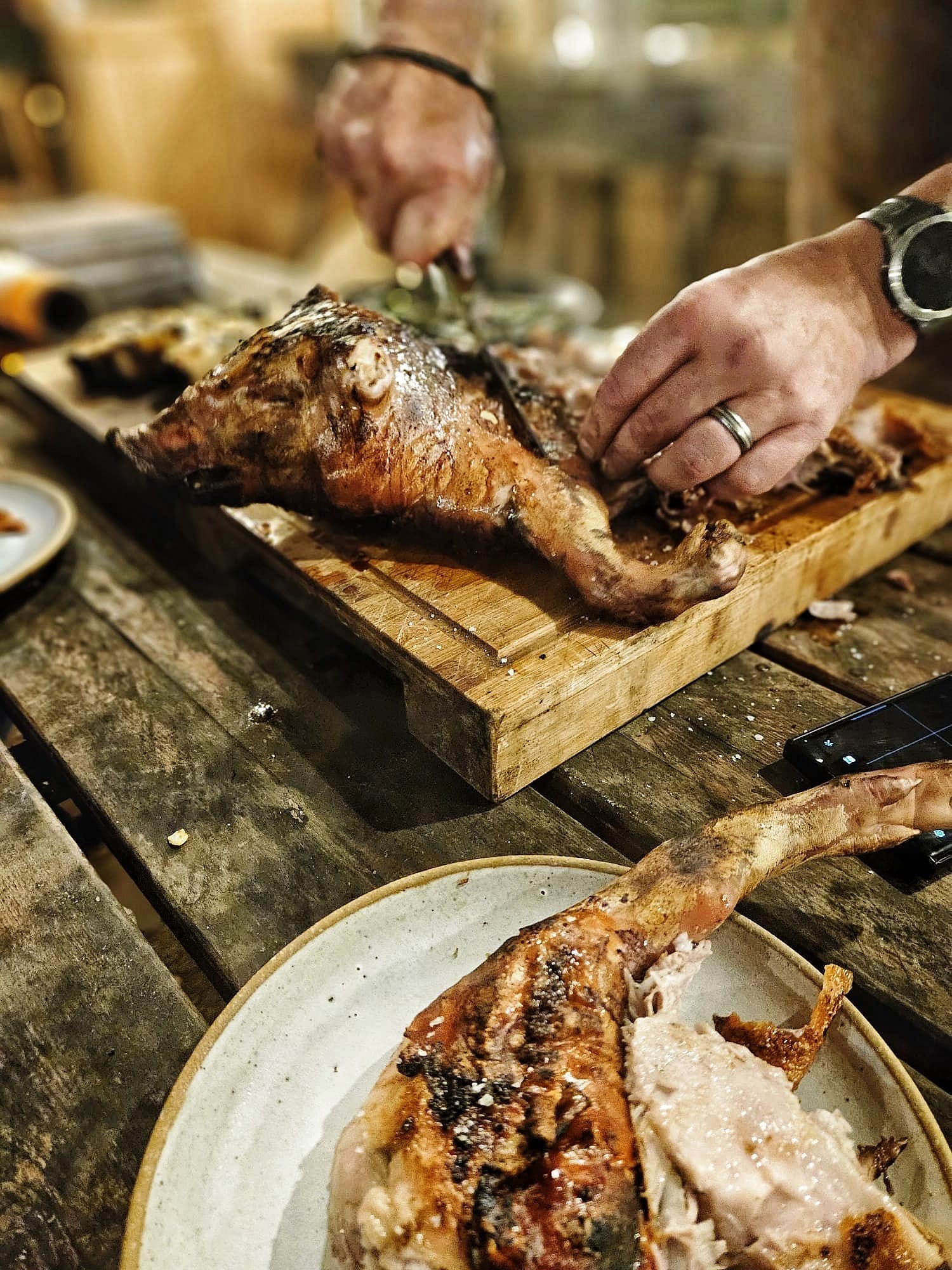
Then comes the feast itself. Prime sizzling meats take on the wonderful smokey flavours of the wood fire. They then take centre stage, served in a rustic style, ceremoniously carved on a solid wooden chopping board before being generously plated and enjoyed by all your appreciative guests.
Finally, instead of the dreaded washing up, conversation flows and you slip into the evening, and enjoy the dancing flames, glowing embers and wonderful warmth of the fire.
Why a Whole Suckling Pig?
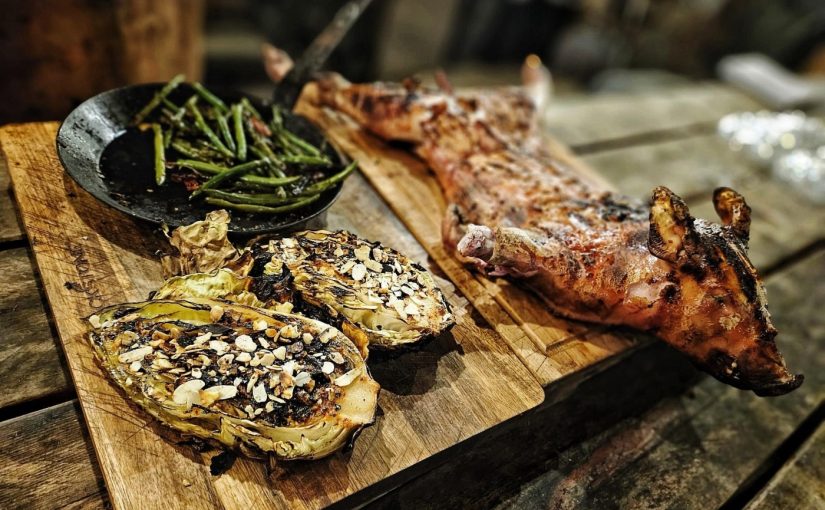
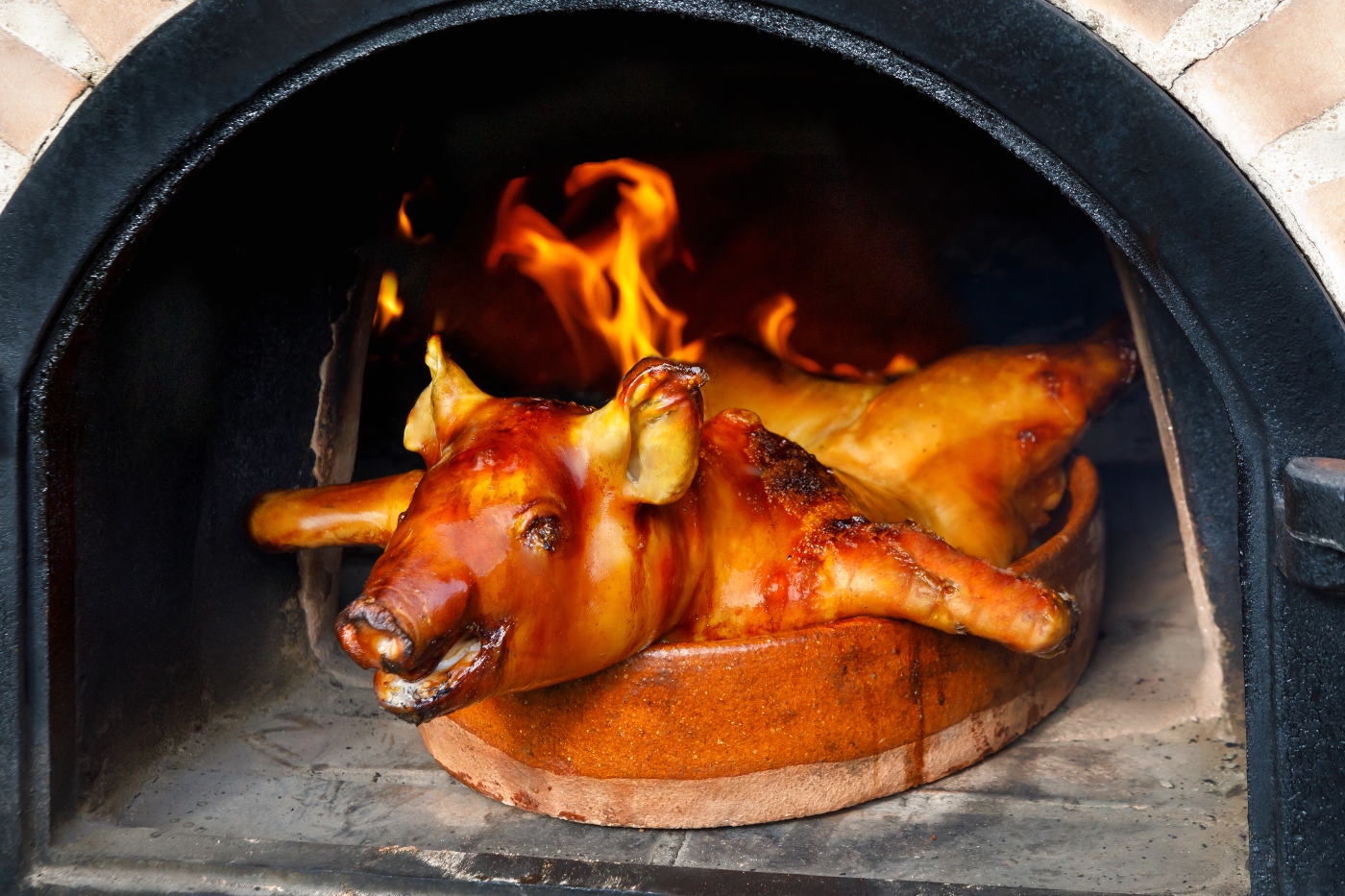
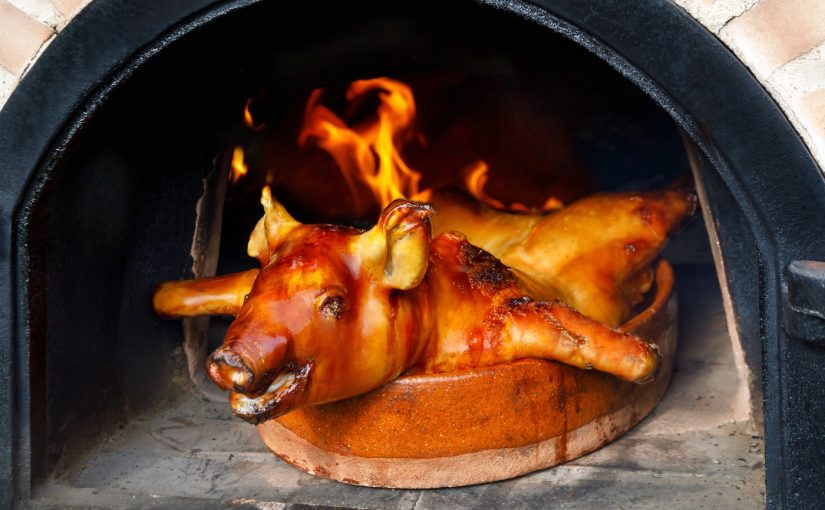
Whole Suckling Pig, along with our Milk-Fed Lamb, is one of our most popular premium roasting meats and it brings real theatre to the Christmas dinner table. It’s no ordinary meat though. Unlike commercially reared animals, our whole suckling pigs are kept with their mothers up to a maximum of 21 days. This farming method stays true to the traditional practices from which the name suckling pig was derived. Keeping things natural also delivers meat with the finest flavour and texture, which makes it the ideal choice for a BBQ Christmas dinner.
Marcus absolutely loves our Whole Suckling Pig. “It’s the perfect size to cook in a couple of hours as a feast with a few mates or around the table at Christmas.”
Cooking asado-style
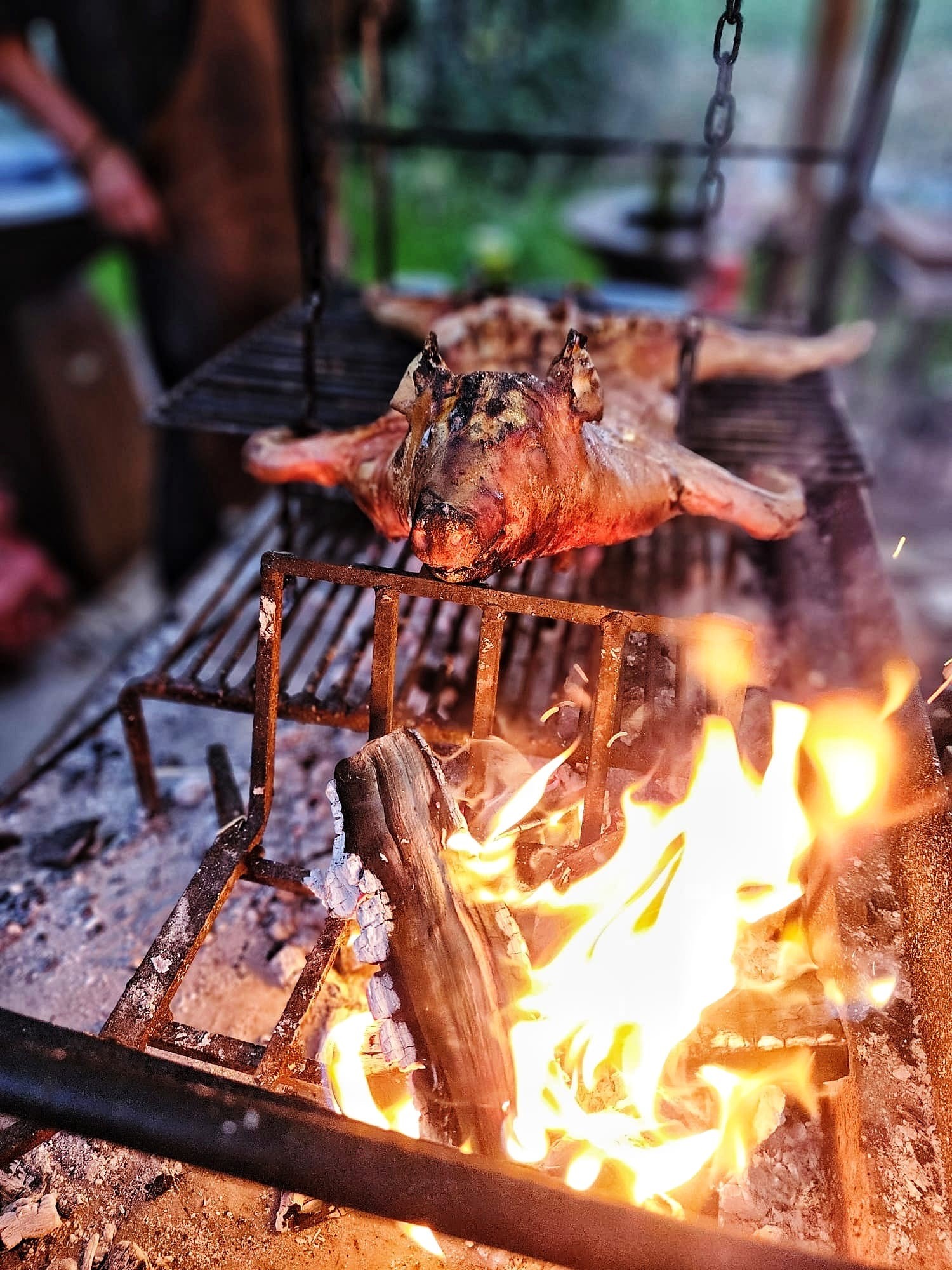
Marcus is a master in outdoor cooking and he has a wide variety of different ways of cooking in his arsenal. For this BBQ Christmas dinner of roast Whole Suckling Pig, he selected his asado grill. Also known as a “parrilla”, it’s a type of grill from South America which is usually used at highly social outdoor meals called an asado. It’s a really simple type of grill that lets you adjust its height to regulate the cooking temperature of the meat. Ideal for a Christmas BBQ!
Marcus owns a pretty impressive Asado which he swears by. “An asado frame grill gives me plenty of options and a lot of space to cook on – a friend made this beast!”
Marcus’ BBQ Christmas dinner recipe
Marcus is a regular Basco customer and for his asado-style suckling pig, he ordered a Whole Suckling Pig which we delivered to his home in Devon. It’s over to Marcus to explain his recipe and technique…
“I’ve not seen many of these cooked, and they’d be traditionally cooked in a wood fired oven. I wanted a simple asado fire style of cook over cherry wood embers, to crisp up the skin and add a wonderful sweet smokiness to the juicy tender pork.”
Marcus placed the suckling pig on the grill and left it to slowly sear for around two hours, turning carefully just a couple of times. “It’s important not to move the meat around once it’s on the grill” he explained.
“Cooked perfectly over cherry wood embers, with the sweet smoke on the crispy skin, this was a little bit of heaven.”
You can serve suckling pig for a BBQ Christmas dinner with whatever you wish, but Marcus had his own interesting Spanish Christmas food recipes for sides. “Enjoyed with family and good friends, I also cooked sides of charred paprika butter and toasted almond hispi cabbage, garlic chorizo beans and a few padron peppers.”
Alternative Spanish Christmas food recipes
If suckling pig isn’t to your tastes, consider the many other equally delicious traditional Spanish premium meats that can be stars for a Christmas BBQ. Here are a few excellent alternative suggestions available from Basco.
Milk Fed Lamb is hugely popular for a Christmas BBQ. Utterly authentic and available from Basco as whole, half, quarter and legs, in Spain, it is known as Lechazo or ‘Cordero Lechal’. It is incredibly soft with crispy golden skin with a deliciously creamy melt-in-the-mouth texture when barbecued. Big on beef? Prime Galician Beef is a personal favourite of Marcus’ and, like Wagyu Beef, is always a winner. The rib steaks have beautiful natural grass-fed marbling from 8 to 10 years of rearing and are perfect for a BBQ Christmas dinner. Prefer pork? Spain spoils you again with Christmas BBQ ideas like Iberico Secreto, Coppa and Presa steaks from indigenous black Iberico pigs that wander the dehesa forests of southwest Spain feasting on herbs, grasses and acorns.
You can also browse Basco-founder and Basque chef Javier’s 40 Christmas Recipes here.
Christmas is celebrated with real gusto in Spain, but what food is eaten on la Navidad? We thought it would be helpful to pull together a complete guide to Spanish Christmas food and drink. To give you some ideas of either how to shake up your usual Christmas dinner or go completely native and indulge in proper traditional Basque Christmas food with all the trimmings. To get you to enter into the Spanish Christmas spirit, here are a few Spanish Christmas food ideas from starters and mains to desserts, drinks and ingredients. Let’s delve in.
Navidad in Spain
The Spanish celebrate la Navidad with lavish meals with family and friends. On Christmas Eve – called Nochebuena in Spain – people usually attend church after their grand Christmas dinner for the ‘misa del gallo’ at midnight. On Christmas Day itself, the Spanish tend to eat slightly lighter meals than on the night before and relax and enjoy the company of family.
Tapas
What better way to start the festive meal than with tapas – a typical Spanish Christmas food. There is such a wide selection of delicious options to choose from.
You could start with some thin slices of delicious Jamón Ibérico De Bellota carved at the table from an impressive leg of delicious acorn-fed pure-bred ham. From there, you could enjoy some flash-fried Padron Peppers with sea salt and maybe a few slices of Manchego cheese of jamón. Prawns are a popular Spanish Christmas food too. Make it really special with Carabineros – large deep-sea jumbo size prawns with a striking festive bright red colour.
Put on a selection of other tapas including Croquetas with different delicious fillings alongside a deeply satisfying Chorizo – there are so many different types to choose from including Picante, Iberico and fresh Cooking Chorizo. Spanish black pudding called Morcilla is beautiful pan-fried or dropped into soups or stews.
The Spanish love fish tapas, too, at Christmas. Authentic Basque Christmas food like Salt Cod, Bonito Tuna, Boquerones and Anchovies marinated in extra virgin olive oil and white wine vinegar go down especially well. Green and black Olives are also a staple Spanish Christmas food.
Primer Plato
The first course is often a traditional Spanish Christmas soup or stew, like an Andalusian stew, Catalan escudella meat stew with sausage or garlic soup hit the spot. Alternatively, a good Gazpacho can cleanse your palate in readiness for the main course.
Plato Principal
Now onto the main event. No Spanish Christmas food celebration like this would be complete without meat. Not just any meat though. It has to be of the finest quality, with the animals reared and fed by producers in a very particular way, because their husbandry and diet really do come through in the flavour.
The pinnacle of Spanish Christmas food has to be a Whole Suckling Pig. Roasted, it not only makes the crispiest crackling you have ever tasted, it yields the softest and sweetest meat – it literally melts in the mouth. In Spain, instead of being carved, it is traditionally pulled apart at the table using two plates – the meat is so incredibly tender.
Beef more your thing? Galician Whole Beef Fillet is so beautifully tender and has huge depth of flavour. Also known as Filet Mignon, Tenderloin or Eye Fillet, it comes from retired dairy cows aged between 8 and 12 years old and has natural grass-fed marbling.
Prefer pork? Presa Iberica is another prime cut of meat that melts in your mouth. The animals reared to create this superb pork are free-range Iberico pigs, indigenous to Spain, who root out acorns under holm oak trees. This gives the meat its highly-prized flavour and marbling. It is so delicious grilled under a medium heat or seared and sliced.
All of the above options can be accompanied by a variety of traditional Spanish vegetables including roasted carrots and pan-fried potatoes. Delicious.
Postre
No Nochebuena meal is complete without an authentic Spanish Christmas dessert. How about a Burnt Manchego Cheesecake? This classic Spanish Christmas dessert is rich, creamy and baked at a high temperature for a dark, deeply caramelised top and an indulgent oozy centre.
Got a sweet tooth? Serve some Turron which is a Spanish nougat, is made with the finest Marcona almonds, local orange blossom honey and sugar. It is available in a variety of flavours and textures it is perfect with a coffee and dried fruits.
Almonds also figure prominently in Spanish Polvorones. These toasted sweet treats contain crushed almonds and are flavoured with cinnamon. Delightful as a festive treat with a glass of Spanish sherry.
Queso
Manchego is the iconic Spanish cheese and the perfect way to draw a Spanish Christmas meal to a close. Varieties vary from those with an intense nutty flavour with hints of caramel and fruit to smooth and creamy manchegos with buttery flavours and hints of green almonds. Whichever you do choose, ensure it carries the ‘Queso Manchego D.O.’ seal of authenticity and serve it with quince paste, rosemary biscuits and fig and almond cakes. We actually offer a special Manchego Cheese Box containing all this and more.
Drinks to pair with Spanish Christmas food
To start the meal, we recommend a sparkling cava to accompany your tapas. Kripta Gran Reserva is from one of the most prestigious sparkling wine producers in Spain. It is elegant, clean and bright with fine with persistent bubbles.
To enjoy with your main, choose between a white or red Spanish wine, dependent upon your tastes and the meat served. If you prefer a red, try the Vega Sicilia Pintia. Aged in oak barrels for 12 months, this elegant, full bodied and intense expression of Tempranillo is from one of the most revered wineries in Spain. Perfect with roast suckling pig or Galician beef.
Want an excellent white? Martinez Lacuesta White Rioja Barrica is a white Rioja wine created from local Viura grapes. Ageing for 3 months in oak barrels gives it its pale yellow-green colour with delicate golden hues, a fresh, creamy entrance and subtle wood fragrances.
Now onto a Spanish Christmas dessert pairing. Alvear Pedro Ximenez 1927 is made from sun-dried Pedro Ximenez grapes from the prestigious Alvear winery and is a sumptuous wine of great intensity with rich, and juicy concentrated fruit.
Finally, settle down and relax after your Spanish gastronomic Christmas with a fine Peinado 100 Year Old Brandy, adored by Michelin starred chefs. Distilled in the town of Tomelloso in La Mancha by one of the oldest Brandy producers in Spain, the barrels are sprayed with aged brandies to bring out the aromas and body.
Javier’s Spanish Christmas food and drink secrets
Basco founder Javier De La Hormaza is a professional Basque chef and would like to highlight and share a few recipes that will make your Spanish Christmas extra special.
Fabulous Finger Food – one of Javier’s favourites is Chistorra Sausage Rolls with Lemon Aioli which are so easy to prepare and have to be tasted to be believed – his recipe is here.
Show Stopping Main – how about an Iberico Pork Wellington? Beautiful melt in the mouth presa iberica, earthy mushroom pate, creamy serrano ham and crusty pastry. Prepare it in advance and pop in the oven.
Easy Escape – want to enjoy maximum time with family and friends? An Oven-Ready Suckling Pig Quarter is a traditional quarter of Spanish cochinillo from Segovia – best of all it requires zero preparation and is utterly scrumptious.
Wow Dessert – want to end the meal on a high? Look no further than Javier’s Spanish Baked Alaska. Don’t be frightened to try this as it is easier than it might first look. It features a base of Santiago almond, lemon and cinnamon cake, topped with creamy turrón de jijona ice cream covered in silky Italian meringue.
Javier has a whole host of Spanish Christmas food ideas and recipes for you to try right here.
Drinks until dawn
Like to party well into the night? Practice the dark art of mixology with these three fabulous creations:
Vermouth Time – a Marianito Cocktail is from the Basque Country, and a more sophisticated way of drinking vermouth with similarities to that timeless classic…The Negroni.
Pedro Pick Me Up – need a quick hit? Affogato De Pedro Ximenez involves a freshly brewed espresso slowly dripped into home-made Pedro Ximenez ice cream for a rich and creamy ‘match in heaven’.
Felice Navidad!
Whatever Spanish Christmas food you do decide to serve on Nochebuena and día de Navidad, Javier and the team at Basco hope you enjoy the absolute best food and company and make amazing memories. Here’s to a very merry Christmas and a happy New Year. Buen provecho!
The Spanish are known worldwide for their culinary prowess and one of their most famous desserts is the famous Burnt Basque Cheesecake. One taste and you will know how utterly fabulous it tastes, but what else do you know about this delicacy? What is Basque Cheesecake? Where does Basque Cheesecake come from? How long can Basque Burnt Cheesecake last? What to serve with Basque Cheesecake? We have the answers to all your “burning” Burnt Basque Cheesecake Questions.
What is Basque Cheesecake?
Burnt Basque Cheesecake is a Spanish dessert made from cream cheese, whipping cream, eggs, caster sugar and plain flour. What makes Burnt Basque Cheesecake unusual is that it is baked so that its outer achieves a toasted, burnished appearance and the inside stays rich and creamy. Some say that this was discovered by accident rather than design – more about that next. What we do know for sure is that it tastes heavenly.
Where does Basque Cheesecake come from?
Unsurprisingly, Burnt Basque Cheesecake originates from the Basque country. In fact, it can be precisely pin-pointed to not just to one city, but to one specific bar. La Viña, in the old quarter of San Sebastián (widely regarded as the best city in the world for food), is a small family bar that is one of the city’s best-loved restaurants. Here, in 1988, self-taught chef and son of one of the owners, Santi Rivera, was experimenting in La Vina’s kitchen and created the original, now famous Burnt Basque Cheesecake. It became the first sweet pintxo in Basque cuisine.
What does Basque Cheesecake taste like?
There are so many superlatives to describe how Burnt Basque Cheesecake tastes. The first thing that strikes you is the texture and how wonderfully soft Burnt Basque Cheesecake is. Taste-wise, it is deliciously creamy and has a slight tang to it. All this is topped off by the burnt outer that delivers a delicious caramelised finish. It is the combination of flavours of the toasted crust and creamy inner that elevates Burnt Basque Cheesecake above all others.
Basque Cheesecake vs normal cheesecake
So, what makes Burnt Basque Cheesecake different from a normal cheesecake? There are three key differences. The first is immediately apparent – the burnt outer. As it is cooked at a higher temperature and intentionally burned, no water bath is required when baking it. The second is obvious when you cut a slice. Unlike normal cheesecakes, Burnt Basque Cheesecake has no crust or base of any kind. Finally, the texture of the interior is gooey and fluffier than traditional cheesecake and the taste is subtly sweeter due to the caramelisation of the outer.
How to make Basque Cheesecake?
After extensive research, Javier De La Hormaza – Basco founder and inspirational professional chef – discovered a particular recipe by a Spanish blogger which is the closest one he could find to the one created by Rivera at La Viña. It is surprisingly simple to make but you have to be diligent and ensure that the outside of the cheesecake is browned well but whilst being careful not to dry out the inside. You can try our recipe for Burnt Basque Cheesecake.
What to serve with Basque Cheesecake?
As a dessert, Burnt Basque Cheesecake on its own is fabulous. Javier recommends serving it at room temperature for the best flavour and texture. You can also serve it with a blackberry compote which is very easy to make by simply stewing blackberries with some sugar and a splash of berry liqueur. Alternatively, raisins soaked in Pedro Ximenez sweet sherry. Interestingly, Santi serves his Burnt Basque Cheesecake in two small slices rather than one big one. Why? He believes that if you take smaller bites and you get more flavour.
How long can Basque Burnt Cheesecake last?
Burnt Basque Cheesecake is so moreish, it’s unusual for anyone to need to save some. However, if you did have some left, it can be stored in an airtight container for around 4 days. Javier recommends eating it within 2 days though if you want the best texture.
Does Basque Cheesecake need to be refrigerated?
Yes, as it contains a lot of cream. If you want to prolong the life of your Burnt Basque Cheesecake, pop it into your fridge in an airtight container and it should last around 4 days.
Can you freeze Basque Cheesecake?
You’re in luck. Yes, Burnt Basque Cheesecake freezes well and can be frozen for a month and it retain the best flavour and texture, but it can survive in a freezer for up to 3 months. To defrost, simply remove it from the freezer 24 hours before you wish to eat it.
There are hundreds of famous Spanish foods that run right through the menu and hit every spot along the taste spectrum. High quality ingredients are key to making Spanish food so unique and popular, not just in Spain, but worldwide, too.
We challenged Basco founder, and professional chef, Javier De La Hormaza to curate just 16 of his personal favourite 16 famous Spanish foods that span the entire menu. It wasn’t easy, but here are Javier’s pick along with recipes and key ingredients you need to recreate them yourself at home. Let’s get started…
Ajoblanco is a typical Andalucian dish of cold almond soup, known as the ‘white gazpacho’ and one of the most famous Spanish foods. Its origins are thought to be Roman or Greek, and this peasant dish is served very cold in the hot months. It can be accompanied by many different things – it can be garnished with cured anchovies with strawberries or in Malaga, served with muscatel grapes and slices of apple or melon.
Few famous Spanish foods are simpler to prepare and more delicious than Gamba Roja a la Sal. The most important thing is the quality of the ingredients, as it is the simple constituents that really sing. You need just top quality gamba roja prawns, rock salt and lemon juice. That’s it, apart from a glass or two of ultra-chilled manzanilla sherry and crusty bread.
Migas Manchegas is a humble but one of the most famous Spanish foods from La Mancha. Traditionally, it uses basic ingredients that shepherds could carry – stale bread, pancetta and chorizo. “Migas”, meaning breadcrumbs, are lightly fried cubes of stale bread tossed in garlic, smoked pancetta, chorizo sausage and choricero pepper puree. It is often topped with a soft fried egg for dipping into and green grapes.
Huevos Rotos con Jamón is one of the oldest and most famous Spanish foods. This delicious peasant dish was mentioned back in 1605 in Spain’s literature masterpiece, Don Quixote of La Mancha. Huevos Rotos con Jamón, can be made with chorizo or chistorra on their own, or with morcilla, gulas or black truffle. In Javier’s recipe, he prefers to serve them with straw potatoes rather than chips, as they provide a wonderfully crunchy texture.
Pulpo a la Gallega, also known as Pulpo a Feira, is a traditional Galician dish and another of the famous Spanish foods you must try. Interestingly, Pulpo a la Gallega is served during the patron saint festivities of the city of Lugo. Don’t be daunted by the thought of preparing and cooking octopus – you won’t need to pound it or hit it against a wall to tenderise it as Basco whole octopus arrives frozen which actually helps to tenderise the meat.
No list of popular and famous Spanish foods could be taken seriously without the inclusion of a Spanish Omlette. Called Tortilla Española or Tortilla de Patata in bars and cafés across Spain, it is the perfect tapa or appetiser. Javier’s recipe to create an extra tasty Spanish omelette, involves caramelising some onions and lightly cooking the mixture with the potato which keeps the omelette moist. Feel free to experiment too by adding other ingredients like piquillo peppers and prawns, wild mushrooms and cheese, ham and tomato.
Chorizo sausage, in itself, is not only one of the most famous Spanish foods, it can be found in many tapas restaurants here in the UK. This is a classic tapas dish that offsets the spice of chorizo with the sweetness of honey and depth of red wine. Javier reduces the red wine to a syrup then adds honey then coats the chorizo in a lovely sweet red wine syrup. Utterly delicious, these are real crowd-pleasers. For an authentic touch, serve with toothpicks.
Fish and seafood feature heavily in the Spanish diet and Salt Baked Sea Bass is one of the most famous Spanish foods involving fish. Perfect for a dinner party, Javier recommends making the salt crust and the fish in advance and then cracking it open at the table in front of your guests – very dramatic and extremely tasty. Salt Baked Sea Bass is delicious and can be served with new potatoes, a green salad and either hollandaise sauce or a mustard and honey vinaigrette.
Popular in Northern Spain for centuries, Bacalao al Pil Pil is a traditional Basque dish made with salted cod, garlic, dried guindilla chilli and olive oil. As one of the country’s famous Spanish foods, it is a big hit with tourists as well as locals. The sauce is thickened naturally as the natural gelatine in the cod is released and emulsifies with the warm oil during cooking. You need to start preparing the salted cod 2 days in advance by soaking it in water and changing the water three times. It is well worth the effort though.
If you are visiting the Basque Country, Basque Grilled Turbot is an absolute must try of all famous Spanish foods. Widely regarded by professional chefs as “The King of The Sea”, turbot is a beautiful flat fish which is perfect for grilling whole, even over ahigh heat, as its natural gelatin keeps the meat wonderfully succulent and rich. For this recipe, Javier makes a sauce from txakoli wine, cider vinegar, olive oil and salt known as ‘agua de lourdes’. This is then drizzled liberally over the turbot while on the grill. Together with the fish’s juices, it makes a fabulous pil pil style sauce.
The two standout ingredients of this fabulous and famous Spanish food are incredibly tender black Iberian pork fillet and intense Pedro Ximenez sherry. Juicy, tender and wonderfully well marbled, pork fillet is known in Spain as “Solomillo Iberico”. This free-range pork is bred in Salamanca, from an ancient breed of pig, the black hoofed Cerdo Iberico, These have roamed the woodland meadows of western Spain feeding on acorns for thousands of years giving the meat its incredible rich and nutty flavour. Served with a glossy Pedro Ximenez sherry sauce, it never fails to impress at dinner parties.
Txuleton rib steaks sit at the head of the table of famous Spanish foods in restaurants all over the country. They are enormous and originate from the small Basque village of Astigarraga, near San Sebastian. Txuleton rib steaks come from Galician beef from old cows between 8 and 15 years old. Ageing of older, chubbier cows, with a diet of natural grass, creates wonderful marbling of the meat, similar to that of Wagyu beef. The meat is then dry aged and is widely regarded as the best steak you can buy with extraordinary depth of flavour and texture. Cooked over charcoal for a lovely smoky flavour, it is classically served with a green salad with spring onions and cider dressing, chips and roasted red peppers.
Spanish suckling pig, or “Cochinillo” is a traditional dish that has been cooked in Spain since medieval times. Segovia is the area that is renowned for producing the best Spanish suckling pigs. The two main ingredients used to cook whole suckling pig are salt and water and the pig is roasted in a dish held up above the water which keeps the flesh moist. The meat is delicious and incredibly tender and the crackling is supremely crispy. Tradition has it that you carve the suckling pig with a plate as the meat is so soft. Javier recommends serving with a salad of iceberg lettuce and spring onion dressed with cider vinegar and extra virgin olive oil.
If you are ever fortunate enough to visit San Sebastian, you simply must try the famous Basque Cheesecake. This fabulous and chunky baked Spanish dessert is the first widely known sweet pintxo in Basque cuisine. When baking it, the outside is heavily toasted, almost burnt looking, whilst the inside stays soft and deliciously creamy – in fact, Javier suspects this classic could actually have been created by mistake. Scrumptious on its own, you can also serve it with a fresh blackberry compote or raisins soaked in Pedro Ximenez sweet sherry.
At first glance, you may think Crema Catalana is simply crème brûlée, however, there are distinct differences. The origins of Crema Catalana actually predate that of the French dessert by 300 years. First created in the 14th century, the other big difference is the ingredients. The French use a vanilla flavoured cream, while Crema Catalana uses milk, cinnamon and lemon and orange zest for added flavour. Once it has been allowed to cool and is then chilled for 4 hours, sprinkle a thin layer of sugar on top then caramelise with a kitchen blowtorch or a hot grill. Serve with some almond puff pastry fingers and a chilled glass of cava or an orange liqueur… or both.
The last of the famous Spanish foods featured in Javier’s top 16 is Tarta de Santiago. This traditional Spanish cake originated in Galicia and dates back to 1577 when it was also known as “royal torte”, because almonds were an expensive ingredient centuries ago. Javier’s preferred recipe is a simple one where the ground almonds, sugar and egg mixture is baked in a mould. Tarta de Santiago can be served as a dessert, for breakfast or part of an afternoon tea. Javier pairs the tarta with a dollop of clotted cream and freshly grated orange zest in his recipe.
These 16 famous Spanish food recipes are just a handful from Javier’s exquisite online Spanish Recipes and Basque Food Recipes. You can also discover blogs about Spanish Drinks, Cooking Tips, Travel and Restaurant Reviews by clicking the links. Enjoy!
Being a relatively hot country, you’d expect there to be many Spanish beer brands in Spain and you would be correct. What is Spain’s most popular beer? By volume, you could probably guess three maybe four Spanish lager brands, but does highest sales equate to highest quality and best taste when it comes to deciding which is the best Spanish beer?
In this guide, we look beyond the big mass-produced beers and take you on a beer discovery of Spanish craft beers from the best micro-breweries across the whole of Spain. All are reassuringly available from Basco. Let’s grab the bottle opener and get started in no particular order.
Er Boqueron
We’re kicking off with one of the most unusual Spanish beer brands. Er Boqueron is an award-winning beer that is the only beer in the world brewed using sea water from an area of the Mediterranean, near Valancia, tha tis known for its level of purity. Totally natural, with no added gas, this unfiltered and unpasteurised beer is light, refreshing and wonderfully easy to drink. Er Boqueron is one of the best Spanish beers and is the winner of two ITQI Superior Taste Awards 2014 for taste and quality. Scores 4.85/5 in our customer reviews. 4.8% ABV.
Tasting notes: on the nose, it is toasty with malt and biscuits with peach and pear to follow. On the palate there is fruit and bubbles with a touch of iodine and balsamic then sweet peach. Drink with fried fish, charcuterie, Spanish ham or on its own.
La Socarrada
Another of the more interesting Spanish beer brands is La Socarrada – meaning “scorched” due to its slighty smokey notes. It is made by a micro-brewery in Xativa, Valencia in small batches using a double fermentation process and continuous bottle maturation. This craft beer is a winter honey ale with made with barley malt, rosemary honey, hops and yeast with a kick of Spanish rosemary. La Socarrada won flavour awards by the International Taste & Quality Institute of Brussels (Belgium) in 2012, 2016 and 2021 and bronze in the 2015 South Beer Cup of South America. Scores 4.80/5 in our customer reviews. 4.7% ABV.
Tasting notes: on the nose, it has smokey shades, rosemary, toast and fresh bread. On the palate, there are notes of notes of black pepper, caramel, cherry and pear. Classed as a gastro-ale, its perfect pairing is is with Spanish ham, Iberico pork, roast lamb or suckling pig.
Moritz Original
In Catalunya, one of the most famous Spanish lager brands is Moritz. Recognised as Barcelona’s favourite lager, this delightfully light, golden lager beer has a rich history that dates back to 1856, It has won numerous awards over the years starting with a gold medal at the 1888 Universal Expo of Barcelona. Often referred to as “Spanish sunshine in a bottle”, it is still made at the original brewery at the Ronda de Sant Antoni, in the Raval. It is brewed using natural spring water from the Font d’Or in Montseny, extra pale barley malt, aromatic hop flowers from Saaz and lager yeast from Moritz. Scores 4.55/5 in our customer reviews. 5.4% ABV.
Tasting notes: Moritz has soft, pleasant with sweet notes of malt and cereals and a light bitter finish. This gasto-lager is perfect with a Bocadillo de Jamón or seafood.
Alhambra Reserva 1925
No list of the best Spanish beer brands would be complete without Alhambra Reserva 1925 – an ultra-premium Spanish beer made in Granada. The recipe of this full-bodied, intense and exquisite flavoured artisan craft beer has not changed since it was originally conceived in 1925. Slow crafted in Spain, Alhambra Reserva 1925 beer is brewed using the purest water from the Sierra Nevada mountains and the best maize and hops from southern Spain. Alhambra Reserva 1925 was awarded Spain’s Best Strong Lager 2016 at the World Beer Awards. Scores 4.68/5 in our customer reviews. 6.4% ABV.
Tasting notes: it has a light toasted aroma and a thick, creamy head with a firm, full bodied and well-rounded flavour. A beautifully balanced, bittersweet flavour, it has notes of bitter orange and a hint of caramel flavour at its finish. Alhambra Reserva 1925 pairs perfectly with seafood and grilled premium Spanish meats.
Rosa Blanca
Born in Mallorca in 1927, Rosa Blanca is the Balearic’s best loved beers. This well-balanced, creamy beer is brewed with traditional lager ingredients of barley malt, maize, rice and hops. Rosa Blanca is one of the country’s lower alcohol Spanish lager brands and has a hint of citrus. This is because towards the end of brewing, when the beer is maturing, Citra hops are added cold to Rosa Blanca, at between 0 and 1º C. This extracts the fruity aromas and citrus notes of this variety of hops, without any bitterness. 3.4% ABV.
Tasting notes: it’s a balanced, very harmonized beer with mild malty sweetness combining with a soft bitterness. Creamy and pleasant there’s a fresh Citra hop aroma with stone fruit notes and a refreshing hint of citrus. Rosa Blanca can be drunk on its own or with any type of dish from fish to sweet desserts.
Victoria Malaga
Brewed in Malaga, Andalucia, Victoria Malaga is one of the classic Spanish beer brands and has been in existence since 1928. Its slogan Malagueña y Exquisita”, meaning “From Málaga and Exquisite” is accurate as this light, golden, fine sparkling beer is carefully made using the traditional slow maturation process, with a minimum of 12 days which ensures its “exquisite” flavour. The bottle’s historic label famously features a German tourist, holding his boater hat, mopping the sweat from his forehead whilst enjoying a refreshing glass of beer. Interestingly, its innovative new brewery in Malaga was nominated for the GANA Building of the Year 2018 Award. 4.8% ABV.
Tasting notes: sweetish aroma of malts, grass and sharpish herbal hops. Refreshing with a balanced body and taste. Lemon pepper flavour with hints of lime. Victoria Malaga is best served ice cold and is perfect with all Spanish tapas and pintxo.
Estrella Damm Inedit
We come to the end of our search for the best Spanish beer and the final beer on our list is a rather special one. Created in collaboration with chef Ferran Adrià and a team of sommeliers from El Bulli, Estrella Damm Inedit is the first beer specifically designed to accompany and complement food. A true gastro-ale, this wheat beer is uniquely brewed to create a complex aroma and an opaque look. This wheat beer is in the style of Witbier, originally from Belgium, and made with unmalted wheat. Using unmalted wheat gives this beer more body and a softer, fuller mouthfeel. Inedit is flavoured with spices, giving it its special taste and making it a uniquely distinctive and dynamic beer. In 2020, Estrella Damm Inedit won a gold award at the World Beer Awards and a silver in the International Beer Challenge awards. 4.8% ABV.
Tasting notes: highly aromatic with a creamy fresh texture, coriander, orange peel and liquorice with a pleasant lingering aftertaste. Designed to be enjoyed with fine food, served chilled in white wine glasses, it works especially well with starters, salads and oily fish, and can be paired with spicy or sweet and sour flavours.
Best Spanish Beer Gift Sets
Sometimes one bottle isn’t enough or you want to surprise someone with your knowledge of the best Spanish lagers. That is why you might wish to consider a Basco Beer Gift Set of some of the best Spanish beers in a special presentation box. We have several available including:
Tapas and Spanish beer go hand in hand. Basco owner and Basque-born chef Javier De La Hormaza has compiled a whole host of beautiful homemade tapas recipes from Gambas Pil Pil to Spanish Omelette, Fried Padron Peppers to Chistorra Sausage Rolls With Lemon Aioli. Click here to browse and attempt Javier’s easy to follow tapas recipes.
The Spanish love their meat and are incredibly proud of how they produce it and relish how it tastes. Genuine Spanish Jamón is amongst some of the best ham products on the planet and the two main types are Jamón Serrano and Jamón ibérico. How do you choose between them? What are the key differences? What type of pigs do they come from? How are they reared? Are they cured differently? How do you slice it? How is it eaten? How do they taste? This “Jamón Serrano vs Jamón Ibérico” guide has all the answers and more.
The history of Spanish Jamón?
It is thought that the decedents of the Spanish pigs used to make Jamón Serrano and Jamón Ibérico landined in the Iberian Peninsula during the times of the Phoenicians around 1100 BC. The birthplace of Spanish ham was Gádir, currently the city of Cádiz, but during the Roman Empire times, ham was much more prevalent.
What is Spanish Jamón?
At first glance Spanish Jamón Serrano and Jamón Ibérico may look quite similar, but the differences, some subtle, have an impact on the taste. Jamón is cured Spanish ham from particular pigs. Serrano and Ibérico are two distinctly different types, so let’s explore how they differ, starting with the pigs.
Breeds of pigs
Jamón Serrano and Jamón Ibérico are made from two very different breeds of pigs and this is one of the reasons they taste and are priced differently from each other.
Jamón Serrano is from white pigs, such as Duroc, Landrace, Pietrain or Large White. Conversely, Jamón Ibérico is from very rare 100% pure-bred Iberian breed pigs which are crossed mainly with Duroc and are a minimum of 50% Iberian. Black pigs have a much greater capacity for fat to infiltrate the muscle and it’s this that gives Jamón Ibérico its unique flavour and texture.
Interestingly, the way you can differentiate whole legs of Jamón Serrano and Jamón Ibérico is by the colour of the pigs’ trotters. The white pigs have white trotters and the Iberico pigs have black trotters.
Diet and rearing
The diet of a pig and its upbringing make a huge difference to the texture and taste of the Jamón it produces. So, which breeds of pigs produce Jamón Serrano and Jamón Ibérico?
White pigs used to create Jamón Serrano are usually reared on farms and fed cereals. Their diets and water consumption are very carefully monitored and they are allowed to move
Black pigs that yield Jamón Ibérico, like the award-winning ham produced by Arturo Sánchez, are fed and reared quite differently. First, we need to understand what “Montanera” is. Montanera is a special period that runs from autumn until March. During that time, black pigs are raised with complete freedom. They are allowed to graze meadows and pastures feeding on a diet of only natural unprocessed ingredients – exclusively holm oak and cork oak acorns, grasses and herbs. What also makes Arturo Sánchez Jamón Ibérico so special is the black pigs are raised for a “double” Montanera over two years. In that time, they gain 75–90 kg in weight and a unique characteristic pure and balanced flavor. Their natural diet, not only intensifies the flavour and enriches texture of the ham, it ensures greater fat infiltration in the meat.
Curing process
Depending on the producer, the ham of white and black pigs used to produce Jamón Serrano and Jamón Ibérico is cured in specific conditions and for certain lengths of time. Both these factors have a profound effect on each type of ham. Both types of ham use a similar curing process, but in general, Jamón Serrano has a shorter curing time.
For example, the Jamón Serrano sourced and stocked by Basco is produced by Martinez Somalo – a family company from La Rioja that was founded in 1900. All their Serrano ham is salted and then cured. The salting process involves burying the hams in salt containers where they remain at a temperature of approximately zero degrees Celsius for as many days as the ham weighs, minus one.
Once salted, the Serrano hams are undergoes a cold-drying process. The hams remain curing for approximately 6 months, starting with a low temperature and high humidity, then gradually increasing the temperature and decreasing the level of humidity. After the first 6 months, the ham loses the most of its weight. Then the heat-ageing stage then begins and can last anything from 6 to 18 months, depending on the type of ham Martinez Somalo wants to produce.
Their Gran Reserva Serrano ham is made from 100% Spanish white pigs, carefully selected for their quality, and cured for a minimum of 10 months and up to 14 months under the watchful eye of Martinez Somalo ham master. This curing process creates a high-quality balanced Serrano ham with excellent marbling. Interestingly, Serrano comes from the word “Sierra’ meaning mountains. It is referred to as mountain ham as it is cured in the cool mountain air.
Jamón Ibérico produced by Arturo Sánchez is cured for a minimum of 48 months. This takes place in natural curing cellars in Guijuelo where the cold, dry winds from the Béjar and Gredos mountain ranges.
Let’s get technical for a moment. The acorn diet of the pigs and the unique way in which Arturo Sánchez Jamón Ibérico is mountain-cured combine to create the perfect conditions to trigger a natural chemical process that promote the presence of tyrosine. Tyrosine is an amino acid that crystalllises during the ham curing process when the amount of salt used is reduced and the temperature is slowly increased. Proteins break down and create little white chalky dots in the meat which are the signs of an artisanal, well-cured ham.
Taste and Health
Both Jamón Serrano and Jamón Ibérico are delicious, natural healthy and nutritious meats. They do differ in taste though, mainly due to the breed of pigs, their upbringing and the curing process. It has a slightly woody, softer, less intense taste than Jamón Ibérico mainly due to a comparatively shorter curing process and the white pigs’ cereal diet.
The wild acorn, grasses and herb diet of black pigs that are used to create Jamón Ibérico play a big part in the taste of the ham. They give it an unmistakable aromatic, earthy, floral and nutty flavour. This flavour is intensified by the much longer curing process which results in a deep, sweet, salty and complex taste. Fat in the meat is also so wonderfully soft, it melts in your mouth. Plus, the presence of tyrosine gives it a unique umami fifth taste dimension.
Cuts of Jamón Serrano and Jamón Ibérico
Whilst the taste of Jamón Serrano and Jamón Ibérico differ greatly, the cuts do not. Both are usually available either as whole legs of ham or pre-sliced for convenience. Basco stocks whole legs and the following sliced varieties; sliced Jamón Serrano and Jamón Ibérico Bellota and Cebo.
How to slice Jamón Serrano and Jamón Ibérico
There is a real art to slicing a whole Jamón Serrano and Jamón Ibérico leg. Most come with the bone in however we also stock a Jamón Serrano boneless ham which is much easier to slice.
If you go for a traditional whole leg of Jamón Serrano or Jamón Ibérico, you will first need to mount it on a special ham stand then clean and shape the ham with a boning knife calla a ‘puntilla’. Also, place a damp cloth under the legs to keep it steady. You will need three types of sharpened knives; a cook’s knife for making the deep cut around the ham shank, a boning knife for peeling off the hard ham skin, and a long flexible ham slicing knife to shave thin slices of Jamón.
Start by cutting off the skin with a boning knife, then move on to peeling the ham by removing the hard skin that wraps the ham fat developed during drying and curing. Only peel the skin off from an area that you are going to eat at the time.
Next, remove the layer of fatty meat immediately under the skin of your Jamón Serrano or Jamón Ibérico leg using your long flexible knife. Start nearest the shank and slice down. Remember to set aside some layers of fat to cover the exposed meat on the leg when finished.
Your Jamón Serrano or Jamón Ibérico ham is now prepared for slicing. Take your ham slicing knife and slice it in thin, almost transparent slices. Use tongs or your hand to lift the slices as you cut. Present your Jamón Serrano or Jamón Ibérico ham slices on a plate in single layers that overlap slightly.
Finally, open a bottle of Rioja, let it breathe whilst your Jamón Serrano or Jamón Ibérico ham slices warm to room temperature of approximately 20°C. This enables natural oleic acids in the meat to soften and helps intensify the flavours. Don’t forget to place layers of fat over the meat and wrap it in a muslin cloth to ensure none of the meat is exposed to the air.
Basco stocks several types of whole hams including legs of Jamón Serrano, Jamón Ibérico de Bellota, de Cebo and also Jamón Ibérico Paleta de Bellota which is a smaller cured front shoulder ham.
You can read a dedicated and highly detailed “How to Carve Jamón Ibérico Leg” Guide here.
Jamón Serrano and Jamón Ibérico Carving Sets
Complete carving sets for both types of Spanish hams are available which contain everything you need to successfully carve like a professional. For lovers of Serrano, we offer a Jamón Serrano Ham Carving Set containing a full ham leg cured for up to 12 months, a ham stand, knife and carving instructions all in a presentation box. A Mini Serrano Ham Carving Set with a 1 kg boneless ham, wooden board and carving knife in a beautiful presentation box makes the perfect gift.
If Jamón Ibérico ham is your preference, you have a choice of two full leg and one shoulder carving sets, all compete a premium ham stand, knife and full instructions. The Jamón Ibérico de Bellota Gran Reserva Carving Set comprises of an acorn-fed 100% iberico certified ham leg weighing 7.4 kg that’s aged a minimum of 48 months. The Jamón Ibérico de Cebo Carving Set contains a free range 50% iberico certified ham cured naturally for a minimum of 30 months. For a smaller, less unwieldly option, our Paleta Ibérica De Bellota Carving Set contains a 4.3 kg acorn-fed 100% iberico certified whole shoulder ham cured for a minimum of 24 months.
Ways to eat Jamón Serrano and Jamón Ibérico
Once carved, there are so many delicious authentic Spanish recipes that are brought to life with Jamón Serrano or Jamón Ibérico.
One of the simplest ways to enjoy Spanish ham is a Bocadillo de Jamón. The simplest and most popular bocadillo in Spain, these sourdough baguettes with slices of Jamón Ibérico de Bellota, sliced tomato, a tub of garlic and a drizzle of olive oil are perfect with a cold Spanish beer. You can find the recipe here.
Melon pairs beautifully with Jamón Ibérico. Melon con Jamón is a tasty Spanish tapas recipe that takes no time to prepare and is perfect for a lunch or starter for a barbecue. Another tapas favourite is one inspired by Spain’s oldest. Huevos Rotos con Jamón is a peasant dish featuring straw potatoes, fried eggs, slices of Jamón Ibérico. Serve with fresh crusty bread.
Fancy an Andalucian brunch or mid-week dish? Huevos a la Flamenca is a quick and tasty meal of baked eggs cooked in a tomato sauce made with onions, garlic, smoked paprika and roasted peppers, topped with crispy Jamón Serrano and spicy chorizo sausage. It’s brilliant with griddled bread.
How to store Jamón Serrano and Jamón Ibérico
Whether it’s Jamón Serrano or Jamón Ibérico, if it is sliced, to preserve its wonderful flavour and texture, it needs to be stored in a refrigerator at a temperature of between 2 to 8ºC.
Whole hams, if stored correctly do not need to be refrigerated and can last for one year unopened. Once you have started to cut it, keep it on its stand, cover it with some fat trimmings, wrap it in cling film and keep it in a dry place away from heat and eat as soon as possible. If stored like this, the opened area can be kept for up to a month. Make sure you open your ham in stages to prolong its life, unless you are using the whole ham in one go for a party or celebration.
The Spanish are famous worldwide for their superior premium barbecue meats. Their quality and taste are unrivalled and Basco sources, imports, stocks and delivers prime cuts of the absolute best available from local Spanish producers. But what do you know about Spanish meats? What is Iberico Secreto? Do you know how to cook Presa Iberica or how to cook Suckling Pig? Basco founder and Basque chef Javier De La Hormaza has created this definitive “Guide to Premium Spanish Meats” complete with recipe suggestions.
What is Iberico Pork?
Iberico pork cuts, including Secreto Iberico, Presa Iberica and Pluma Iberica, have fabulous flavour which comes from the diet and lifestyle of indigenous black Iberico pigs. These pigs are free to roam the ‘dehesa’ forests of southwest Spain, grazing on herbs, grasses and most importantly, acorns. Exercise gives the pork its unique marbling and their diet adds wonderful flavour to the pork. High in mono-unsaturated fats, Iberico pork is healthier than other porks.
What is Iberico Secreto?
Iberico Secreto is a part of the extreme top of the loins of Iberico pigs. When it is traditionally quartered the meat is united to the loin’s fat or ‘hoja de tocino’. It is called Secreto because this small thin cut is hard to find on the pig. It has beautiful marbling and tastes a little like bacon but it has a more complex flavour thanks to the black Iberico pigs’ herb and acorn diet.
How to cook Secreto Iberico?
Secreto Iberico is a little like a tender skirt steak. Javier reveals how to cook Secreto Iberico “simply sizzle this thin cut on the grill and the fat immediately begins to melt away, bathing the pork in lovely acorn-flavoured juiciness. Alternatively, you can cook Secreto Iberico it in cast iron skillet at a medium high heat.” One of Javier’s favourite Secreto Iberico recipes is Ibérico Pork Schnitzel with Caper and Lemon Butter which you can try here. Plus, there are other Secreto Iberico video recipes here.
What is Presa Iberica?
Presa Iberica is a cut of Iberico pork that is attached to the shoulder and located near the head of the loin. Presa Iberica is a wonderfully tender, well marbled cut of meat which is very similar in flavour to that of beef. This shoulder steak is beautifully thick and juicy, but leaner than Pluma end loin or Secreto flank steak. It has that unmistakable flavour of acorns and herbs.
How to cook Presa Iberica?
Javier is a big fan of Presa Iberica. “You can prepare Presa Iberica really quickly. Simply season with salt and pepper then either grill or sear at a medium to high heat until done. Presa Iberica has less fat than other cuts of Iberico pork, so be careful not to over-cook – it should be pink in the middle. After leaving it to rest for 5 minutes, cut it into thin slices and enjoy.” You should also try Javier’s recipe for Iberico Pork Wellington which uses a whole Presa Iberica, an earthy mushroom pate, Serrano ham and a light crusty pastry. You can also watch the video recipe and other Iberico Pork recipes here. Absolutely delicious.
What is Pluma Iberica?
Pluma Iberica is a classic Iberico pork cut from the end of the loin. It’s wonderfully juicy and much juicier than Presa or Solomillo Iberico pork. Pluma, which means ‘feather’ in Spanish, is a relatively thin steak, it’s a lovely and lean meat. Like all our genuine Iberico pork, its delicious flavour comes from black Iberico pigs that feast freely on sweet acorns and natural grasses across the extensive ‘dehesa’ oak forests of southwestern Spain. What is Pork Pluma like? It is very well marbled with flavorful fat that melts away when cooked giving you a rich and tender steak.
How to cook Iberico Pluma?
One of Javier’s favourite ways to cook Pluma Iberica is also one of the easiest. Simply season with salt and pepper then grill or sear the pluma at a medium high heat so the centre is still pink – be careful not to overcook it. Eat once it has rested for 5 minutes. Pluma is fabulous for barbecues too. Javier’s Barbecued Pluma Iberica with Hazelnut Gremolata recipe is a chargrilled Pluma with a parsley, garlic, and lemon gremolata spooned over the top with a sprinkling of roasted hazelnuts. Here’s his recipe.
What is Galician Rib Steak?
Highly respected food critic Jay Rayner has described Galician Rib Steak as “the best steak I’ve eaten either before or since”. Maybe that’s why it’s the choice of fine dining restaurants worldwide? Our range of Galician beef comes from retired 8 to 10 year old Frisona dairy cows from Galicia in the Northwest of Spain. Being naturally grass-fed for this long gives the meat a higher fat content and extraordinary depth of flavour and texture with marbling on a par with Wagyu beef. Our Galician Rib Steaks are aged for a minimum of 35 days. Rubia Gallega Rib Steak is also reared in Galicia but these indigenous cattle graze freely in meadows for 8 to 12 years and steaks are dry-aged for 45 days. This gives this succulent steak an intense beefiness.
How to cook Galician Rib Steak?
We asked Javier “how long should I barbecue 1kg Galician Rib Steak?” He shared his method which involved salting the steak 30 minutes before cooking then getting the barbecue coals are completely white with no flames and piled up so the coals are 20cm from the steak. Cook the steak for 8 minutes on each side – don’t be tempted to touch or move the steak whilst it is cooking. Javier’s full recipe for barbecued Basque Txuleton Steak with grilled peppers, garlic and friend potato matchsticks can be found here.
What is Suckling Pig?
Ever since medieval times, the Spanish have enjoyed Suckling Pig. But what is Suckling Pig exactly, what makes it such a delicious authentic Spanish traditional dish and how old are Suckling Pigs? Suckling Pigs are young pigs, fed only with their mother’s milk and are reared for no more than 28 days. This makes its meat so wonderfully tender, sweet and juicy with a fabulously crispy skin. The best Suckling Pig comes from Segovia in the Castile and León region of Spain and this is where Javier sources the Suckling Pig for Basco customers. Whole Suckling Pigs are one of Basco’s best-selling premium meats and are ideal for an extra special Sunday lunch or Christmas Dinner. We also offer a highly convenient Oven Ready Suckling Pig Quarter which is perfect for 3 to 4 people which comes in a thermoresistant bag ready to pop in the oven.
How to cook a Suckling Pig?
The Spanish really know how to cook a Suckling Pig. The traditional Segovian method is to roast it whole in an oven using just salt and water. The water is important as it produces steam to ensure all the moisture is kept in the meat but the Suckling Pig needs to raised up above the water using wooden slats of spoons. Javier’s recipe for Roasted Whole Suckling Pig is as authentic as it gets – follow the recipe here. Want an even easier and incredibly convenient way how to cook a Suckling Pig? Don’t need a whole Suckling Pig? Check out Javier’s Oven-Ready Suckling Pig Quarter video recipe here.
What is El Capricho Ox?
If you are a foodie with a penchant for steak, you will now doubt be familiar with the name ‘El Capricho’. This restaurant is internationally renowned as being the world’s best steak restaurant. El Capricho is the legendary restaurant found in the tiny village of Jimenez de Jamuz in the Leon province of northwest Spain. Basco is honoured to partner El Capricho to offer and exclusive limited supply of selected ox and old cow steak cuts. El Capricho’s proprietor José Gordón has dedicated the last 25 years of his life to the pursuit of the very finest meat to serve in his restaurant. He only selects the finest mature oxen from natural, organic farms. The El Capricho Ox Steaks that Basco stocks have been dry-aged for over 120 days to really intensify the flavour.
How to cook El Capricho by José Gordón Rib Steak?
To cook El Capricho steaks by José Gordón in the traditional Spanish way, you need to barbecue over charcoal. Javier again insists that the coals must be white, with no flames, and the steak 20cm above the hot coals. Salt 30 minutes before cooking then barbecue for 8 minutes on each side and leave to rest 5 minutes before eating. They can also be cooked on a ‘plancha’ or cast-iron pan or griddle. Because El Capricho steaks by José Gordón have wonderful marbled fat running throughout, they need only a little oil in the pan. Salt prior then sear them on a medium high heat for 8-10 minutes each side, rest for 5 minutes then salt and serve with a crisp green salad and chips. Simply stunning.
Fish is an important part of a healthy Spanish diet, not just the flesh, but the roe, too. We are all aware of caviar, but something as valuable to the Spanish way of life is Bottarga – delicious salted, cured fish roe. What is bottarga? What does it taste like? How do we eat it? Our guide deep dives into the history and intricacies of this precious rich delicacy.
Rather than fishing for the truth, we went straight to the source. We interviewed Paco Rodríguez, Quality Manager of Herpac.
What is Bottarga?
Bottarga is salted, lightly cured fish roe pouch of a female grey mullet. It’s often referred to as “Mediterranean caviar” or the “truffle of the sea”. It has a wonderful deep golden, amber colour and a delightfully delicate taste. Bottarga is incredibly popular, particularly in the South of Spain. Internationally, similar foods include Japanese “karasumi”, Taiwanese “wuyutsu” and Korean “eoran”.
What kind of fish does Bottarga come from?
Bottarga comes from a Spanish thin-lipped grey mullet called “Pardete” in Spain. It is a pelagic fish which is common on the coasts of many seas and oceans on the planet. Spanish pardete tend to originate from the warm coasts of southern Spain, especially off the coast of Murcia.
What does Bottarga taste like?
Bottarga has a deep, intensely nutty, salty taste and has a silky-smooth texture. It is one of the most distinctive tasting delicacies of the Mediterranean.
What is the history of Bottarga?
Paco Rodríguez explains “to find the origins of Bottarga, one has to go back to the very origins of Mediterranean culture – the Phoenicians, Carthaginians, ancient Egyptians and Romans.”
The first documented accounts of Bottarga production are from the Nile Delta in the 10th century BC.
Is Bottarga healthy?
“Yes, Bottarga is a 100% natural product, with only three simple ingredients – grey mullet, sea salt and time. Bottarga is not only delicious, it is nutritious as it is rich in protein and serotonin” reveals Paco. Bottarga contains numerous vitamins including vitamin C, B1, E, E2, A, K plus other important vitamins in small quantities. High in protein, Bottarga is perfect for strengthening muscles.
What is the history of Herpac Bottarga?
Basco stocks only the finest authentic Andalucian Bottarga which is produced by Herpac. Paco gives us the full story; “Herpac is a family business founded in 1986 as a result of the effort and dedication of two brothers, Paco and Diego Pacheco. Faithful to the seafaring tradition of the village where they were born, Herpac is dedicated to producing 100% handmade salted, smoked and canned products, including Bottarga.”
What makes Herpac Bottarga special?
Basco selected Herpac Bottarga because it is exceptionally large, moister, and a cut above any other Italian or Greek cured roes. Paco adds; “we use a unique and extraordinary raw material, as well as the careful and expert work of a company faithful to its origins. It is a tradition that has been passed down from father to son for many generations.”
How to store Bottarga?
Bottarga is easy to store. Simply keep it refrigerated between 5–10ºC.
How to eat Bottarga?
Basco founder and professional Basque chef Javier De La Hormaza is a huge fan of Bottarga. “I recommend slicing bottarga very thinly and serving it on top of some ripe vine tomatoes. Sprinkle on some crushed fried almonds and finish with a drizzle of some quality extra virgin olive oil like our 100% picual Fuenroble that is dense and grassy. Bottarga is a very versatile ingredient that can be used as a seasoning agent or to give a punch of umami flavour when grated on salads, soups, risotto and pasta dishes. Serve it with a cold glass of manzanilla sherry as part of a tapas selection.”
Where to buy Bottarga?
If you are reading this, you are already on the Basco website and just a couple of clicks away from the finest Bottarga in existence. Basco stocks authentic Herpac Cured Grey Mullet Bottarga which you can order online for delivery direct to your door, chilled, vacuum packed and ready to eat.
Bacalao, or salted codfish, is a highly traditional and prized delicacy that is enjoyed not only in Spain, but also from as far away as the Caribbean to Northern Europe. This dried and salted codfish has become an important part of the Spanish diet. But what do you know about Bacalao? What kind of fish is bacalao? Is salted cod healthy? How long do you soak salted cod? Do you know how long to cook bacalao?
We put all these questions, and more, to Helena Kaperotxipi of Salazones Udana in Lesaka, Navarra in northern Spain. Salazones Udana is an artisan producer of finest bacalao in the world with over 30 years of experience. Their salted cod is one of Basco’s best sellers. So, let’s start right at the beginning…
What is bacalao?
Bacalao is the Spanish name for salted, dried codfish. It is salted and dried in order to preserve the fish. The history of bacalao is fascinating too. Basque whalers and Spanish conquistadors took nutritious salted Norwegian cod with them on their voyages to the fertile fishing grounds off the coast of Newfoundland because it lasted so well when preserved. Ever since, Spain has had a huge appetite for bacalao.
What kind of fish is Bacalao?
Bacalao is traditionally made using the Gadus Morhua species of cod.
Where is Salazones Udana Salted Cod fished?
Helena explains “The cod we use for our bacalao lives in the cold seas and deep waters of the northeast Atlantic around Iceland, Norway and the Faroe Islands. This has been the traditional fishing ground for Basque fishermen for centuries and the source of these large and powerful fish which can weigh 4 to 7 kg. Interestingly, 1 in 3 cod are fished around from Iceland.”
How is Spanish bacalao made?
In the case of Salazones Udana bacalao, traditional fishing techniques, mainly with hooks, are used to catch the cod. The traditional salting method is also employed. We asked Helena how to make Spanish bacalao; “Our qualified experts salt our bacalao for at least 21 days, with sea salt, preferably from Ibiza. It then continues to mature here in Lesaka, Navarra, to achieve the highest quality bacalao which contains high amounts of mineral salts and superb taste” reveals Helena.
Is salted cod healthy?
Bacalao is incredibly healthy and nutritious. It is preserved naturally by curing using sea salt rather than artificial preservatives. It is a natural source of collagen and magnesium which can help in the prevention of osteoporosis. Rich in phosphorus, it can also aid brain function.
It can be part of a healthy balanced diet due to its low fat and calorie content, and being rich in protein and vitamin B12. For example, fresh cod only has 17 grams of protein, but when cured in salt that increases up to 70 grams of protein in every 100 grams of bacalao. Plus, it is suitable for diabetics and coeliacs as it does not contain sugar or gluten.
How long do you soak salted cod?
To prepare bacalao prior to eating, it needs to be desalted. To do this, take your bacalao salted cod and rinse it thoroughly but carefully under cold water before placing it in a container, skin side up, with double the volume of water. Put it in the refrigerator and change the water every 8 hours or so. Depending on the thickness of the piece of bacalao, it will need 24, 36 or 48 hours of desalting.
Once desalted, you can eat it as it is in salads or you can cook it.
How to store salted cod
Salted cod can be kept for a year in a dry, dark place below 12º or 15º C but it will become increasingly dry. In a domestic refrigerator at 4ºC you can keep it salty for a year.
Helena tells us “You can keep desalted bacalao in the refrigerator for 2 or 3 days like any fresh fish. Alternatively, you can freeze it for whenever you want to cook it.”
Where to buy salt cod
Tempted to try bacalao? Basco stock a select range cured by the prestigious artisan producer Salazones Udana. These are of the very highest quality and include Salt Cod Loin which are lovely and thick steaks from the best part of the cod. Available in large and standard sized packs, these extra’ quality bacalao are served at the best restaurants in Spain.
If you want bacalao purely as an ingredient, for example for croquetas, then salt cod trimmings are more cost-effective yet equally delicious. These are also available in a large catering pack or a standard pack for personal use.
How do you cook salted cod?
If you want to know how to cook bacalao Spanish style, who better to ask than Javier De La Hormaza – Basco’s inspirational founder and professional Basque chef.
Javier’s extensive collection of authentic Spanish salted cod recipes that demonstrate how to cook bacalao. These include buñuelos de bacalao, bacalao con tomate, bacalao al horno, croquetas de bacalao, bacalao a la miel and bacalao a la donostiarra. Basco even offers pre-prepared Salt Cod Croquetas. Here, Javier picks some of his favourite bacalao salt cod recipes.
Bacalao a la Vizcaina is a classic bacalao recipe which features a sauce made exclusively from red onions and choricero pepper puree.
Bacalao Al Pil Pil is an enigmatic salted cod Basque dish with garlic, dried guindilla chilli and olive oil. It’s a magical and truly tasty recipe.
Bacalao en Aceite is a classic pintxo that marinates Bacalao in a garlic and chilli oil to give it a really punchy flavour.
Croquetas de Bacalao is a traditional Spanish salt cod tapas dish which combines bacalao with a beautifully flavoured thick béchamel.
Piquillo Peppers Filled with Salt Cod is a classic Basque recipe of whole piquillo peppers filled with a delicious salt cod béchamel and served with a red pepper sauce.
What drinks would you serve with salted Bacalao?
Bacalao pairs well with many different Spanish wines, but Javier recommends you try enjoying salt cod dishes with a good Rioja.
In Spain, we love to start the day with a traditional Spanish breakfast. Spanish breakfast foods are part of our culture the occasion is the perfect opportunity to enjoy discussing the coming day with friends and family. But what do Spanish people eat for breakfast?
I’m Javier De La Hormaza, founder of Basco and a professional Basque Country chef. I’d like to share with you my top 5 traditional Spanish breakfast foods, in no particular order. Each is relatively easy to prepare (with a little help from Basco) and all are utterly authentic and delicious.
Spanish Fried Breakfast
It’s not only the British who like a fried breakfast in the morning, the Spanish adore a fry up, too. My recipe is a sure-fire winner with anyone who wants to kick off the day with a hearty meal. It only takes 10 minutes to prep and 20 to cook and it is well worth it. It’s not too dissimilar to an English fried breakfast, but with some important upgrades with Spanish ingredients.
For this recipe for a Spanish fried breakfast, I switch out English bangers for fried soft cooking chorizo, bacon for grilled smoked pancetta, black pudding for Morcilla Spanish black pudding and the egg for a crispy fried duck egg. Served with slices of baked potato, fried bread and grilled tomatoes with thyme.
Together the taste combination is a sensational start to your day. You can follow my recipe for a Spanish Fried Breakfast here.
Fried duck Egg with Sobrasada Sausage
Want a quick, satisfying and delicious traditional Spanish breakfast? My Fried Duck Egg with Sobrasada Sausage can be cooked from scratch in 10 minutes and really hits the spot. If you haven’t heard of Sobrasada sausage, it is a traditional soft, chorizo-style sausage from Mallorca made with ground free-range pork, sun-dried paprika, salt and other spices. The national sausage of the Balearic Islands, Sobrasada isn’t cured in the traditional way, but preserved using local paprika and then aged for a little time.
Sobrasada takes a Spanish egg breakfast to a whole new level of taste. The cured sausage has a wonderfully soft and spreadable texture which I fry to bring out its unique flavour. I spread the fried Sobrasada onto a slice of toast before frying a duck egg in the same pan until the whites are crisp but the yolk still runny, then serve with fresh thyme, salt and pepper. It’s so simple and simply delicious.
You’ll find my quick and easy recipe for Fried Duck Egg with Sobrasada Sausage here. Enjoy!
Pan Tumaca
At first glance, you might mistake pan tumaca for bruschetta. That’s totally understandable, however, there are differences and to explain, we need to rewind a few centuries. Pan tumaca, (pa amb tomàquet being its proper name) is one of the earliest Spanish breakfast foods which was originally eaten by peasant farmers. It came about mainly due to the fact that because bread was baked just once a week, when it went stale, tomatoes were used to soften it and add flavour.
Pan tumaca can be eaten as part of a traditional Spanish breakfast, or as a starter or side dish. You’ll find it in regions including Murcia, Valencia and Andalucía, but it is the Catalans who claim to have invented it. My recipe for pan tumaca is reassuringly simple and involves grating large ripe tomatoes and spreading it onto thick slices of sourdough drizzled lightly with oil, toasted in a pan then rubbed with garlic. A little espinkle of salt and drizzle of olive oil finishes it nicely. Give Pan Tumaca a go with my recipe here.
Spanish Scrambled Eggs with Black Pudding
Of all the hearty traditional Spanish breakfast foods, this Spanish egg breakfast recipe is one of the quickest and most delicious. Spanish Scrambled Eggs with Black Pudding combines silky scrambled duck eggs with Morcilla de Burgos – an authentic Spanish black pudding that contains rice – thought to be a Moorish influence – and originates from the Castilla y Leon region of northwestern Spain.
My preferred Morcilla de Burgos is artisan made by a family business since 1930 and has a real depth of flavour. First, I lightly beat duck eggs, add a little milk and season them. I then fry slices of morcilla until crispy and toast slices of sourdough. I then melt butter in the pan, add the egg mixture and stir slowly until slightly runny. Spread the morcilla on the toast and top with eggs. Tastes sensational and here’s the full recipe!
Churros con Chocolate
Traditional Spanish breakfast foods aren’t all savoury. My final recipe is for a classic Spanish sweet snack that’s often eaten at a Spanish breakfast time or as an afternoon snack. Churros con chocolate date back to the 16th century when Spanish explorer Hernando Cortez brought the mysterious delights of Aztec chocolate back to Spain. Churros con chocolate have been a firm Spanish breakfast favourite ever since.
You’ll often see them sold by street vendors. In fact, I distinctly remember as a young boy rushing back to my grandma’s with them wrapped in newspaper and dipping them in hot chocolate. Fond memories.
For my recipe, I make a silky hot chocolate made from Toblerone to dip the churros into. The bits of nougat add a cheeky crunch and wonderfully nutty flavour. To dip into, a choux-style pastry piped through a star-shaped nozzle to create long fingers, which I fry I oil and sprinkle with cinnamon and sugar. Lie the sound of it? Of course you do, and here’s the recipe.
If you’re in a hurry, you can cheat a little with our authentic pre-made and frozen churros which are ready in just 3 minutes.
Nothing is more Spanish than tapas. These delicious and wonderfully sociable dishes are so incredibly varied and surprisingly easy to make when you’ve the right ingredients and you’re armed with Javier’s inspired Spanish tapas ideas.
What is tapas food?
In essence, a “tapa” is a small dish or plate of food. Legend has it that tapas originated from the word “tapa”, which is Spanish for “cover” or “lid”. In bars, small dishes of food such as slices of bread or meat, were given away free with each drink. Patrons used to “cover” their glass with the dish to keep flies out of their drink. Over time, these simple dishes of food became more varied to attract and satisfy their customers.
Javier’s easy Spanish tapas ideas
Basco founder and professional chef Javier De La Hormaza has shortlisted fifteen of his favourite tapas menu ideas for all occasions. He briefly describes each one and has provided a link to the recipe which clearly explains how to make tapas that are delicious and homemade.
Spanish Omelette
This has to be one of the most popular and easy dishes for tapas and is served in cafes and bars right across Spain. Often called tortilla de patata, legend has it that during the siege of Bilbao, a general invented it as an easy, fast and nutritious way to satisfy his army. Either way, today, it is so simple to cook and utterly delicious. My version includes caramelized onions which make it extra tasty, but you can also add whatever other ingredients you like. Here is my simple recipe for Spanish Omelette.
Spicy Chorizo Sausage Recipe with Honey and Red Wine
Chorizo sausage features in many dishes for tapas and this is one of my go tos. What I really like about this tapas recipe is its balance of salt, spice and sweetness. Chorizo originated in the Iberian Peninsula, and it is famed for its wonderfully smoky and spicy taste which comes from the very finest Spanish paprika. The secret to this classic tapas dish is ensuring you reduce the red wine down and down into a syrup, adding the honey and coating the spicy chorizo in this deep sweet sauce. Check out my recipe for Spicy Chorizo Sausage Recipe with Honey and Red Wine now.
Pulpo a la Gallega
This is the Galician tapas dish that I like cooking most for my friends. It actually dates back to the 16th Century when octopuses were dried to feed the monks of the Monastery of Oseira and is often eaten to celebrate patron saint festivals in Lugo. This very traditional tapas dish involves carefully boiling octopus, adding potatoes and then seasoned with sea salt and smoked paprika and a splash of extra virgin olive oil. It’s easy to prepare and impressive when served. Try my Pulpo a la Gallega recipe for yourself.
Morcilla with Piquillo Peppers and Quail Eggs
Want a quick and easy tapas recipe that always delights and satisfies? Morcilla with Piquillo Peppers and Quail Eggs always hits the spot. The key ingredient is good morcilla, which is a type of Spanish black pudding, and the absolute best comes from Burgos, southwest of Bilbao. To create this dish, thick slices of morcilla sausage are fried in garlic infused oil until crisp. They are then served on a bed of roasted piquillo peppers and topped with quail eggs fried with crispy edges. Get the full recipe for Morcilla with Piquillo Peppers and Quail Eggs now.
Patatas Bravas
Ask anyone in the world to name one tapas dish and most will reply “patatas bravas”. It’s one of the most popular on the planet and originates from Madrid after 1542 when the Spanish conquered the Incas and brought tomatoes back to Spain. “Bravas” which translates as “fierce” refers to the fiery tomato sauce which complements the chunks of fried potato. The sauce in my recipe combines onions, garlic, spicy paprika, flour, fresh tomatoes and chicken stock. I am happy to share with you my Patatas Bravas recipe.
Fried Padron Peppers
I love the bold verdant colour and sweet salty taste of these deliciously spicy padron peppers. These wonderful peppers are another delicacy that originates from the province of Galicia, in the town of Padrón. It’s believed that padron pepper seeds were brought back from South America by 16th-century Franciscan monks who grew them at their monastery in Herbón, near Padrón. That’s centuries ago, but what I do know is that padron peppers are really simple and easy tapas to fry in just 2-3 minutes. A liberal sprinkling of good sea salt is vitally important when serving. Take a minute to read my Fried Padron Peppers recipe now.
Gambas Pil Pil
The truly great thing about prawns, aside from their incredibly taste, is they are so quick and easy to cook, so they’re perfect for tapas when you’re in a hurry. There are conflicting stories as to the origin of Gambas Pil Pil. Some say it is a typically Andalusian tapas dish, others insist it is from the Basque Country – either way, it is inarguably delicious and spicy. Always use the best uncooked king prawns you can find and cook them rapidly in olive oil, garlic and chilli and serve them sizzling hot. My recipe for Gambas Pil Pil is a surefire winner at dinner parties.
Pan Tumaca
Of all these Spanish tapas ideas, Pan Tumaca, also known as Pa amb Tomàquet, is the one that demands the very best ingredients. Why? Because the recipe is so simple, and with so few elements, that the taste of each ingredient really shines through, especially the tomatoes. This signature Catalan toast dish, originally eaten as a mid-afternoon filler by peasant farmers in the summer months, is a little like bruschetta. Make sure you use the largest, tastiest and juiciest high-quality tomatoes, the best sourdough bread and sea salt flakes you can find – it makes all the difference. Here’s where you’ll find my recipe for Pan Tumaca.
Pinchos Morunos
I can’t get enough of these fragrant and spicy Spanish skewers and neither can dinner party guests. Pinchos morunos translates literally as “Moorish skewers” which pinpoints their origin of North Africa. The Moors have a deep 800-year history in the Iberian peninsula and their influence on architecture and food in Spain remains today. Packed with exotic spices and offset with lemon, my recipe is as close to the original Islamic recipe as possible as it uses lamb, rather than pork. It’s important that you marinade the lamb overnight if possible, however they cook on a hot barbecue in just a few minutes. My recipe also Pinchos Morunos also includes a lovely salad dressed with olive oil and sherry vinegar. Delicious together.
Ensaladilla Rusa
I have many Spanish tapas ideas up my sleeve, but Ensaladilla Rusa, aka Russian Salad, is one I admit was inspired, and invented in the 18th Century, by Belgian chef Lucien Olivier, of the famous Hermitage restaurant in Moscow. How this potato salad made its way to Spain and became a legendary tapas, I have no idea, but it makes a great summer barbecue tapas dish served with Picos De Pan breadsticks. The key ingredients are potatoes, Bonito white tuna from the Bay of Biscay and mayonnaise – you can make it in advance and it takes just over half an hour from prep to serving. This is my authentic recipe for Ensaladilla Rusa.
Chicken Tapas with Romesco Sauce
Chicken doesn’t often come up as an ingredient for Spanish tapas ideas, but I simply had to include this recipe as it is one of my all-time favourites and it’s so healthy too. The star of this recipe are chicken thighs – try to get the plumpest free-range ones you can. First though, the Romesco Sauce. The origins of this sauce date right back to the 18th Century when Catalonian fishermen in the port of Tarragona. Cumin, smoked paprika, roasted peppers, tomatoes, nuts, garlic olive oil and sherry vinegar are all combined to create a paste with the consistency of pesto. This sauce forms a bed for the chicken thighs which are quickly cooked in a hot pan, under a grill or on a barbecue. Get the recipe for Chicken Tapas with Romesco Sauce now.
Chistorra Sausage Rolls with Lemon Aioli
These delightfully tasty sausage rolls are a big hit in tapas and pintxo bars right across Spain. Not to be confused with chorizo, chistorra (which is from the Basque word for sausage; “txistor”) is a thinner, longer, semi-cured chorizo originally from the Basque region of Gipuzkoa. Vivid red in colour, they have a wonderfully smoky taste and make the most delicious sausage roll filling. For my recipe, I use an all butter ready rolled puff pastry which adds real luxury and the tangy lemon aioli cuts through the spices and butter of the pastry. Ready in just 20 minutes, here is my incredibly easy recipe for Chistorra Sausage Rolls with Lemon Aioli.
Gilda Pintxo
As Spanish tapas ideas go, those with anchovies are real stand out stars. La Gilda is an iconic pintxo and has a fascinating history. A regular customer at the now famous Bar Casa Valles in San Sebastien back in 1946 who was sat at the bar picked up a cocktail stick and speared olives, guindilla peppers and salted anchovies onto it. It was then named after the Rita Hayworth hit film “Gilda”. That’s how to make tapas! The taste is box office too with big strong, salty and pickled flavours. As with all simple tapas and pintxo, good ingredients are vitally important. So find and always use the best Cantábrico anchovies, mananzilla olives and Guindilla pickled peppers that you can. As recipes for easy tapas ideas go, Gilda Pintxo has to be one of the simplest.
Albondigas
Several dishes for tapas have Moorish roots and these delicious meatballs are one. Albondigas from the arabic “al-bunduq” meaning “hazelnut”, which is small and round like these meatballs, were traditionally a Berber or Arabic speciality made from lamb. They were introduced to southern Spain during the Moors’ centuries of rule. My recipe, like many which have developed over the years, uses a mixture of pork and beef mince, which is mixed with onions, cumin and smokey paprika. These are slowly cooked in a wonderfully rich tomato sauce which contains roasted red peppers and a classic Rioja red wine. A little melted Manchego on the top gives it the finishing touch. Piqued your appetite? Take a look at my Albondigas recipe now.
Berenjenas con Miel
The last of my pick of dishes for tapas is another with a Moorish history. Served in and around Andalusia which the Moors once occupied, I love the contrast in tastes this dish brings to the palate. You get the salty hit of fried aubergine and the unctuous sweetness of miel de caña. This Spanish black treacle translates as “sugar cane honey,” and is found in the Canary Islands and regions around Granada and Malaga. You need to soak aubergine pieces in cold water before frying them in flour and drizzling miel de caña and sprinkling sea salt flakes liberally over the top. An utterly delicious and incredibly moreish Moorish tapas. Check out my recipe for Berenjenas con Miel now.
Beyond Spanish tapas ideas…
Javier shares some of his most inspired, tried and tested recipes, not just easy tapas ideas, but everything from Basque Recipes and Bocadillos to Spanish Paella and Dessert recipes on his extensive online collection which can be found by clicking here.
Most of us will be familiar with chorizo, but what do you know about chorizo’s thinner and longer counterpart… the chistorra sausage? If your answer is “very little”, then that is about to change.
To create this Ultimate Guide to Chistorra Sausage, we decided to consult Maialen Maiza Burillo from artisan chistorra sausage creators Embutidos Arbizu in the Navarra region, northwest of Pamplona. This proud family producer has been making chistorra sausage in the traditional way since the mid-sixties and it is one of Basco’s most popular sausages after chorizo.
What is Chistorra sausage?
Chistorra sausage is a special type of semi-cured chorizo from either Navarra, Aragon or the Basque Country in Spain. “Thin and wonderfully flavoursome, it is made from pork, seasoned with paprika, salt and garlic all held in natural sausage casing. It has a bright-red colour, smoky taste and can be eaten either fried, boiled or baked” explains Maialen.
What is the history of Chistorra sausage?
Originally, Chistorra was from the Basque region of Gipuzkoa and comes from the Basque word for sausage “txistor”. Traditionally, chistorra was made with left over pork meat which was ground and semi-cured to preserve it so it would last throughout the winter months. Maialen is especially proud of her family’s part in chistorra sausage’s popularity “Chistorra is particularly popular here in Navarra, where it can be found hanging in almost every butchers, and is a key ingredient for many local dishes.”
Are there any special traditions regarding Chistorra?
Chistorra is traditionally served in San Sebastián on 21st December each year on the feast day of Thomas the Apostle. On this day, in all Spanish cities, not just San Sebastián , there are stalls of products created by artisan producers, including “talo” (a traditional corn flatbread) and chistorra which is enjoyed with either Basque sagardoa cider.
How is Chistorra sausage made?
In the case of Arbizu Chistorra Picante Sausage, Maialen explains the process. “Our chistorra is always made using free-range pork, either dewlap or pancetta, which is pork belly. The meat selected is put through a mincing machine and paprika, salt and a little water is added during the kneading process. Once the everything is properly kneaded, it is removed from the mixer and added to the filling machine where it is stuffed in either lamb tripe or collagen. After this process has been completed, it is dried for four or five days and then vacuum packed.”
What are the ingredients of Chistorra sausage?
The ingredients of Chistorra sausage made by Embutidos Arbizu are 100% natural with no additives and no gluten. It is quite simply free-range pork, wonderfully piquant and warming paprika from Murcia, salt and fresh garlic. When combined, semi-cured and cooked they create chistorra’s unmistakably delicious taste.
What is special about Embutidos Arbizu Chistorra sausage?
Over to an immensely proud Maialen. “Our family has been making chistorra for three generations and we believe that this experience is what has shown us how to make such a delicious product. It was our grandfather Pepe and grandmother Ramona that started the business and showed us how to make traditional artisan-made chistorra.”
Is Chistorra good for tapas?
Very much so. Tapas or ´Pintxo´ is one of the most typical ways to eat chistorra. In all of the parties and celebrations throughout Spain, especially in Navarre, Aragon or the Basque Country, you can find people enjoying chistorra this way.
How do you cook Chistorra sausage?
The most common ways of cooking chistorra sausage is grilled, fried, boiled or baked. In Navarra, home of Embutidos Arbizu chistorra, locals usually fry it. Javier De La Hormaza, Basco founder and inspirational chef, has two favourite chistorra sausage recipes. “Mussels with Chistorra Sausage and Txakoli is my variation on the classic Moules Marinière recipe. I steam mussels with fried Chistorra and lots of Txakoli Basque country white wine. Alternatively, try making Chistorra Sausage Rolls with Lemon Aioli – a tasty pintxo I first tasted in Ganbara pintxo bar and restaurant in the old quarter of San Sebastian. If you don’t fancy cooking, then our artisan Basque Chistorra Sausage Croquetas are entirely handmade – fry from frozen and they’re ready to eat in 3 to 5 mins.
What wine or beer would accompany Chistorra?
Chistorra pairs extremely well with virtually any authentic Spanish red wine, white wine, beer or cider. Whichever suits your taste.
Where to buy Chistorra Sausage
You don’t need to hop on the next plane to Spain to enjoy the very best chistorra. Luckily for you, Basco stocks premium Arbizu Chistorra Picante Sausage that is vacuum-packed and will deliver it direct to your door. What could be more delicious or convenient?
You’ve no doubt heard of Suckling Pig, but what exactly is this authentic Spanish delicacy? What is its history? How is it reared? How is it cooked? What makes it so utterly delicious and revered throughout Spain since medieval times?
Basco founder, and Basque chef, Javier De La Hormaza took time out to speak directly with Guillermo De Diego who is the Export Manager from Carnicas Tabladillo. This is one of Spain’s most respected producers of “Cochinillo de Segovia” – suckling pigs from Segovia in the Castile and León region, northwest of Madrid. They are one of the finest producers of suckling pig and are one of Basco’s bestsellers.
What is suckling pig?
A suckling pig is a young pig, fed only with its mother’s milk, and that has an ideal weight of 3 to 6 kilos.
Guillermo explains a little about its history. “The roasted “cochinillo” has been part Castilian’s cuisine tradition since the Roman Empire invasión. It gained popularity by the 17th century when it was offered to travellers heading to the Court. By the mid-twentieth century, several restaurants in Segovia offered this exquisite dish. In times of bonanza, the suckling pig was considered a luxury product, as regular pigs yield many kilos of different types of meat, the cochinillo was very much a king´s caprice.”
What does suckling pig taste like?
When roasted, suckling pig is so wonderfully tender and succulent, it literally melts in your mouth. Its delicious sweet meat is contrasted by its incredibly crispy and light crackling.
Is suckling pig always served whole?
Whole is the traditional Spanish way of serving suckling pig – for example, Basco’s marca de garantia Cochinillo de Segovia produced by Tabladillo, is one of their most popular products. However, other cuts are also available including a boneless joint for eight, a rack for two and also a leg of suckling pig for two to three people. For ultimate convenience, Basco also offers an oven ready suckling pig quarter for four people that you simply roast in the bag in two hours.
How big is a suckling pig?
Suckling pig is a pig that is no more than 28 days old and hasn’t consumed any food other than breast milk. Its meat is known for being incredibly tender and juicy. Each weighs between 3 and 7 kg and the average size of a suckling pig is 54 cm long and 25 cm high. Guillermo goes into more detail. “At Tabladillo, we work with many different cochinillo cuts, including from the quarters to the ears and the sirloin.”
How old are suckling pigs?
Apart from diet, age is what differentiates a suckling pig from a piglet. A suckling pig is around just one month old, whereas a piglet is approximately two months old.
What is special about the pigs?
Segovia has been the suckling pig’s home and part of the traditional Castilian menu since the time of the Roman Empire, where the wealthiest families enjoyed it. The tradition of the Segovian Cochinillo with salt and water has been maintained over the centuries. This was popularized in the seventeenth century in taverns and “figones”.
“By the twentieth century, the cochinillo reached international fame for its wonderful tenderness and dramatic serving method where it is carved with a plate, which is later smashed against the floor in front of the customer. This is a tradition that continues today” reveals Guillermo.
How are the pigs reared?
In the case of Tabladillo cochinillo, Guillermo believes that high standards are important. “Apart from official controls and having external lab services, we have our own veterinary technicians. They are in charge of the daily monitoring of the health of our animals at the farms, as well as the subsequent microbiological, chemical and physical analysis at the slaughterhouse.”
Once Tabladillo suckling pigs are weaned, the mother´s roam free in their ceilinged enclosures. Where they are fed with fodder from high-quality cereals. Suckling pigs stay protected in their enclosure where they are fed by their mother at a stable temperature, as they are highly vulnerable to any change in conditions.
How do you produce your suckling pigs once slaughtered?
Guillermo is understandably extremely proud of the quality of his suckling pig. “An exclusive traceable monitoring process allows us to identify the origin of each cochinillo throughout the different stages of their production and the distribution. We ensure the highest quality and food safety for our final customers. Don’t forget that the quality of some of our piglets, identified with a band, is also reflected in the ‘Procose Quality Brand’, which is equivalent to a Protected Geographical Indication. This distinction is achieved through strict breeding and quality controls which gives our suckling pigs the prestigious “Tierra de Sabor” seal, which highlights agri-food products of distinguished quality.”
All Tabladillo suckling pigs stocked by Basco are produced entirely within the Community of Castile and León. They comply to all the conditions and requirements demanded by the Tierra de Sabor Brand Guarantee Use Regulation.
How long does it take to cook a suckling pig?
The cooking time of a suckling pig varies according to the size and type. For example, a whole large fresh cochinillo takes 3 hours 30 minutes to cook, whereas a suckling pig rack will take less time.
How many people does a suckling pig feed?
A whole Tabladillo suckling pig can feed up to eight people. The portion size depends on the weight of the suckling pig. It’s also important to take into account whether you’re serving suckling pig as a main or side dish, as well as knowing the number of diners and their ages, as the proportions will be different.
How to cook a suckling pig
Javier really enjoys cooking suckling pig and has several recipes. The traditional Segovian way to roast suckling pig is whole, in an oven using this recipe. If you prefer a boneless alternative which is perfect for a Sunday roast or Christmas dinner, Javier has a recipe that is simple to execute and has delicious results. Finally, if you want an intimate dinner for two, Javier’s Crispy Suckling Pig Rack with Rosemary Juices recipe is rather special.
First place some wooden spoons or spatulas on the bottom of the oven tray – this prevents the skin from sticking. Add water generously until the wooden spoons or spatulas are completely covered. Preheat the oven for about 15 minutes at 180ºC. Place the suckling pig in the oven, skin side down. Roast at 180ºC for 1 hour and a half. Remove the suckling pig from the oven, turn it over and put it in the oven with the skin side up for a further 1.5 hours. Finally, strain the sauce and serve it on the side – never on top of the suckling pig as you don’t want to soften the crackling.
Do you spit roast a suckling pig?
The Segovian style, which is always cooked in an oven, is the best and most authentic way to roast suckling pig. Spit roasting is not recommended as the suckling pig is small compared to larger piglets and adult pigs, which are better suited to being slowly roasted on a turning spit.
How do you carve a suckling pig?
The traditional Segovian way to carve a suckling pig is to actually carve it with a plate as it so incredibly tender. This is mainly done in restaurants and is part of the theatre of eating cochinillo, but in private homes it is usually cut with a knife.
What to serve with suckling pig
There are many ways to serve a suckling pig and the most common accompaniments are potatoes, fresh salads and other delicious side dishes.
Where to buy suckling pig
Provenance is key with suckling pig. You need the reassurance of buying from a supplier who only deals with Spain’s very best producers who take quality in everything they do seriously. That is why all Basco suckling pig is reared, produced and specially imported direct from Tabladillo in Segovia. Whole, racks, boneless joints, legs and oven ready suckling can all be bought online here, perfectly packaged with frozen packs and delivered direct to your door.
Morcilla is one of the gems of Spanish gastronomy and is widely eaten throughout the whole country. But how is it made, what is its history and how does it taste? This Ultimate Guide to Morcilla goes under the skin of this wonderful Spanish blood sausage to reveal all.
Javier De La Hormaza, Basco’s founder, interviewed Alberto López Ríos, owner and Commercial Director of Embutidos Rios. This highly respected family business in Villarcayo, Burgos, has been producing authentic Morcilla de Burgos since 1930 and their traditional artisan Spanish black pudding is one of Basco’s best-selling delicacies.
What is Morcilla?
Morcilla is a sausage used either as a tapas dish in its own right or as an ingredient in other meals. It is made using natural casings and filled with ingredients like rice, onion, pork fat, blood, salt, and spices. Morcilla varies from region to region, but the most highly regarded Morcilla is from Burgos, 150 miles southwest of Bilbao, in northwestern Spain.
What does Morcilla mean in English?
Morcilla can be directly translated as ‘black pudding’, but it’s essential to retain the product’s specific name, Morcilla de Burgos. This is because black pudding, while somewhat similar, has significant differences in ingredients, how it is made and ultimately, its taste.
What is the history of Morcilla?
Morcilla de Burgos is the most renowned variety of Spanish blood sausage. It was initially created in the 18th century, when rice from Valencia was introduced to the Castilla region, making it a distinctive ingredient compared to other Morcilla varieties made in Spain. Morcilla de Burgos has been a part of Spanish gastronomy for over two centuries.
What is Morcilla made of?
Alberto López Ríos explains; “Our Morcilla de Burgos contains extra high-quality rice with a Designation of Origin from Valencia. It also contains natural onion, pork fat and blood. It is spiced and seasoned with extra quality paprika with a Designation of Origin from La Vera in Extremadura, and extra quality black pepper imported directly from Sri Lanka. All these are encased in a 100% natural casing.”
How do you make Morcilla?
In the case of Alberto’s Morcilla de Burgos Rios, following a stringent selection of raw materials, pork fat and onions are chopped, mixed with rice, and then the pork blood and spices are added. What this does is give a well-balanced and uniform mixture that is then filled into natural casings to form each piece. These are then cooked, allowed to cool and then vacuum-sealed for ultimate freshness.
How do you describe the flavour of Morcilla?
With Morcilla de Burgos, it is almost impossible to separate the flavour from the texture. That is because it is renowned for its juiciness, softness, slightly spiced character and wonderfully harmonious balance. It’s this combination that really appeals to such a broad range of people.
What is special about Morcilla de Burgos Rios?
Over to Alberto, again; “Morcilla de Burgos Rios is made from top-quality, entirely natural ingredients. It contains no additives or preservatives and is gluten and lactose-free. Our factory, which has specialised in the making of Morcilla de Burgos since 1930, remains faithful to the traditional recipe of our ancestors. It’s also accredited under the international quality and food safety standards of IFS and BRC.”
How do you cook Morcilla blood sausage?
Accomplished chef Javier reveals that the simplest and most common way to cook Morcilla de Burgos is to slice it into approximately 1.5 / 2 cm thick pieces and place them on a frying pan with a drop of oil. On a medium heat, you need to seal both sides of the morcilla for around two minutes on each side to create a crispy coating with a soft succulent middle.
Alberto’s preferred way to grill his beloved Morcilla de Burgos is to slice it into pieces of about 1.5 / 2 cm and simply place them on a grill. “Make sure your blood sausage is an appropriate distance from the coals to avoid burning and seal both sides well,” insists Alberto.
Where to buy Morcilla
In the UK, authentic artisan Spanish Morcilla is difficult to find, however Basco stocks and delivers direct to you a selection of the finest quality Morcilla, including our best-selling Morcilla de Burgos Rios. Other blood sausages are available from Basco including Montanegra Morcilla Iberica and Santa Rosalia Wagyu Black Pudding.
Few things are more quintessentially Spanish than Jamón Ibérico, but what do you actually know about it other than it tastes absolutely delicious and utterly unique?
Basco founder Javier De La Hormaza decided to create the definitive guide to Jamón Ibérico. He took time out to talk extensively with Ricardo Sanchez, Director and 4th generation of world famous Ibéricos Arturo Sánchez – a company with more than a century of tradition, experience and craftsmanship in producing Iberian pork products. This is the ultimate guide.
How is Jamón Ibérico made?
Ricardo speaks from experience and defines true Jamón Ibérico as ham made exclusively from pure-bred black Iberian pigs. Why Iberian pigs? Because this particular breed has a greater capacity for fat infiltration into muscle tissue. This is what gives Jamón Ibérico its unique flavour and texture.
In the case of Arturo Sánchez Jamón Ibérico, they work with the best breeders in the North of Seville and the South of Extremadura to individually select each pig to ensure purity of their Iberian pigs.
Ricardo reveals that unlike other acorn-fed producers, their pigs are reared using a double-montanera process where they are raised in the wild, feeding freely on 100% natural holm oak and cork oak acorns, and grass, from autumn to March for two consecutive years. This gives them a distinctive pure and balanced flavour.
How long is Jamón Ibérico cured?
In the case of Ricardo’s treasured 100% acorn-fed Iberian hams, every detail of the curing process is carefully considered. Each ham is cured for a minimum of 48 months to achieve its impeccable flavour – this is considerably longer than Serrano or other Iberian hams. Where they are cured also makes a difference. For example, Arturo Sánchez cures them in their Guijuelo cellars where the cold and dry wind from the Béjar and Gredos mountains accentuates the flavour.
How to store sliced Jamón Ibérico
Sliced Jamón Ibérico ham is easy to store in a refrigerator at a temperature of between 2 to 8ºC. This will not only prolong the life of the ham, but also maintain its wonderful flavour and texture. Javier recommends either hand-carved Arturo Sánchez Jamon Iberico de Bellotta or Jamon Iberico de Cebo ham.
Does Jamón Ibérico need to be refrigerated?
If your Jamón Ibérico is sliced and vacuum sealed, then yes, it does need to be refrigerated. However, whole hams, if stored correctly do not need to be refrigerated.
Can you freeze Ibérico ham?
It is possible to freeze Jamón Ibérico, however, from a flavour and texture point of view, it will never be the same.
Whichever you select, you first need to mount it on a ham stand then clean and shape the ham with a ‘puntilla’ boning knife. Remove the hard bitter rind and yellow fat, then profile the ham by trimming away all the small pieces of yellow fat, leaving the ham as smooth as possible.
For personal use, when slicing Jamón Ibérico, you should use a flexible ham carving knife and ideally start to slice the ham through the highest narrow part, called ‘la babilla’ or front of the leg. First mark the hip bone and separate it from the meat then begin cutting thin slices which will get progressively wider. Once you reach the femur, alternate from one side to the other. Always slice in the same direction and slice thin, almost transparent strips and use your free hand or tongs to lift slices away from the leg.
If you are a restaurateur, hosting a party or have an insatiable appetite for Jamón Ibérico and intend to consume the whole ham within a few days, start at the widest part, the ‘la maza’ or the back of the leg. You should always retain at least 25% of the fat on the lean part of the ham. The more perfect your slices, the easier it will be to plate.
Finally, we reach “el jarrete” the shank. This is one of the juiciest parts set between the two bones.
Once sliced, like a bottle of red wine, you should rest your slices, slightly overlapping, on a warm plate at around 20°C. This helps the flavours intensify, becoming richer and more aromatic. Another hand tip is to save and place the fat layers back over the cut ham to cover the exposed meat and prolong its life, alternatively, use cling film.
Javier’s definitive guide to carving a leg of Jamón Ibérico ham can be found here.
What to do with Jamón Ibérico bone
Once you’ve carefully sliced all the fabulously tasty Jamón Ibérico meat from your ham, do not throw the bone away. The bone is precious and can be used to create delicious authentic Spanish soups and stews.
How long does whole Ibérico ham last?
Ricardo is particularly insightful regarding the life of an Iberico ham and agrees with Javier about how to conserve a ham’s life by taking steps to protect and store it correctly. A whole Ibérico ham can be actually be kept at home for two months and will continue to be in perfect condition if you follow these steps.
First, remove the ham from its original packaging so it can breathe. This also prevents mold from forming, however, mold is actually part of the ham’s curing process and is just its natural way of expelling moisture. You can clean off any mold with a cloth and rub the ham with its own fat.
Next, choose an area of the house with a cool and dry place, away from sunlight, to hang your Ibérico ham – 10-15°C is ideal. Once the ham is cut, keep it in its holder in a dry place away from heat and consume as soon as possible. Ricardo recommends a maximum of one month.
What is the difference between Ibérico and Serrano ham?
Iberian ham and Serrano ham are both widely regarded products of the Spanish gastronomic tradition, but there are significant differences, especially in terms of flavour and quality. This is down to the breed of pig, diet and curing process.
Serrano ham is from white pigs, such as Duroc, Landrace, Pietrain or Large White which are reared on farms and fed a diet based mainly on feed and cereals to make them grow rapidly and yield lots of meat.
Iberian ham, however, is from 100% Iberian breed pigs crossed mainly with Duroc and a minimum of 50% Iberian bred and raised at least part of their life in meadows during the montanera season. Iberian are allowed the luxury of grazing freely in Spanish pastures on a diet rich in acorns, a natural diet that enriches the flavour and texture of the meat.
Curing is also where Iberian and Serrano hams differ vastly. Serrano hams are usually cured for a short 9 to 12-month period, whereas Iberian ham is aged for 18 to 48 months for a much fuller flavour.
How to eat Jamón Ibérico
If you are eating Iberian ham on its own, it’s rather like drinking a good wine. Serve it at room temperature, around 20°C which is when the fat begins to melt. Don’t mix it with anything, including tomato or olive oil, but feel free to enjoy it with bread in alternate bites.
Whilst supermarkets often stock standard Serrano ham, it’s unusual to find the finest authentic Jamón Ibérico on their shelves. The best Jamon Iberico ham is imported direct from Spain’s best producers, like Arturo Sánchez. Fortunately for you, Basco has sourced the finest Jamon Iberico ham sliced, boned, on the bone shoulder and legs plus full carving sets, and can deliver direct to your door. Click here to see our extensive range of Iberico ham products.
Christmas is rapidly approaching and as a local independent Spanish food specialist, we’re opening our first ever pop-up gourmet shop in the last week of November at the Victoria Shopping Centre, Harrogate.
Harrogate foodies can expect a sumptuous array of gourmet gifts continental delicacies perfect for Christmas. From speciality gift hampers, whole hams and suckling pigs to premium charcuterie, fine cheeses, rich Riojas and warming sherries.
SUPPORT A LOCAL INDEPENDENT & ARTISAN PRODUCERS
Based at Thorp Arch, Wetherby, we’re an established business that’s built an exemplary reputation for bringing authentic Spanish food and drink, direct from producers and delivering them to your door. In fact, Basco is now the UK’s leading online retailer dedicated to Spanish food and drink.
Situated in a prime spot on the corner of Harrogate’s Victoria Shopping Centre, near WH Smith, the Basco Pop-up Shop opens for one week only on Monday 22nd November and closes on Sunday 28th November. There’s late night shopping until 7:00pm on the Thursday too.
GOURMET FOOD & WINE IN TIME FOR CHRISTMAS
We stock an extensive range of over 400 quality products sourced by inspirational Chef and Basco owner Javier De La Hormaza from some of the best artisan producers in the whole of Spain. Because we import everything direct and control own supply chain, stocks are assured, so there’s plenty of gourmet food and wine to choose from and enjoy during your festivities.
EXCLUSIVE FREE TASTINGS
Authentic Spanish gourmet food is so incredibly delicious, we’d like to share its unique tastes with you. That’s why throughout the week, at the Basco Pop-up Shop, we’ll be giving you the opportunity to enjoy free tasters of some our most popular delicacies. One day it might be charcuterie, the next cheese another maybe a little sherry. We’ll see how the mood takes us.
PREMIUM MEATS & SPECIALITY CHEESES
If you live in North Yorkshire, by shopping at the Basco Pop-up Gourmet Shop, you can support your local high street and local business whilst also satisfying your passion for fine continental foods. Our Pop-up Shop will be welcoming and well stocked with the finest meats including whole Ibérico carving hams, chorizo, charcuterie, Galician beef steaks, boneless suckling pig, milk-fed lamb and prime Wagyu beef.
There’s a mouth-watering selection of Spanish cheeses from traditional Manchego to Spanish picos blue, too. Seafood is also a Basco speciality with Biscay Bay boquerones, premium cooked octopus, salt cod, anchovies and huge Carabinero prawns on offer.
LUXURY HAMPERS OF ALL SHAPES, SIZES & TASTES
Our luxury authentic Spanish hampers make uniquely delicious Christmas gifts and feature gourmet fine foods with, or without, alcohol. Speciality Spanish Hampers and Gift Sets include Paella, Steaks, Seafood, Gourmet Food, Craft Beer, Ham & Wine, Charcuterie, Sherry & Tapas, Wagyu, Cheese and Chorizo Al Inferno.
SUPER PREMIUM BLACK LABEL RANGE
We also have an exclusive Black Label range which showcases the highest quality, super premium Spanish ingredients from Galician ox beef and 100% Ibérico Bellota pork, to the freshest of seafood from Cadiz and the finest wines from our partner bodegas.
SERVICE WITH A GENUINE SMILE
Javier and his team can’t wait to meet Harrogate’s discerning foodies and will convey their passion for authentic Spanish food and drink. Whether you’re popping in to pick up a few Spanish staples such as paprika, olive oil, rice or a tin of authentic Bonito tuna, or wanting to order a whole ham or suckling pig to be delivered for Christmas (free delivery for all orders over £75), you will receive impeccable service.
DON’T MISS THE BASCO POP-UP DELICATESSEN – OPENS MONDAY 22 NOVEMBER
Put a date in your diary to come and experience the finest gourmet Spanish food and drink at the first ever Basco Pop-up Gourmet Shop. Remember, it will only be open for one week, so don’t miss your opportunity to an authentic Spanish flavour to your Christmas.
Pluma Ibérica is a classic cut of Spanish pork from the end of the loin – it’s one of my absolute favourites. Where does it sit in terms of other Spanish steaks? Well, it’s juicier than presa steak or solomillo iberico, yet fairly thin, but leaner compared to secreto skirt steak.
The name Pluma translates form Spanish into English as “feather cut” due in part to its distinctive wing shape.
What I love about this pork cut is its beautiful marbling. This flavourful and abundant fat that runs throughout the meat simply melts away when you cook it. Believe me, when you first cook pluma, you’ll be as knocked out by how rich and tender it is as I was.
SNUFFLING LIBERATED BLACK IBERICO PIGS
The incredible taste, complex flavour and tenderness of Pluma Ibérica is all down to the fact that the black Iberico pigs are allowed to range freely across the extensive ‘dehesa’ oak forests of Spain’s Iberian Peninsula. The pigs gorge themselves on an abundance of sweet acorns and aromatic natural grasses. It’s this wonderful diet and unrestricted freedom to snuffle that makes all the difference and makes Pluma Ibérica simply unique and a genuine pleasure to cook with.
FIVE FANTASTIC PLUMA IBERICA RECIPES
Picking just five great Pluma Ibérica recipes has been hard as I have dozens of favourites, but after a lot of deliberation, I have curated five I think you’ll like. Before we get into these, if you do fancy simply cooking it like a steak, I’d avoid going rare, but grill it medium. Season it well and serve with a quick squeeze of lemon. Simple but so good. Anyway, here are my five Pluma Ibérica recipes.
Barbecued Pluma Ibérica with Hazelnut Gremolata
First marinade your room temperature Pluma Ibérica in olive oil garlic and thyme for 30 minutes. Meanwhile, fire up your barbecue and make the gremolata with chopped parsley, garlic, zest, lemon juice, hazelnuts, olive oil, salt and pepper. Cook the pluma for 2 to 3 mins on each side or until done to your liking. Rest for a minute, then serve on warm plates with a good spoon of the gremolata sauce and your choice of potatoes and salad. Full recipe here.
Pluma Ibérica with Sherry Braised Mushrooms
This one pan recipe uses just three ingredients: Pluma Ibérica, king oyster mushrooms and amontillado sherry. Marinade the pluma in the olive oil, garlic and thyme for 30 minutes before cooking. Heat some oil in a large frying pan and sear the mushrooms on both sides until light brown and set aside. Add sherry to the pan, boil until reduced by half then add beef stock and reduce by half. Simmer, add the mushrooms and gently braise for 3 minutes, season with salt and pepper. Melt a little butter into the sauce for a glossy and shiny sauce. Full recipe here.
Pluma Ibérica with Cherry Chimichurri
Pork and cherry is a match made in heaven. Pluma Ibérica served with a chimichurri sauce made from freshly chopped cherries never fails to turn heads. Marinade the pluma in the olive oil, garlic and thyme for 30 minutes then make the chimichurri sauce. Combine cherries, shallots, coriander, parsley, oregano, red chilli, olive oil, red wine vinegar and kirsch, then season with salt. Fry the pluma for 2 to 3 mins on each side, rest for one minute, then then drizzle over cherry chimichurri. Full recipe here.
Pluma Ibérica with Miso Butter Shallots
Pluma Ibérica and miso works wonderfully. Trust me. Marinade room temperature pluma in the olive oil, garlic and thyme for 30 minutes. Preheat the oven and pop in your shallots on a shallow baking tray. Whisk melted butter, miso and warm water together, pour over the shallots, roast for 10 minutes then knock the temperature down and cover with foil for 10 minutes. Heat your barbecue and cook the pluma for 2 to 3 mins each side, rest a minute, then spoon over the miso butter shallots. Delicious. Full recipe here.
Pluma Ibérica, Truffled Potato Foam and Ibérico Migas
I love this dish as it takes Pluma Ibérica to a totally different level. I start by marinating room temperature pluma in olive oil, garlic and thyme for half an hour. For the truffle potato foam, I boil then simmer potatoes until they’re soft then drain them. Whilst they cool, I gently warm milk in a pan then blitz the potatoes in a blender with butter, slowly pouring in the warm milk. Season, add truffle oil and then sieve. I dry the Iberico jamon in the oven for 4 hours to create crispy migas, then break into small chips, make sourdough breadcrumbs, fry them in butter then mix with the migas. I then fry the pluma for 2 to 3 mins on each side, blob truffled potato foam onto warm plates, place the pluma pork on top and scatter with ibérico migas. Astounding good. Full recipe here.
Few things excite me and my palate like Basque pintxos, and if there is an epicentre for them, it has to be my beloved Bilbao. Often referred to as the Basque Country’s tapas, these simple yet delicious delicacies elevate local ingredients into a highly sociable and incredibly moreish artform enjoyed in pintxo bars worldwide, including London’s lively Pix Pintxos.
How to make pintxos can be relatively easy though if you have authentic Spanish pintxo recipes and the right high quality ingredients.
I recently revealed my Top 10 Pintxo Bars in Bilbao and also the Best Pintxos Bars in San Sebastian. So when I decided to share my Top 10 Pintxo Recipes, I thought it would be an easy task, however, narrowing them down to my ten favourite ones was incredibly difficult. Here goes though… and enjoy recreating them for yourself!
Gilda Pintxo
This seemed like the best pintxo to start with as it is widely regarded as the first of the Basque pintxos. This is one of the pintxos San Sebastian is famous for thanks to brothers Blas and Antxon Vallés. The ingredients are wonderful – pitted manzanilla olives, Cantábrico anchovies and Guindilla pickled peppers skewered on a simple wooden toothpick and marinated in extra virgin olive oil. Perfect with a glass of txakoli, beer or sparkling wine. Gilda Pintxo recipe here.
Chistorra Sausage Rolls with Lemon Aioli
Now when you think sausage rolls, you don’t tend to think of Spain, but think again. I first discovered these delicious pintxo in Ganbara, a fabulous pintxo bar and restaurant in San Sebastian’s old quarter. Light crisp and buttery pastry gives way to the spices and satisfyling meatiness of chistorra sausage. I like to dip mine in a lemon aioli that’s delicately infused with saffron threads. They’re yours in just 30 minutes with my recipe here.
Bacalao en Aceite
Bacalao is salt cod and this recipe is one of the classic cold pintxos recipes. It may be served cold but there is plenty of heat there thanks to the fact that after being de-salted for 48 hours, it is marinated in garlic and guindilla chillis. I love these with a good glass of Rioja and some rustic crusty bread. 5 ins to prep, 30 to cook – my recipe is here.
Bonito Tuna Pintxo with Pepper Vinaigrette
The Cantábrico Sea on the Basque coast is where the star ingredient for these basque pintxos can be found. I use the ventresca flesh, which is from the belly of the Bonito tuna, as it has a delightfully delicate texture and is so succulent. It sounds difficult to come by, but it can be bought in both cans or jars. Spear chunks on toothpicks with a manzanilla olive, spoon on diced pepper and shallots then drizzle with olive oil. The salinity and acidity of a sprinkle of salt and a dash of cider vinegar really bring it to life. Serve with crusty bread and a glass of txakoli. Intrigued? Try the recipe here.
Pintxo de Txaka
Shellfish play an important part in the pintxo culture. Txaka are actually crab sticks – aka surimi sticks – which are classic Basque pintxos. Finely diced crab sticks are mixed with mayonnaise and a pinch of cayenne pepper, then served on a slice of toasted baguette with grated hard-boiled egg on top. Absolutely delicious. Click here for the full recipe.
Garlic Mushroom and Ibérico Ham Pintxo
What I Iove about this Basque pintxo most is the way the flavours and textures of the earthy mushrooms combine the nutty Ibérico ham. These are then elevated by the garlic oil flavoured with sherry vinegar. Incredibly quick and easy to prepare and cook, the mushrooms and ham are stacked and held in place with a wooden toothpick atop a slice of toasted baguette, cut on the bias. See how it’s done here.
Txangurro Tartlets
Whilst this recipe takes a little more preparation, once you master how to make pintxos like these delicious pre-dinner canapés, they’ll be part of your repertoire. Inspired by the traditional Txangurro a la Donostiarra, these are one of the pintxos San Sebastian is famous for. The slow cooked spider crab meat, shallot, leek and tomato filling is flambéd with Cognac, spooned into crispy tartlets and baked under a hot grill. It’s a fabulous little pintxo recipe.
Rabas
Fresh squid figure often in Spanish pintxo recipes. Rabas is a classic Sunday pintxo which is half inch strips of fried squid in a crunchy and light golden batter. What makes a real difference to this pintxo recipe is to make the batter the day before and also not to overcook the squid to avoid it turning rubbery. I always enjoy my Rabas with a liberal squeeze of lemon and an ice cold beer. My Rabas pintxo recipe is here.
Tigres Stuffed Mussels
There are numerous pintxos Bilbao is responsible for creating and these Tigres are an absolute classic that have been consumed in their hundreds in Baste Taberna in old town Bilbao for over 30 years. You need really good quality fresh mussels that are chopped and mixed with onions, paprika and tomatoes and stuffed into the mussel shells with a thick béchamel. They’re then rolled in breadcrumbs and golden fried to this easy step-by-step recipe.
Iberico Ham Croissants
This is a personal favourite recipe of mine and my wife. These are pintxos San Sebastian diners absolutely adore and we first tried these in Ganbara, a favourite restaurant and bar of ours in the town’s old quarter. The croissants are impossible to resist with their delicious buttery, golden, flaky pastry and salty nutty ham. Don’t be frightened to try making the croissants, my recipe takes you through every step to ensure you get perfect pintxos.
Bilbao is my city, so I’m pretty well qualified when it comes to recommending pintxo bars. What a city it is too. It’s perfect for wandering around and discovering delicious local delicacies, just follow your nose. Alternatively, you could take this walking tour which takes in ten of my favourite pintxo bars. Before we start, let’s have a little bit of context.
Bustling Bilbao
Neighbour city of San Sebastien, Bilbao is in the heart of the Basque Country in northern Spain. From the moment you set foot in the city, it becomes immediately apparent that there’s a lively dining scene. Choices span from casual corner pintxo bars to highly respected Michelin-starred restaurants.
Bilbao is blessed with a host of museums and galleries from Frank Gehry’s ground-breaking Guggenheim Museum in the Arts District to the Museum of Fine Arts and Maritime Museum. There is also the striking Azkuna Zentroa, which is the city’s premiere culture and leisure centre designed by Philippe Starck which contrasts with Bilbao old town and its art deco-style La Ribera Market – Europe’s largest indoor market which is packed with stalls and restaurants offering incredible traditional food and drink.
Pintxo bar hopping
Pintxos are the Basque country’s equivalent of tapas and bar hopping is in the blood of most Bilbainos. It’s easy to see why as enjoying these small plates is not only highly sociable, great fun and tremendously rewarding – you get to sample a huge diversity of local specialities for just a few euros. Many pintxo bars also offer a menú del día which is usually astounding value.
For our pintxo bar walking tour, we start in Calle and Kalea Licenciado Poza area, Bilbao’s Mecca of pintxo culture. We then work our way east, over the Bilbao estuary and down into Santa Maria in the old town. Walking, it takes just 35 minutes, but that’s without stopping, so add a good few hours if you want to sample the best pintxo on offer at your leisure. Please note that these bars are numbered in sequential walking order and not their top 10 ranking – we’ll let you decide which is best.
1. Gaztandegui
If you’re a fan of fine cheese and wine, this is very much your place. Behind its traditional wooden façade, their specialities include melted cheese pintxos and their signature cheese and mushroom pancakes with piquillo pepper sauce are to die for.
Location: García Rivero Maisuaren Kalea, 10
2. La Viña del Ensanche
Established in 1927, this is one of the oldest bars in Bilbao. Here you’ll see whole hams hanging from the bar – not just any hams, but the very best Jamon Ibérico in Bilbao. You must try their hot pintxo plates such as their foie, wild mushroom and potato foam pan or their hake and piquillo peppers that can be served in larger portions. Don’t leave without trying their cheese ice cream. Excellent draft beers and top wines by the glass, plus a kitchen workshop and store.
This is a small but seriously busy bar at lunch and dinner times, so do get in early. This Michelin-recommended pintxo bar is famed for its sensational ‘txangurro gratinado’ spider crab gratin. Also highly recommended are their spicy morcilla balls crusted in peanuts and their artichoke tempura with crispy ham and sesame seeds. All delicious.
The pintxos at Café Iruña are as impressive as the Mudéjar inspired interior décor of this bar that dates back to 1903. Fabulous wall tiles, wooden carved ceilings and stained glass windows are the perfect backdrop to the stunning dishes. For me, their highlight is their ‘pintxos morunos’, lamb skewers barbecued to order and served in a spicy lemony sauce. There’s a great value for money menu del día, too.
Pintxo bars don’t come more highly decorated than the multi award-winning Gure Toki in the old quarter’s Plaza Nueva. Taste the traditional and innovative mix of pintxos and it’s easy to understand why it’s Michelin recommended. Don’t leave Bilbao without trying their oxtail croquettes, idiazabal cheese soup with quail egg and wild mushrooms, grilled foie with apples and Pedro Ximénez.
Tucked away in the top corner of Plaza Miguel de Unamuno in the old quarter, Bacaicoa is a real gem. This buzzing pintxo bar is specialises in dishes using mushrooms, croquetas and chorizo. In fact, their txori al infierno – aka hells’ chorizo – is particularly delicious and fiery. There is also a good selection of wines, draught beers and Vermouths.
Location: Plaza Miguel Unamuno, 2
7. Baste
I love this family run bar and restaurant which was founded in 1969 and specialises in seafood and authentic traditional Basque pintxo. It’s famous throughout Bilbao for its ‘tigres’ – a stuffed mussel shell filled with thick bechamel, rolled in breadcrumbs and fried until golden brown. They’re sold singularly and they’re very popular, so catch them if you can!
Location: Muñoz María Kalea, 6
8. Motrikes
Now it’s not that easy to find vegetarian pintxos, but if you are a vegetarian of fancy a break from eat or fish, head to this cool little pintxo bar located in the 7 streets, old quarter. This is where you’ll find the best spicy mushrooms on toast in Bilbao. The staff are wonderfully friendly, the wine is great, too.
Location: Goienkale, 41
9. Taberna Basaras
Just a 2-minute walk from the fabulous Ribera Market in the old quarter, his unassuming pintxo bar gives fast and friendly service and specialises in Cantábrico anchovies. These are served on sliced bread with a thin strip of a spicy pepper called ‘alegria riojana’. They’re also renowned for their tortilla de patatas and their choice of quality wines.
Finally, our walking tour ends at what is the catalyst of modern pintxos in Bilbao… Irrintzi. There’s always something new, colourful and intriguing. I’d recommend that you feast on falafel with shitake mushrooms, pork knuckle with vegetables, black bread with calamari and mini steak tacos. You won’t regret it.
What do you know about Spanish churros? You know that you can’t get enough of the deliciously sweet snack dipped in liquid chocolate, but what about their history? What are traditional churros ingredients? What’s an easy churros recipe? Are homemade churros better than frozen? We’ll give you the answers to all these questions. But let’s start at the beginning.
HISTORY OF THE CHURRO
How was the Spanish churro born? Well, it’s complicated and opinion is divided. Some say they are a descendant of a Chinese pastry, called ‘youtiao’, a breadstick like snack fried in oil that Portuguese explorers brought back to Spain.
Another more romantic theory is that churros were invented by Spanish shepherds that fried a dough made of flour, water, and salt as an alternative to fresh bread. They were easy to make and fry in an open fire in the mountains. And the name? Legend says that it was named after the ridged horns of the native Churra sheep.
Whichever you believe, today, they’re loved worldwide from the Philippines to South America.
WHAT ARE CHURROS?
In Spain, churros con chocolate are traditionally a breakfast or afternoon treat served in cafes or specialised churrerias – some say they are a hangover cure. This classic Spanish sweet snack is made from a choux pastry style mix, piped with a star-shaped nozzle into long straight or curled fingers. They’re then fried in oil and coated in a mix of sugar and cinnamon. Street sellers fry churros freshly on street stands and sell them hot. Delicious.
HOMEMADE CHURROS CON CHOCOLATE RECIPE
Want an easy churros recipe using the best churro ingredients? Basco chef and boss Javier De La Hormaza has the perfect one. It’s A totally authentic homemade churros recipe and reminds him of his childhood when he would be treated to churros from a street vendor, and take them back to his grandma’s wrapped in paper like fish and chips. She would then make hot chocolate fresh and all the family would sit down and devour them.
In this recipe, Javier pairs churros with a silky hot chocolate made from Toblerone. The small pieces of nougat give the sauce some extra crunch and a delicious nutty flavour.
CHURROS INGREDIENTS
For the churros:
250ml water.
110g unsalted butter.
150g strong flour, use the ‘000’ type.
2g caster sugar.
2g salt.
2 large eggs.
Sunflower oil (approximately 1Ltr) for deep fat frying.
Caster sugar and 1 tsp of powdered cinnamon for coating the churros.
For the chocolate sauce:
150g Toblerone chocolate
50g dark chocolate, minimum of 70% cocoa solids.
200ml whole milk.
100ml single cream.
40g caster sugar.
Small pinch of fine sea salt.
Few knobs of butter.
METHOD
Making the churro paste is actually very easy.
Simply bring the water, butter, sugar and salt to the boil. As soon as it starts boiling, turn the heat off and stir the flour in with a wooden spoon or spatula. Mix the batter well so there are no lumps, being left with a smooth paste.
Allow the paste to cool down for a couple of minutes and add the eggs one at the time, beating the mix with a wooden spoon until the paste fully absorbs them.
Pre-heat the deep fat fryer to 180˚C or heat 4 inches of oil in a large, heavy-based frying pan.
Place the churro paste into a piping bag with a star nozzle. For best results, it’s important to work with the paste whilst it’s still warm.
On the side, prepare two plates, one with kitchen towel to absorb the excess oil and another with the caster sugar and cinnamon mix, so you can coat the churros all over.
When the oil is hot, squeeze from the piping bag a spiral shape long churro, piping as far as the diameter of the fryer or pan can fit. When you reach the end, use a small knife to cut the paste from pouring any further. Use a pair of tongs to dip the spiral in the oil. Once the churro has a golden brown colour, turn to the other side and fry again until golden; be careful as they will not take long.
Remove carefully from the oil, strain the excess oil on the kitchen towel and dip in the sugar and cinnamon mix. Using a pair of scissors, cut the churros to the length you prefer. Repeat with the rest of the batter mix.
For the chocolate sauce, place the milk, cream and sugar in a pan and place on a medium heat. Chop the chocolate into small pieces with a knife or use a grater. Just before the milk boils, remove from the heat and add the broken chocolate, stirring well with a wooden spoon or spatula. Bring the pan back to the heat and stir until fully dissolved but without boiling. It should have the consistency of double cream. Season with sea salt and stir in a few knobs of butter to make the sauce silky and smooth.
Serve the hot chocolate in coffee cups, accompanied by the churros and a glass of iced water.
Want the authentic taste of homemade churros but with zero effort? We have ready-made Frozen Churros which are one of our best sellers. Each 2kg pack contains up to 40 churro hoops which are ready in just 3 minutes. Just pop them into a pan of hot oil – no mess, no waste – just hot, delicious Spanish churros.
Then there’s the chocolate. We’ve two quick, thick and luxurious churro chocolate options for you.
Made in Navarra by skilful artisan Spanish chocolatiers since 1847, our 200g tablets of Pedro Mayo Hot Chocolate create 2 litres of thick, full flavoured and creamy churro chocolate in minutes when mixed with fresh milk, boiled and thickened. Alternatively, our 800g bags of Pedro Mayo Hot Chocolate powder create 4 litres of hot chocolate. Both create heavenly and silky smooth hot chocolate for dipping churros.
Whether you go to the slight effort of rustling up homemade churros and hot chocolate or let Basco give you a helping hand, I guarantee you’ll have fun indulging in this scrumptious authentic Spanish treat.
Javier, here. I’m hugely excited to announce that three of my favourite gourmet Spanish foods from Basco – Pluma Iberica Pork, Carabinero Prawns and Sal de Añana Salt Flakes – have each just received the world’s most highly coveted Great Taste Awards. My team here can’t believe it and we’re still celebrating the great news.
12,772 products from over 100 countries were judged by 500 of the most demanding palates. Internationally renowned food critics, chefs, cooks, restaurateurs, buyers, retailers and producers, as well as a whole host of food writers and journalists tasted, judged and awarded the Great Taste stars.
Lucky 13
Great Taste is acknowledged globally as the most respected food accreditation scheme for artisan and speciality food producers, which is what makes receiving not one but three awards so incredible. Our three latest awards join our previous 10 Great Taste Awards to make 13 in total.
As well as a proud badge of honour, the unmistakeable black and gold Great Taste label is a signpost to a wonderful tasting product, which has been discovered through hours and hours of blind tasting by judges.
Great Taste Ratings
Recognised as a stamp of excellence among consumers and retailers alike, Great Taste values taste above all else, with no regard for branding and packaging. All products are removed from their wrapper, jar, box or bottle before being tasted. The judges then savour, confer and re-taste to decide which products are worthy of a 1, 2 or 3-star award. Our Pluma Iberica Pork is the winner of our fourth 3-star Great Taste Award.
3-star: Extraordinarily tasty foods – less than 3% of products are awarded a 3-star each year – don’t leave the shop without buying it!
2-star: Above and beyond delicious – less than 10% of entries will achieve this rating.
1-star: A food that delivers fantastic flavour. Approximately 25% of entries will achieve this rating each year.
Pluma Iberica Pork – 3-Star Winner
What is it?
Pluma Iberica is a cut from the end of the loin. Tender and rich, Pluma is juicier than presa steak or solomillo iberico, relatively thin, but leaner than secreto skirt steak. Black Iberico pigs roam freely across the dehesa oak forests of southwestern Spain feasting on sweet acorns and natural grasses. It’s this diet that gives the pork its incredibly complex flavour whilst the exercise marbles the meat with wonderfully flavourful fat that melts away as it cooks.
What did the judges say?
“This arrived at the table in prime condition with the aroma promising good times ahead. The meat is tender with a nutty and creamy note that is delightful.”
“A natural sweetness to the meat, packed with deep and balanced flavours. We sense the pigs have had a very happy and healthy life.”
“Amazing aroma which preceded an amazing flavour. The texture was loose, soft, moist, sweet and earthy.”
Carabinero Prawns – 2-Star Winner
What is it?
Carabinero Prawns are one of the world’s most sought after prawns. Our beautiful Carabineros are large deep-sea prawns caught off the coasts of Morocco or Spain. Known by the Spanish and Portuguese as Carabineros, the English as Scarlet Shrimp or Cardinal Prawns and the French as the Crevette Imperiale, they are famed for their huge size and dramatic bright red colouring. Their flavour is more distinct and robust than other shrimps and langoustines. Michelin star chefs love the drama they bring to a plate.
What did the judges say?
“Very attractive looking red prawns. Beautifully cooked. Lovely aroma, deliciously sweet, meaty and juicy. Outstanding.”
“A beautiful, glistening, vibrant coral red prawn which smells of the sea! Well-presented and wholesome looking.”
“Meaty yet buttery and soft at the same time. Mineral notes complementing the sweetness. Intensely rich fish flavours.”
Sal de Añana Salt Flakes – 1-Star Winner
What is it?
Sal de Añana Salt Flakes and are held in acclaim by 22 Michelin star chefs in Spain alone. Their provenance is fascinating. In the oldest town in Alava, in Basque Country, stands the Salt Valley of Salinas de Añana, once a vast sea 200 million years ago. Saltwater is poured over 5,000 platforms to create salt through solar evaporation and an extensive network of wooden channels distributes the water to every corner of the Salt Valley. It’s this completely traditional and organic production method that guarantees the quality of Sal de Añana.
What did the judges say?
“Large sparkling flakes with a firm crunch. Intense salty flavour, pure taste, lasting well.”
“We like the large flakes and how it is crisp and crumbly. There is an intense mineral note along with a wonderful brininess. This is a special product.”
“Glistening crystals, some very large and and pure white. Crumble well and with intense minerals – not just salty.”
2019 Great Taste Esteemed Judges
The panel of judges this year included; cook, writer and champion of sustainable food, Melissa Hemsley, Kenny Tutt, MasterChef 2018 champion, author, Olia Hercules, chef and food writer, Gill Meller, Kavi Thakar from Dishoom, food writer and stylist, Georgina Hayden and author and chef, Zoe Adjonyoh, as well as food buyers from Selfridges, Fortnum & Mason, Sourced Market and Partridges.
Other Great Taste Awards winners available from Basco
Iberico ham is a mouth-wateringly delicious cured Spanish ham known for its nutty flavour and creamy stripes of fat that run through it. It’s one of our specialties here at Basco and a real treat that’s best enjoyed with friends over a good glass of wine!
Iberico ham is traditionally sourced from black Iberian pigs native to the sunny Iberian Peninsula. They’re reared in large areas of woodland, known locally as ‘dehesas’, to give them plenty of space to roam around. Iberian pigs’ typical diet of acorns and grass is what gives their meat such a succulent flavour and its unique marbling effect.
Here at Basco, we source our Iberico ham legs from artisan ham and charcuterie specialist Montanegra who breed their pigs in Extremadura, a region in southern Spain that’s famously known for being the home of Iberico ham. Montanegra are considered to be one of the best Iberico product retailers in Spain thanks to their incredible experience and expertise that spans over 70 years and several generations. As well as breeding 75% of their pigs themselves, they also dry the hams at their base in Badajoz in the heart of Extremadura.
Iberico ham is traditionally served thinly sliced on a plate with a beautiful glass of rioja but it’s use in the kitchen has endless options, lifting any ingredient or dish to another level. Serve it with scrambled, poached or fried eggs, with pasta or risotto dishes, with grilled vegetables, sprinkled on cold or hot soups, wrapped round some scallops or as a garnish to any type of meat. You can also use its beautiful fat to flavour oils, butters, make dressings or cook roast potatoes and chips. To help you out with preparing and presenting this delicious meat, so you can make the most of its tantalising taste, we’ve put together an expert step by step guide on how to cut Iberico ham so it’s the ideal thickness and size for easy serving.
Step One: Place your Iberico ham leg on a stand ready for carving
Before you start carving your Spanish jamon, you’ll need to make sure you have all the right equipment including a ham stand. You should then fit the ham leg on the stand, making sure it’s securely fastened, and place a damp cloth underneath it to keep it steady.
Step Two: Select the right knifes for carving
Once it’s secure in its Jamón stand, it’s time to select which knifes you’ll need to carve your meat. There are three types you should ideally have: a cook’s knife for making the deep cut around the ham shank, a boning knife with a small but rigid blade for peeling off the hard ham skin, and a long but flexible ham slicing knife to shave those beautiful thin slices of Jamón Ibérico. Make sure all knives are clean and sharp before you start opening and carving the ham.
Step Three: Remove the skin off your Iberico ham leg
Before you can carve your Spanish Jamón properly, you’ll need to remove the outer skin using a boning knife. To make this step easier, start by making a vertical cut with your cook’s knife round the shank of the ham (5). This cut will then be used as a starting point from where you will start slicing on both the maza (A) and contramaza (B) sides. Once the vertical cut has been made you can start peeling the ham. Peeling consists on the removal of the hard skin that wraps the ham fat developed during the natural process of drying and curing. To begin to remove the outer layer of skin, use your boning knife to mark a small incision all-round the area you are going to peel and slowly start to trim the hard skin off. Peel the whole leg if it will be eaten quickly, or peel one section at a time if you are going to eat your ham in stages. The usual order is first the maza (A) and punta (C) and then the contramaza (B).
Step Four: Cut off the outer layer of fat
The next thing you’ll need to do is remove the layer of fatty meat immediately under the skin of your Spanish Jamón. Using your long flexible knife, start at the vertical cut nearest the shank and horizontally slice the outer fat from the centre and sides of the leg. Make sure you set aside some of the fat layers to use later to cover any ham that’s not being carved.
Step Five: Slice your ham in thin strips
Now you’ve prepared your Iberico ham leg, you can start to slice it in thin, nearly transparent, even strips using your ham slicing knife. Ensure each slice is carved in the same direction and use your free hand or a pair of tongs to hold the slices as they begin to lift away from the leg.
The slices will always be parallel between each other, following the lines marked with arrows in Figure A, B and C. The slices need to be very thin, nearly transparent, reaching the width of the ham piece and reaching 2.5 inches. When slicing from the maza section, we recommend that in each portion you combine slices from the shank (D), central part (A) and from the point end (C). Once you have taken a few layers from the maza section, the coxal bone (6) will start to stick out. All you need to do, is cut round it with your boning knife to loosen the coxal bone up.
You can then present your Iberico ham slices on a plate or platter, placing them in single layers that overlap slightly.
Step Six: Allow your Iberico ham slices to rest at room temperature
Just like you leave a good bottle of red wine to breathe before drinking it, you should leave your Iberico ham slices to settle in a room that’s around 20°C before serving. This not only allows the natural oleic acids in the meat to soften it but will also help intensify the flavours, so they become richer and more aromatic. If the room is not quite warm enough, a good tip is to serve it on warmed plates instead.
Step Seven: Place your saved fat layers back over the meat to preserve it
If you’re not cutting your entire Jamón Ibérico up in one go, you’ll want to ensure it doesn’t dry out. You can do this by placing the fat layers you saved back over the meat, ensuring none of it is exposed to the air, and then wrapping the whole leg in a muslin cloth. It should then be stored in a cool, dry and well ventilated place that’s ideally room temperature. How long an Iberico ham lasts will depend on how well you cover it and where you store it, but its high fat content should keep it preserved and ready to eat for weeks after it’s been cut.
While Iberico ham is wonderful to eat on its own, there are several traditional and tasty ways to serve it up. Why not try it with some lightly toasted bread, rubbed with some ripe plum tomatoes and drizzled with our single press heroina extra virgin olive oil? Pairing Spanish Jamón with a classic rioja like our Marques de Murrieta Reserva is truly a match made in heaven, however it also goes beautifully with a white wine like our creamy Enate Barrel Aged Chardonnay.
For more delectable inspiration, take a look at your Iberico ham recipes ideas on our Spanish recipes page.
This easy paella recipe transforms simple ingredients into a Spanish paella
I often wonder what could be more Spanish and utterly delicious than paella (pronounced pah:eh:YEH:rah), and I always struggle. No dish evokes the passion of its people and flavour of its culture more than an authentic Spanish paella cooked to a traditional paella recipe. And that’s what I’m about to share with you – the eight key steps on how to make paella. This easy paella recipe transforms simple ingredients into a Spanish paella that will become a firm favourite of yours.
Before I get started on how to make paella, a pinch of history. Paella has ancient roots that date right back to the 10th century when Moors in Muslim Spain first began cultivating rice. Valencians often made casseroles of rice, rabbit and spices for family and religious feasts, which is what led rice to becoming a staple food by the 15th century. Its modern incarnation more specifically originates from Valencia in the mid-19th century and today, it’s eaten by people of all walks of life, the length and breadth of Spain, and foodies the world-over.
The rice is vitally important and the best type of rice grain for cooking paellas is the short grain ‘Japonica’ variety. Within the denomination of Arroz de Valencia D.O. the most popular varieties are Senia, Bomba, and Albufera. The Senia variety absorbs more flavour during cooking, retains a creamy texture but it can overcook very quickly. Bomba, which is the most well-known paella rice variety and has documented references since 1913, is a more hardworking rice than Senia, allowing you to cook it for longer. Albufera sits the middle of both other varieties. There is also Calasparra which is grown in the area around the town of Calasparra in Murcia. Rice grown in the DO of Calasparra is called Calasparra rice. However, both Balilla X Sollana and Bomba varieties are cultivated there.
For me, paella is so popular, not only because of its wonderful taste and flavours, but also for its incredible versatility and ability to easily feed a large group or family. The base for every paella recipe is essentially the same – aromatics, rich tomato sauce, rice and stock – however, the base can be quickly and easily made utterly unique by building flavours with different meats, seafoods and vegetables. If you don’t already have a favourite Spanish paella recipe, you’ll find plenty of flavour inspiration on my paella recipes page.
Whether you’re following a traditional paella recipe like my seafood paella recipe that’s packed with tiger prawns, monkfish and fresh squid, or opting for an easier option like our chorizo and chicken paella recipe, there are eight easy steps that apply to nearly all of my recipes. Let’s get started on how to make paella!
Flavour the pan.
The first step of any paella recipe is to fry any meat or seafood you plan on including in some good quality olive oil. Cook it in the same pan you plan on cooking the rice in and allow the ingredients to nicely caramelise, so they intensely flavour the base of the pan. Set aside the meat or seafood for later, then add a little more oil to the pan and lightly fry the paella seasoning of finely chopped garlic and sometimes onions. Be careful not to let it burn on the bottom, so stir it regularly.
Gently fry the rice.
Now it’s time to add the rice. How to cook Bomba paella rice is quite easy. Once added, simply gently stir the rice until it starts to turn translucent. Here’s an important tip – I always spread it evenly in the pan, that way each grain starts to cook at roughly the same speed. Incidentally, I’m always asked can you use paella rice for risottos and the answer is yes, in fact, Bomba rice is the perfect variety for both styles of dishes.
Start to build a rich sauce.
Start the sauce by frying smoked paprika dulce for just 30 seconds to avoid burning. Next add the flesh of a dried ñora pepper which has been pre-soaked in boiling water, followed by the tomato sofrito. Sofrito is a traditional Spanish sauce that forms the basis of any paella. Slowly add it to the pan, stir and enjoy the wonderful rich aromas it creates as it combines with the garlic and wonderfully smokey paprika. You can find my recipe for creating a proper authentic homemade tomato sofrito for paella here.
Prepare the saffron.
I love saffron. It’s an essential spice for a traditional paella recipe. To prepare it correctly, you need to toast and then pound the saffron to enable it to properly infuse with your paella mix. It’s what gives paella its vibrant golden colour. My saffron guide goes into more detail of how to prepare it.
Add the saffron and a high-quality fresh stock.
The quality of the stock makes such a difference to a paella. The authenticity of my paella recipe really does rely on using a fresh stock because it adds so much wonderful flavour and depth to the rice as it soaks it up. Add the stock to the pan and then the saffron, stir and allow them to infuse. Creating a high-quality stock is easy. Here’s a handy tip – if making a seafood paella recipe, make my prawn stock in advance and then freeze it in an ice cube tray for later use. It freezes well and saves lots of valuable time.
Boil for 5 minutes.
When you know how to make paella, you’ll know that timing is everything. I always set the timer and let my paella cook to the ‘17-Minute Rule’. Firstly, pre-heat your oven to 150oC and then bring the dish to the boil on your hob and cook on a high heat for 5 minutes until the rice begins to rise to the surface.
Add the meat or seafood and bake for 12 minutes.
You’re now just minutes away from the perfect Spanish paella. Stir it well, add the seafood or meat that you set aside earlier, then let it bake in the oven for a further 12 minutes. This gently simmers the rice in the stock and ensures it’s perfectly al dente.
Resist and rest for 5 minutes before serving.
The aromas will be so tempting when you open the oven, but you must use all your will-power to resist serving it immediately. Cover the pan in a cloth and let your paella to rest for 5 minutes. This gives all the wonderful flavours the chance to settle and the meat or seafood to become lovely and tender.
What to serve with paella?
Once you’ve finished following the eight basic steps of my easy paella recipe, you’ll want to think about what to serve with your paella. It’s a flavourful and complete dish that is usually delicious just as it is, however, I like to simply garnish it with some lemon wedges to give it a slightly zesty final lift. Buen Provecho!
What wine should you serve with paella?
For seafood and white meat paellas, try our unoaked chardonnay from Bodegas Enate in Somontano. This rich and buttery white wine has bags of exotic fruits and honey that balance really well with the richness of the rice.
Meat paellas are wonderful with a red like Scandalo made from 100% Monastrell grapes from Alicante – the epicenter of paella making. This red has intensity and rich notes of red fruits with a good level of spice which works well with the spices and tomato sofrito used in paella cooking. Serve slightly chilled with our spiced duck and wild mushroom paella.
It’s something that many people have asked us at Basco. So, we thought we should investigate the phenomena of Spanish smoked paprika by interviewing Ricardo Rodriguez from Pimenton El Angel – the leading spicy, bittersweet and sweet smoked paprika producer from Extremadura, in the Caceres region of Spain. First though, a little history and context.
What is paprika made from?
Technically speaking, Spanish paprika is a ground spice made from the dried red fruits of the larger, sweeter varieties of the bell or sweet pepper (capsicum annuum). The most common variety used for making Spanish paprika is tomato pepper, sometimes with the addition of more pungent varieties, called chilli peppers and cayenne pepper.
Where does paprika come from?
Paprika actually originated in central Mexico and was first brought to Spain in the 16th century and if you were wondering, ‘pimentón’ is how to say paprika in Spanish.
Is paprika spicy?
It can be. It’s available in three versions; mild ‘dulce’, mildly spicy ‘agridulce’ and spicy ‘picante’. The most common Spanish paprika denominations of origin include smoked Pimentón de la Vera and sun or kiln-dried Pimentón de Murcia. Pimenton El Angel has been sold for so many years, it’s almost become an institution in itself.
Now you’ve grasped the basics of Spanish paprika, it’s over to Pimenton El Angel’s Ricardo Rodriguez to reveal his lifelong passion this wonderfully sweet and smoky spice.
Tell us the history of the Pimenton El Angel?
Pimentón El Ángel is a family business founded in 1880. We are a company dedicated and specialising in the production of Spanish paprika, and are one of the largest producers in the area. Pimentón in Extremadura is an exclusive paprika from the region that is produced following the traditional way of drying the peppers under smoke with oak firewood. We are the fourth generation of the family, manufacturing, packing, commercialising and exporting pimentón from Extremadura. Our passion is to create the best quality Spanish smoked paprika for our customers.
What’s been your biggest challenge?
In 2005, we had a fire at our Spanish paprika factory and all our family, employees, customers and suppliers helped us to get back on our feet and move forward. It made us really stop, think and value what we had. Nowadays, the company is stronger with completely renovated facilities and a professional team that is making us even more successful than before the fire.
Your proudest moment?
For us, there is no better recognition than when we visit a small shop and find a small tin of our ‘pimentón’ Spanish paprika from Extremadura.
What’s the most rewarding part of producing Spanish paprika?
When we see the final result of our product. We manufacture one of the best paprika’s in the world, its colour and aroma are unique and of we love to taste as many of the incredible smoked paprika recipes out there as we can.
How does Pimenton El Angelmake Spanish smoked paprika?
The production of our spicy, bittersweet and sweet smoked paprika begins with carefully picking each individual pepper by hand. We then take them to a traditional dryer where they are expertly smoked with oak wood. We check every batch, trace all stages of production and analyse all raw materials that we use. Later, the dried peppers are crushed and then milled in our factory’s traditional stone mills. The process is completed with the packaging of our Spanish paprika in tins, glass jar, bags, sacks for sale.
What’s the difference between our Spanish paprika and that of other paprika producing regions of Spain and countries?
The key difference is the way Pimentón El Ángel’s peppers are dried. We dry our peppers in the autumn using a traditional wood smoking process, whereas other producers leave theirs to dry in the sun.
What are the differences between the different types of Spanish paprika produced?
There is a big difference between paprika and sweet paprika and a lot of that depends upon the pepper itself. For example, one variety of pepper will produce a wonderfully aromatic sweet smoked paprika whilst another might create a bitter-sweet or spicy flavour.
What qualities you are looking for when picking peppers for your Spanish paprika?
The key factor when selecting peppers for our Spanish smoked paprika is actually the human factor, as all Pimentón El Ángel peppers are collected individually by the expert hands of artisan farmers. They select only the healthiest peppers that are free from impurities and foreign bodies which are then processed in traditional stone mills.
Is there a particular time of the year when the peppers are harvested?
Cultivation of the peppers for our Spanish smoked paprika starts in seedbeds from March, when the plants begin to germinate. Once they are a certain size, they are transplanted into the ground usually around May. In September, the peppers are plump, red, ripe and ready to be picked Once harvesting is over, farmers will dry the peppers until the end of September and the beginning of October. This is when the peppers will be in the best condition to produce the best quality Spanish smoked paprika.
What is Spanish paprika used for in cooking?
There are plenty of exciting paprika recipes and I have plenty of tips for anyone wanting to know how to use paprika in cooking. When making a sofrito (the base sauce), you must introduce the paprika last because otherwise it could become bitter. Another tip is don’t limit yourself in your use of Spanish paprika – experiment! It can be used to create a huge variety of simple culinary pleasures such as drizzling virgin olive oil and sprinkling paprika over a piece of toasted or dry bread rubbed with a cut clove of garlic. Spanish smoked paprika is fantastic with to boiled potatoes, goat’s cheese or other melted cheeses, on vegetables mashed with a drizzle of olive oil. A light dusting also adds an extra dimension to cooked octopus and Spanish ham, in fact, with the majority of staple foods and of course, with paella.
When should Spanish paprika be added to a paella and what does it contribute to the dish?
The first thing to bear in mind is that if you want to use Spanish paprika in a paella, it should be bittersweet or sweet smoked paprika. Add it to the paella after creating the initial sofrito, just a few seconds after the broth is introduced and always to simmer. Oh, and don’t forget to add the all-important saffron, too.
Does Basco stock Pimentón El Ángel Spanish paprika?
Yes, in fact, it is the only Spanish paprika we at Basco stock because of all the paprika’s we have tasted, we agree it is the best. We offer both the sweet ‘dulce’ and spicy ‘picante’ varieties made from peppers grown and produced exclusively in Extremadura in either a small can and large bag. The El Angel Smoked Paprika Dulce 75g can has a distinctively authentic oak wood-smoked flavour whilst the El Angel Smoked Paprika Picante 75g can has the same smoky flavour stoked with the fire of chili. Larger 500g packs of El Angel Dulce and Picante offer even greater value and the ability to unleash to excitement of cooking with Spanish paprika whenever you wish.
The weather has been a completely unexpected and very welcome surprise for UK sun-worshippers. Record temperatures and a heatwave that’s just kept on giving, and the usual sweltering heat in Spain, have seen more and more wine drinkers switching to a refreshingly chilled rose as their drink of choice.
If you’re already packed and jetting off to Spain to recharge your batteries or have returned wanting to relive the experience, I can reveal that Ibizkus Rose really is a wine you should consider.
About the Ibiza wine growing region
As I’m sure you’ll already know, Ibiza is located in the Mediterranean Sea and is one of four Balearic Islands of Spain.
Now, whilst Ibiza is known for being the party island, there is actually a lot more to Ibiza than sheer unadulterated hedonism. Visit and you’ll notice a distinct shift towards a gastronomic food scene, upmarket beach clubs and a significant rise in the quality of indigenous Ibiza wine, especially those containing Mourverde, Monastrell wine grape varieties.
Wine was always produced on the island, but it in recent decades, due to the influx of holidaymakers, wine has been overlooked for cocktails. Ibiza wine, such as Ibizkus Rose, is produced on a smaller scale to the rest of Spain and most of the island is perfectly suitable for wine production.
All Ibiza wine comes under the quality scale of ‘Vino de la Tierra’, and there are approximately 60 hectares under vine, 6 wineries and around 1,400 hectolitres of wine, per year, produced. The quality is superb.
A traditional Mediterranean climate of hot summer days and cool evenings is perfect as it allows the Monastrell grape variety to continue to ripen throughout the night. The soil plays an important part in shaping Ibiza wine too as the rich terracotta clay and a surface of chalk produces a clean and refreshing style of wine.
The Ibizkus Rose Winery
Ibizkus was initially founded in 2007 under the name of Totem wines. Since then, it has quickly established itself as one of the leading producers on the islands and has nurtured a reputation for making premium Ibiza wine of excellent quality. Their wine making journey began with the production of Rose and Red wines, then a White was added to the Ibizkus wine portfolio. Under the guidance of master of wine, Laurent Frésard, the winery has worked with the combination of diverse Mediterranean soil and unique grape varieties to produce genuinely stunning wines that are unmistakably fruity, easy to drink, clean with a modern twist.
Marvellous Monastrell wine grapes
The cellars are located between the villages of San Rafael and Santa Gertrudis and it is here where the grapes are destemmed, aged, vinified and finally bottled. They have 30 vineyard plots and grow varieties of Monastrell, Syrah, Tempranillo, Macabeo, Malvasia Grec, Parellada and Chardonnay.
The Monastrell wine grape variety really has come to shine on Ibiza. Known also as Mataro or Mouvedre wine grapes, this variety is black thick-skinned and ripens late, so it’s perfect for Ibiza’s hot sultry days and cooler evenings.
Ibizkus wine making
Grapes are harvested in the morning when it is decidedly cooler, then begins the process of hand selection ensuring the best of the bunch are picked to go into making Ibizkus Rose wine. The grapes are refrigerated prior to maceration to help prevent over colour extraction and maintain the beautiful light salmon pink colour.
Ibizkus Rose tasting notes
On first sight, the bottle is the aspect of Ibizkus Rose which immediately catches my eye. It’s a long, slender Provence-style bottle, with a beautiful and contemporary decoration of flowers and grapes with a unique glass stopper. A delightful touch.
Lift a glass of Ibizkus Rose to the sunlight, and the appearance of this Ibiza wine is a light salmon pink colour with a glint of copper. The nose really opens up to reveal luscious red fruits of strawberries and cream, raspberries and floral notes. The palate itself is wonderfully refreshing, with a zingy zesty note which gives this elegant beginning to the tastes. I love this aspect of Ibizkus Rose. The fruit aromas continue through to the palate and the red fruits of raspberry and strawberries are now joined by a sweet spice. I can really detect the presence of quality Monastrell wine grapes, aka Mourverde.
Ibiza is all about its seafood specialities and Ibiza wine is a match made in heaven with the fresh fish pulled daily from the Mediterranean or even Asian food. A plate of fresh simply cooked prawns with a spritz of lemon and a cool glass of Ibizkus Rose will transport you and your palate straight back to the beach bars of Ibiza. It could even tempt you to impulsively book a flight back there. Now there’s a thought…
You’ve three seconds to name a refreshing, quintessentially English pre-dinner cocktail…
Nine out of ten people would likely blurt “gin and tonic”, but what if we told you that gin and tonic recipes aren’t solely the preserve of the English? Gin cocktails are historically a very Spanish thing. In fact, the Spanish are the world’s biggest gin drinkers.
Before we reveal Basco’s Chef Javier De La Hormaza’s Top 5 Spanish Gin Cocktail recipes, let’s explore a little about the distinctive glass that contains many of them.
We’ve seen a rapid explosion in popularity of the big bulbous ‘copa de balón’ gin cocktail glasses bursting with garnishes and spices. These originated in Spain, and particularly in the Basque country, birthplace of Javier himself. But why the copa de balón or ‘balloon glass’?
Legend has it that nine years ago, Michelin-starred chefs from the Basque area started using large Bordeaux wine glasses filled with ice to keep their gin and tonic cocktails cool in the furnace heat of their hectic kitchens. The large glass kept the cocktail considerably cooler and created less dilution, unlike traditional tall Tom-Collins glasses. Also, the balón shape intensifies the aromas from the spices and natural botanicals of gin based cocktails.
You won’t find a gin and prosecco cocktail, gin elderflower cocktail or gin fizz cocktail making our list. Javier concentrates on gin cocktails for Summer with a distinctly Spanish twist.
So, which is the first of Javier’s Top 5 Spanish Gin Cocktails?
1. Xoriguer Gin and Tonic
To create this classic Spanish gin and tonic, I reach for what is indisputably Spain’s most iconic gin, Xoriguer. Distilled exclusively in Mahon, on the island of Menorca, Xoriguer is the only gin, other than Plymouth gin, to have a designation of origin. I love this stunning gin and tonic cocktail because it is lightning quick and easy to prepare. The gin has a fascinating aromatic nose that takes warm herbaceous notes and kicks them into life with the sharp citrus bite of freshly cut chunk of lemon peel, offset with some casually crushed juniper berries. Finally, I find a Schweppes 1783 tonic water adds just the right amount of crispness. Try making one of my favourite easy gin cocktails here.
2. Marianito
Sipping straight vermouth is a tradition in Northern Spain, especially as a Sunday aperitif. Visit and you’re likely to hear ‘la hora del vermut’ – ‘vermouth time’ – before lunch drinks and tapas. My Top 5 had to include the vermouth-based cocktail Marianito from my beloved Basque Country. The origin of the Marianito gin cocktail recipe remains a mystery. Some say it originated in Bilbao and was named after its creator, who knows? This Marianito isn’t a long drink. In fact, it’s not dissimilar in style from a Negroni. So, rather than a copa de balón, I first select and chill a martini class. I then mix Vermouth Lacuesta Rojo with Siderit dry gin and Campari with ice, add three dashes of Angostura Bitters, then strain into the martini glass. I then garnish with a zesty orange twist and plump green olive. It’s a very sophisticated way to enjoy vermouth that you too can enjoy here.
3. Fino Martini
Creating bone dry martinis is a real passion of mine but sometimes, instead of selecting a bottle of Spanish vermouth, my hand wavers, then instinctively grabs a fino. Delicate and elegant, Alvear Fino is a very dry Spanish sherry with fresh aromas of yeast and tropical citrus fruits with a wonderfully salty finish. It’s so distinctive. To make a Fino Martini, I set a martini glass chilling, then add one part of Alvear Fino Spanish sherry to a glass with ice, then two parts of Iradier y Bulfy Gin and gently stir. This smooth, sweet and rounded gin is without doubt the best Spanish gin I have tasted. Infused with botanicals such as cocoa and black pepper, it’s distilled from the finest Basque barley. I then drain into the martini glass and present with a simple twist of lemon. Ya está! Fino Martini recipe in full here.
4. White Lady
Where do we start with the White Lady, one of Laurel and Hardy’s favourite drinks? At the beginning. It has at least two hotly disputed origins. Did Harry MacElhone create it at Harry’s New York Bar in Paris in 1929 or did Harry Craddock at the Savoy first mix one, with the recipe appearing in the 1930 Savoy Cocktail Book? I don’t know which story to believe! What I do know is that my recipe is a timeless classic that uses Spanish ingredients from a family distillery in Catalunya called Mascaro. I take a cocktail shaker with ice and add Mascaro Gin 9 – a rare double-distilled gin made with wild juniper from the Penedes area of Sierra Llacuna – rich, lively and velvety Mascaro orange liqueur, freshly squeezed lemon juice, sugar syrup and egg white. Remove the ice, shake again and serve with a lemon twist. It’s such one of my favourite gin cocktails for summer and the recipe is not too challenging.
5. Gin Bloody Mary
My Bloody Mary is a great Sunday brunch-time drink and a lifesaver I’ve used to kickstart many mornings after lively nights before. This recipe is very Spanish as I switch vodka for gin and add a dash of fino sherry – I admit it’s unusual, but I have heard it called a ‘Red Snapper’ somewhere. Anyway, to make one, I coat the rim of highball glass with celery salt, fill it with ice and set it to one side. In a cocktail shaker glass, I add Siderit dry gin, Alvear Fino sherry, a few cracks of pepper and salt then squeeze in half a lime. I then introduce tomato juice along with horseradish, Worcester and Tabasco sauces. Shake (not too loudly if hungover) then strain into your highball glass and garnish with a lime wedge and fresh celery. Relax, sip and recover. Here’s the recipe.
I do hope you have fun making and enjoying my Top 5 Spanish Gin Cocktails, not necessarily all in one session. I’d be really interested to hear what difference you think of the Spanish gins, sherries and liqueurs make, too. Feel free to email me at info@bascofinefoods.com. Salud!
At Basco, we take them very seriously and hold the rich, red, deliciously juicy Mediterranean orbs in high esteem. However, some people in Spain don’t take them seriously at all. Yes, they respect and celebrate them, but ultimately, they just want to go crazy and have more fun than you ever thought was imaginable with tomatoes. This all takes place at La Tomatina Festival.
What is La Tomatina 2018?
La Tomatina is a festival like no other. There is just one attraction and one aim; to pelt anyone and everyone with tomatoes until the whole town is writhing in thousands of gallons of passata.
Where is La Tomatina Festival held?
Buñol is a small Valencian town of 10,000 people in the east of Spain. 364 days of the year they are perfectly normal law-abiding Spaniards, but since 1945, on the last Wednesday of August, a mass fight breaks out resulting in the town’s streets running red with the juice and flesh of 120 tonnes of tomatoes.
When is La Tomatina celebrated in Spain?
This year, La Tomatina Festival erupts on 29th August 2018 and up to 40,000 adults from all over the globe are expected to descend on Buñol to take part in an exhilarating tomato fight.
How did La Tomatina start?
It goes way back to the last Wednesday of August in 1945 and the ‘Gegants i Cabuts’ Giant and Big-Heads parade involving people wearing giant papier mache heads. Some youngsters who’d been at the festival decided to join the parade of marching bands and big heads. Things got a little too lively and they caused one of the Giants to fall and fly into a fit of rage. All hell broke loose as the Big-Head went on the rampage smashing anything in his path. The crowd joined in and a vegetable stall got drawn into the melee. The next thing, furious festival goers were arming themselves with tomatoes and giving each other their best shots. The local police eventually managed to maintain order… until next year’s Gegants i Cabuts.
These things happen
Well, yes, it was an accident, however, the youngsters decided to come tooled-up with tomatoes of their own next year. The police got whiff of it and squashed the trouble each year until it was banned in the early 1950s. But the locals defied the authorities and carried on the tradition, even risking arrest.
The death of La Tomatina Festival
The festival remained cancelled but in 1957, feelings were so high amongst protesting residents that they held a tomato burial. They solemnly paraded a coffin containing a giant tomato around the streets of Buñol whilst a band played funeral marches.
The resurrection of La Tomatina Festival
It worked! La Tomatina became an official festival once more. Word of it quickly spread across Spain swelling numbers of festival goes and tomato lovers. Today, it is an event that’s high on bucket lists worldwide and is popular and since 2013 numbers are restricted as it is a ticket only event.
So how does La Tomatina Festival start?
It all starts at 10 am on the last Wednesday in August, not with tomatoes, but with a single ham. ‘El palo jabón’ is an event where a Spanish ham is speared atop a greased pole that is then erected in the square near the church. A human pyramid surrounds the pole as revellers clamber over each other and clamour for the ham. Once the ham is seized, the party kicks in. It’s an incredible sight.
At 11am, after palo jabón, lorry after lorry full of tomatoes and people, slowly push their way through the excited fighters dumping a total of 120 tonnes of ripe tomato ammunition into the crowd. Every conceivable vantage point is taken and the fighting is fierce yet fun. It’s impossible not to laugh.
Does it hurt?
That depends. Precautions are taken as all tomatoes must be squashed before being thrown. Also, many fighters wear swimming goggles to shield their eyes from the naturally acidic tomato juice.
Are there any rules?
Some. Don’t throw bottles or hard objects. Don’t tear or throw tee-shirts. Squash tomatoes before throwing them. Keep a safe distance from trucks. Stop throwing tomatoes after the second starter pistol shot. Follow the directions of security staff. Common sense really and nothing to spoil the fun.
How does it end?
Exactly one hour after it starts it stops. A signal is given, ceasefire is declared leaving the whole town in a bright red, dripping, oozing, post-ecstatic state of squelchiness.
That’ll take some cleaning up
It does, though that’s all part of the experience, too. Some go to the ‘Los Peñones’ pool to wash. Most wait for the trucks to return which then hose them and the buildings down.
Buñol must be in a right state?
Actually no, the citric acid in the tomatoes means that once they buildings and streets are hosed down, they’re left sparkling clean.
Anyone else do this?
La Tomatina has inspired other celebrations around the world including in the US, Colombia, Costa Rica, China and India.
La Tomatina facts
Started 1945 in Buñol, Spain. Now circa 40,000 participants. 120 tonnes of tomatoes. 60 minutes. One hell of a mess.
If you’ve been to La Tomatina or are planning to this August, we’d love to hear your experiences and see your tomato splattered pictures. Please email us on info@bascofinefoods.com.
Our step-by-step guide is the ultimate masterclass in how to perfectly carve a serrano ham that will sate your appetite and wow your guests.
Spain is renowned for its delectable cured meats. From moreish morsels of Mallorcan sobrasada to a lovingly carved whole serrano ham, you don’t have to go far in this wonderful country to find a regional variation on a pork-based delicacy.
Of all of the meats, it is the divine jamon – cured Spanish ham – that is the pride of traditional Spanish cuisine and Spaniards eat more of it per person than any other country in the world – and it’s easy to see why. For this is a showstopper of a meat that gets party guests talking, tastes unbelievably good, and requires a very specific, meticulous method for successful carving.
Serrano ham in particular is one of our most popular products at Basco, and this is largely because of the tantalising flavours created by the traditional curing process that has gone into every ham we stock. Before we can get into how to carve serrano ham well, we need to truly understand this curing process and the journey your jamon has been on before reaching your table.
AUTHENTIC SPANISH MEAT
There are different types of ham, each with its own unique taste, and it is the breed of pig that sets jamon apart. The two most well-known types of jamon in Spain arejamon iberico and jamon serrano. Iberian ham, which is also known as pata negra, comes from the black Iberian pig that is native to both Spain and Portugal, while serrano ham is from white hoofed breeds of pig.
Jamon serrano literally translates as ‘ham from the sierra’, or mountain range, and it is an aged ham that has been popular for millennia. Every jamon serrano is covered with sea salt for around 20 hours, then it is rinsed before being hung to dry in the cool mountain air for up to 15 months. During this curing time, the ham sheds up to 40 percent of its weight as the fat melts away and chemical changes mean that salty flavours imbue the meat.
From field to fork, every jamon available from Basco has undergone this transformative process. The ham we stock comes from Spanish Duroc pigs born in the Sierra de la Demanda region, an area in the provinces of Burgos and La Rioja in northern Spain. These animals were raised humanely, fed corn and cereals, and kept on lush pastures before undergoing the curing process and being transported to the UK.
SEAL OF APPROVAL
As it has such a measured curing time and can be an expensive product, it is so important to know the quality before you buy serrano ham. We only source animals that are ETG-certified, meaning that each of these meats has the accreditation for Guaranteed Traditional Speciality.
Plus, our supplier, Martinez Somalo, is a member of Consorcio del Jamon Serrano Español, the regulatory body established in 1990 that provides the seal of quality and ensures all of our hams meet the stringent criteria required. These criteria include key factors, such as how long the meat has been left to cure and whether it has a minimum fat cover of 1cm.
At every stage of the processing period, the Consorcio makes sure each supplier it is assessing is meeting all of the hygiene standards. This absolutely ensures the jamon is of the highest quality before it can be sold on.
FROM FIELD TO FORK
By the time you have made the decision to buy serrano ham and it is in your kitchen, it has already been on an impressive journey. Once you have brought it home and before you are ready to start carving by following our guide below, you will need to know the main key serrano ham storage tips in order to keep the meat at its tastiest.
A whole serrano ham continues to cure until it has been cut into, so you can keep it for up to 12 months, where the flavours will continue to intensify until you are ready to carve. If it still contains a bone, you will need to store it in a cool, well ventilated, and dry place, and you will need to either hang it by a rope or keep it in a serrano ham stand called a jamonero.
Storage rules change after it has been carved. To find out where it is best to keep it once you have made a start on carving, read the section below our guide.
PARTY FOOD
Jamon serrano is an incredibly versatile meat, and our Somalo Serrano Gran Reserva ham is the perfect choice for a wide range of serrano ham recipes and other Spanish meat recipes. We tried an array of hams from across Spain before selecting this one – and when you taste it, you’ll see why this was worthy of our customers.
You can use it in everything from soups and stews, but it comes into its own when it takes centre stage on the table at a party. It is a meat that you can really show off and it is sure to get your guests talking. Whether finely sliced and beautifully presented or cut into chunks and placed in a stew, every mouth-watering mouthful is delicious.
However, before you make a start on carving serrano ham at your big event – in fact, before you even buy serrano ham – you will need to know how to cut it properly.
Here we bring you a guide to how to perfectly carve serrano ham leg so that you can get the most out of this complex cured meat:
1. BEFORE WE BEGIN: PREPARATION
Prior to carving the ham, you will need a serrano ham stand and a serrano ham knife for carving – in fact, you will need three knives: your ham-slicing knife, a boning knife, and a cooks knife, which has a wide blade. We stock a professional ham carving knife at Basco, and this is probably the best knife to cut serrano ham with.
There is no cooking required, so just fit the leg on the jamonero stand with the trotter facing upwards and check it is fastened. Ensure maximum grip by placing a damp cloth below the stand and make sure your hands are clean and dry at all times as they can get greasy as you cut into the meat.
2. SOMETHING TO CONSIDER
Before you begin cutting into the ham, consider how much of it is to be consumed. If it is not going to be eaten quickly and you are planning on eating it over a longer period, it is best to only cut the back fat from one part of the ham that is going to be eaten. This means the meat that isn’t being eaten will retain its quality. If you are eating the serrano ham over a longer period of time, begin with the part called the maza, then the punta and finally consuming the contramaza last of all.
3. THE FIRST CUT
Once you have decided upon how much is to be eaten, use the cooks knife to make a vertical cut around the ham hock. This is the starting point from where you will start slicing on both the maza and contramaza sides.
4. THE PEELING
Once the vertical cut has been made, begin to remove the outer layer of skin of the area you will start to carve. Use the boning knife to mark a small incision all-round the area you are going to peel and slowly start to trim the skin off. Peel the whole leg if it will be eaten quickly, or peel as you go if not. Be sure to keep the large slices of fat under the hard skin, in order to cover the ham to prevent it from drying if you’re not eating it all. Trim all the white fat until the ham meat starts to appear.
5. START SLICING
From the vertical cut, slice down the leg with the slicing knife, being sure to make every cut follow in the same direction and follow from the hock to the tip. These cuts should be made in parallel and have the width of the leg of ham and the length should be no more than 4 to 5cm.
It is important to add a quick safety note here: keep your non-slicing hand away from the blade and use it instead to hold the slices as they start to lift from the bone. Alternatively, use this hand to hold the tongs that hold the ham slices as they lift away.
6. PRESENTATION TIPS
Cutting serrano ham is all about keeping the slices thin. You want them to be almost transparent and they should be as wide as the ham and around 2 inches long. Present them on the plate with each slice overlapping. When serving your ham, you want to avoid it too being too cold. The optimal temperature to serve your ham in is around 20℃, or room temperature where it will have a lustrous appearance. This warmer temperature means the oleic acids in the ham begin to infuse with the saltiness of the cured meat and, like a beautiful red wine, the flavours are able to come to the fore.
7. WHERE TO USE THE MEAT
The meat nearest the bone is hard to slice well. This can be roughly cut into small chunks and used for soups or stews, while the jamon bone can also be used for adding flavour to a broth or soup. You can freeze the bone and use it later.
8. STORAGE NOTE
When it comes to serrano ham storage, it is best to keep it in a cool, dry place. Cover the exposed slicing area with the fat layers you saved earlier so that it doesn’t dry out – try to do this every time you’re not slicing – if you are finished with eating the ham for that sitting, wrap the whole of the leg with muslin cloth ready for next time. Covering the meat with the fat layers and muslin will preserve it of up to two weeks. If the ham has been left exposed to the air for a while, slice off and discard the first layer of exposed meat because this will be dry, tough and inedible. This is why we peel the ham leg; it helps to ensure the serrano ham lasts longer. Below the first layer is another layer that is still delicious. For any boneless meat or jamon that has been removed from the bone, pop this in the fridge wrapped in plastic wrap or, should you have some, butcher paper.
TUCK IN
Now you know how to carve serrano ham leg, you will need to know how best to enjoy it. While we love gossamer-thin slices as a simple tapas dish, why not be adventurous and try this delectable ham in a bocadillo with some grated fresh tomato and olive oil? We stock some truly wonderful types of olive oil, including the sweet and delicately flavoured Hacienda Ipora.
This is a multifunctional meat that can add something extra to meatballs, a Spanish twist to fried eggs and ham for brunch, and it is a divine ingredient in salads. In fact, a favourite fruity pairing that you will find added to serrano ham is pears. The sweetness of the fruit combines with the salty flavours of the ham to create a wonderful combination of sweet and savoury – the ultimate combination to lift a salad to a new, flavoursome level.
You can’t have delicious cured meats without a glass of red, and rich fruity flavours of our Milenrama Rioja Tinto make for the ideal accompaniment We also, if you prefer white, recommend our LB1 Verdejo, a 2016 wine that has zesty citrus aromas that bring out the saltiness of the serrano ham.
So, whether you are planning a party and want to wow your guests, or you have simply always hankered after the opportunity to cut your own jamon serrano, take the plunge and buy serrano ham from us today. It will be an unforgettable taste sensation that allows you to enjoy living like a true Spaniard in the UK and will give you the chance to understand what makes jamon such an intrinsic part of Spanish cuisine.
When it comes to making the perfect Spanish Gin and Tonic we have it covered!
First, a little bit of history… Gin, or jenever as it was originally known, is an aromatic liquor flavoured with juniper berries. Since its origins as a medicinal drink in the Middle Ages, the British love of gin spread to its naval base in port Mahon, Menorca and before long, Spain was producing its own version of the drink and is now among the biggest consumer of gin in Europe.
Gin Xoriguer is a celebration of gin’s unmistakable fragrance and versatility with a Spanish twist. Xoriguer is the most popular Spanish gin on the market and is at the core of the classic Menorcan Pomada cocktail – a mixture of gin and lemonade over ice.
The traditional pairing for Spanish gin is tonic, a carbonated beverage flavoured with quinine. Capture the vibrancy of Spain with our top tips for making the perfect Spanish style gin and tonic.
So, let’s get to it. Here are our top tips and essentials to making the best Spanish Gin and Tonic:
1. The Glass
First thing’s first: the glass is as important as the drink it contains. For an authentic Spanish gin, use the balloon-shaped Copa Balon glass. Bulbous and with a glass stem, the Copa Balon dates back to the 1700s and is from the Basque region in Northern Spain. Its unique design helps to trap the aromas of the gin and has plenty of necessary space for ice and garnish.
2. The Ice
The size and temperature of the ice is also very important for getting that perfect gin Mahon natives would be proud of. Larger ice cubes will melt slower, keeping your drink cold for longer without diluting it so you’ll really be able to taste the quality of the gin.
3. The Gin
The most important aspect of the drink in all its herbaceous glory is of course the gin. To buy Spanish gin that truly captures authentic Spanish gin culture, treat yourself to a bottle of Xoriguer. Achieve the perfect balance of a Spanish G&T by adding a quarter of gin to three-quarters tonic to your copa glass. Remember, though, that ultimately, he measurement is up to you and will depend on how you’re feeling that day!
4. The Tonic
As the tonic amounts to three-quarters of the G&T, it should be top quality. Stick to traditional, unflavoured tonic waters so as not to mask the subtle notes of the garnish. The luxurious new 1783 range from Schweppes combines classic flavours with contemporary innovations from expert craftsmen to produce exquisitely balanced cocktails. Pair Gin Xoriguer with Schweppes’ premium 1783 Crisp tonic to experience the original fragrance and punch of a traditional Menorcan gin.
5. The Garnish
This is the bit where you can get adventurous. Satisfy all the senses by completing your Xoriguer Mahon gin with the perfect garnish. For something refreshing and citric, you can’t go wrong with a classic lemon twist. To bring warmth and spice to your palette, orange peel, star anise and cinnamon are a delicious option. Alternatively, Menorca gin lends itself well to a delicately floral G&T: add some fresh herbs such as thyme, lemon peel and edible flowers for a botanic flourish. Xoriguer gin is made with local juniper and herbs, so adding some freshly crushed juniper berries will enhance the natural essence of your G&T.
Making the perfect sangria is all in the technique!
Sangria is a traditional drink synonymous with a warm climate and carefree times. It’s a long- established favourite originating from Spain in the early 19th century. Steeped in history, it remains popular today. Over the years, there have been many different versions of the original and authentic sangria recipe. If you would like to know how to make Spanish sangria or if you simply want to know the best traditional sangria ingredients, then take a look at our top tips.
Open the Rioja
The sangria classic recipe works best with a good quality, young Rioja wine. Rioja originates from the La Rioja and Navarre wine regions of Spain and is made primarily from Tempranillo grapes. It exudes a strong taste with a distinctive aroma of smooth spices and dried fruit which complements perfectly the other flavours within traditional sangria. Rioja is also relatively inexpensive and available in most supermarkets.
Bring on the brandy
By this, we mean Spanish brandy or brandy de Jerez as it is known. Produced around the Andalusian city of Jerez, the brandy mixes effortlessly with the Rioja to give a unique ‘punch’ to your sangria.
Be prepared
If you want to know how to make the perfect sangria then it is important to be prepared. This means that as well as ticking off your list of ingredients, you also need to marinate the peaches, sugar, vanilla, cinnamon sticks and red wine the day before. This allows all the ingredients to infuse, maximising the taste.
Create the perfect fruit blend
The Spanish sangria recipe, of course, wouldn’t be the same without fruit. Mixed together, lemons, limes, oranges and peaches to make a fresh and tasty flavor. To get a real bite from the citrus fruits make sure you use the zest from the peel.
Don’t forget the vanilla
The simple sangria ingredients of fruit, red wine and sugar are commonly known. A less well-known ingredient is vanilla. Simple to store at home in an air tight jar, vanilla is full of flavour and adds a dash of vigor to your sangria. To extract the vanilla, simply open the bean pod by cutting down the middle carefully with a knife. Then, using the back of your knife, slide the vanilla seeds the full way down the pod so you have all the contents on at the end of your knife. From there, put the seeds collected on your knife directly into your sangria recipe.
Add a twist
Cinnamon sticks provide a delicious twist of flavour that balances perfectly with all other sangria ingredients. Available from all major food retailers, cinnamon sticks have a long shelf life and are easily stored.
Remember the ice!
If, like most you’re planning on drinking your sangria on a hot summer’s day then it is unlikely you will forget the ice. But even if you are drinking sangria in sub-zero temperatures, as well as controlling the temperature, ice will also moderate the strength of your sangria.
If you would like any further tips on how to make Spanish sangria then have a look at our Sangria Recipe which includes a full list of ingredients and preparation method.
If you’re looking for tips on how to cook a roast suckling pig to make a tasty dish to remember, then look no further.
Suckling pig, or cochinillo as it’s known in Spain, is one of our most popular products here at Basco – and for good reason. Packed with flavour and dripping with delicious juices, it’s a dish that dates back to Medieval times which is still enjoyed by families all over Spain today. We only source suckling pigs with the Cochinillo de Segovia guarantee seal to ensure unbeatable quality and the best flavour, and import them directly from farms in the Segovia region who have the highest standards when it comes breeding and rearing.
Here we take a look at a few ways to ensure you get the most out of this tasty meat dish, from how to keep it from drying out in the oven to how to carve a whole roasted pig. You can also take a look at our roast pig recipe for a step by step cooking guide that follows a traditional method while still using modern conveniences for ease.
1. Butterfly your suckling pig to ensure it cooks evenly
The best way to prepare your suckling pig for the oven is to butterfly it, laying it on its back and cutting down its spine. Begin at the bottom and work your way up to the head, splitting the spine with a cleaver to open it up. Butterflying your suckling pig is a crucial step as it will help ensure that it cooks evenly on all sides.
2. Put water in the bottom of the roasting tin to stop your meat drying out
Cooking a whole roasted pig that’s deliciously succulent and juicy will no doubt be your end goal. The best way to ensure the meat stays moist throughout roasting is to place about an inch of water in the bottom of the tray and top it up as your suckling pig cooks. This will stop the meat and skin from drying out, and make carving much easier as it should just fall off the bone when it’s done.
3. Sit your whole suckling pig on a rack above the bottom of the roasting tin
To avoid your meat touching the roasting water or the bottom of the tin, make sure you elevate it either using a slatted tray or by fixing several clean wooden slats into your oven tin for the pig to sit on. Placing your whole pig directly in the water or on a dry roasting tin could cause it to burn, dry out or be undercooked.
4. Oil the skin of your whole roasted pig for the perfect crackling
To ensure you get a crispy layer of crackling on top of your roast suckling pig, you should brush a layer of lard and olive oil over the skin around halfway through its total cooking time. This will stop the skin from burning as well as create a nice crispy layer. Before you oil your pig though, make sure you prick the skin with a fork or knife so air bubbles don’t start to form underneath.
5. Carve your suckling pig with a plate if you want to be extra traditional!
If you’ve followed your roast pig recipe properly, the meat should slice easily off the bone with just a little help from a sharp knife- or even the edge of a plate if you want to follow Segovian tradition! It’s best to place your cooked pig flat on a serving platter first and take it straight to the table to be carved.
Once you’ve prepared the perfect roast suckling pig, serve it up with seasonal vegetables and pair it with a rich red wine like our Lopez Cristobal Crianza from Ribera del Duero.
For prawns five ways, look no further than Basco’s tasty Spanish prawn recipe ideas.
Prawns are a versatile, flavoursome addition to any dish and, whether added to paella or tossed into a salad, they infuse every meal with a sweet, succulent taste. However, in order to make the most of them, you need the perfect prawn recipe.
Luckily, if you have been on the lookout for the best way to cook prawns, you have come to the right place. Chef Javier De La Hormaza has created five dishes to provide inspiration for your own mouth-watering meals. For these recipes, Javier uses Spanish-imported prawns available from Basco, which bring a taste of the Basque region to the UK. Read on to find out more…
This is a simple shrimp ceviche recipe that takes just 35 minutes to create, but it packs a lasting punch when it comes to flavour. Javier uses a traditional method for creating homemade shrimp ceviche, taking the prawns and marinating them lime juice first. This gives them an added zest that balances the tartness of the granny smith apple, while the coriander infuses the dish with its unique aroma and chilli gives it an extra kick.
Tapas is at the heart of Spanish cuisine, and Javier’s lemon and garlic prawns recipe is a must for your tapas table that can be ready just 10 minutes. To get the perfect blend of flavours for these sizzling garlic prawns, everything needs to be done at the very end: flash cook the prawns in hot oil, then add the remaining ingredients at the very last minute before you serve them to your guest.
The gambas prawn pil pil recipe is another easy-to-make tapas dish that can be served up within 15 minutes. Made with fresh prawns, plenty of garlic and a hint of chilli, it must be served sizzling and accompanied by crusty bread to really make the most of every bit of the sauce. A glass of red is optional, but definitely adds to the flavour!
If your dining companions enjoy fiery food, this is the dish for them. Piri piri comes from the Swahili for ‘pepper pepper’ and that’s exactly what you get with this piri piri prawns recipe: a hot meal that leaves a lasting impression. Javier recommends marinating the prawns overnight in the chillis so that the heat permeates the prawns.
This prawn paella recipe uses carabinero prawns because these make the perfect addition to this beloved Spanish dish. Paella ingredients and methods vary across the different Spanish regions. Javier’s version follows the mantra that the secret to a good paella is a quality stock made from the prawn heads and shells. The flavours from these mix into the rice and combine to make an appetising main meal. It will take you over an hour to make this, but you’ll be glad it did – every mouthful is worth the time taken to create it.
Making a fresh stock from scratch is an essential component when making an authentic paella.
Don’t forget that the main ingredient in a paella is the rice, so the way that you flavour the rice will be purely down to the ingredients and stock that you use during cooking. Fresh stocks can be made well in advance and kept in the freezer for up to 6 months. I like to freeze my stock in ice cube trays, so I can take out what I need by simply popping the cubes out. This is my favourite paella stock as it works really well with both seafood or mixed paella dishes. The key is to allow the flavours in the stock to cook together for at least 30 minutes, blend the mix and reduce by half to concentrate and make the stock rich and intense.
Ingredients (Makes about 500ml of stock)
2 tablespoons of extra virgin olive oil
Head and shells of 12 large tiger or carabinero prawns
1 onion, finely chopped
1 leek, finely sliced
1 celery stalk, finely sliced
1 carrot, peeled and finely chopped
1 Garlic head, cut in two
100ml dry white wine
100ml brandy
3 beef tomatoes, chopped roughly
1 bay leaf
3 sprigs of thyme
3 sprigs of parsley
1 star anise
5 litres of fresh water
Salt
Method
Pre-heat the oven to 200°C/400°F/Gas Mark 6. Roast the prawn shells in the oven for 15 minutes and set aside.
To make the stock, heat the olive oil in a large stock pot pan over a low heat. Add the onion, leek, celery, carrots and garlic and gently sauté for about 10 minutes until soft and translucent. Add the bay leaf, thyme and parsley and stir well for a couple of minutes until the herbs are soft, add the roasted prawn shells and cook for a couple of minutes.
Increase the heat and pour the brandy and flambé making sure you scrape the bottom of the pan with a wooden spoon to deglaze the pan, reduce the brandy by half. Pour the white wine and reduce by half again. Stir in the chopped tomatoes, followed by the water and star anise.
Bring to the stock to the boil, then reduce the heat and simmer gently for 30 minutes, stirring every 5 minutes.
Allow the stock to cool slightly and transfer the contents to a food processor or blender but don’t forget to remove the star anise first. Carefully blend until smooth.
Season with salt and add a pinch of sugar to balance the acidity of the tomatoes.
Strain the stock through a fine-mesh sieve to get rid of any prawn shell fragments.
Return the stock to a clean pan and place back on a high heat. Bring the stock to the boil and reduce the liquid by half or about 500ml so you concentrate the flavours more.
Sofrito is a key ingredient when cooking paella. It provides one of the foundations to the dish, as it rounds the flavour of the stock and provides sweetness and depth to the rice.
Sofrito is a traditional Spanish tomato sauce, very similar to an Italian passata and used in a variety of Spanish dishes. Chopped onions, garlic, peppers and tomatoes are fried in olive oil until you obtain a rich and concentrated tomato sauce. It can be eaten with rice or eggs but often used as the base ingredient to sauces, soups, stews or dishes like paella or as filling to empanadas. You can keep sofrito sauce in the fridge for up to 5 days or you can freeze it for up to 6 months.
<itemprop=”recipeIngredient”>2 cloves of garlic, finely chopped
<itemprop=”recipeIngredient”>½ green pepper, finely chopped
<itemprop=”recipeIngredient”>100ml dry white wine
<itemprop=”recipeIngredient”>500g ripe plum tomatoes, roughly chopped or 1 can of peeled plum tomatoes
<itemprop=”recipeIngredient”>1 bay leaf
<itemprop=”recipeIngredient”>1 sprig of rosemary
<itemprop=”recipeIngredient”>1 sprig of thyme
<itemprop=”recipeIngredient”>A pinch of caster sugar
<itemprop=”recipeIngredient”>Salt
Method
<itemprop=”recipeInstructions”>In a medium size sauce pan, heat the oil and add the chopped garlic, onion, peppers, bay leaf, rosemary and thyme and fry for about 10 minutes on a low heat until soft and translucent. Add the chopped tomatoes, white wine, season with salt and a good pinch of sugar and cook for 30 minutes on a low heat, stirring occasionally.
Learn how to prepare saffron, to accentuate this beautiful spices’ aroma and taste.
Saffron is a unique spice characterised by its slight bitter taste and aroma; these tasting notes come from its chemical components called picrocrocin and safranal. It also contains a carotenoid dye called crocina, which gives food a golden yellow colour. This makes saffron an appreciated component in many dishes around the world. To ensure you draw the colour out of saffron and that it’s evenly distributed throughout your Spanish paella recipe, saffron threads should be lightly toasted to release all the essential oils and aromas, pounded to a fine powder and infused in warm water or stock for about 30 minutes before using. This preparation method will ensure you get the best out of the king of spices.
Toasting, pounding and blending saffron
Always choose good quality saffron from La Mancha. The characteristics of the land and the extreme weather, with very cold winters and very hot summers, as well as the cultivation and elaboration methods that have been kept throughout the years make La Mancha saffron so unique. Saffron from La Mancha carries the guarantee of Protected Designation of Origin which certifies its origin, quality and production method.
To toast the saffron, you will need to fold a piece of tin foil into a small rectangle or square parcel, tucking the edges up so you can easily pick it up. The tin foil protects the saffron threads from drying too much or burning. Place the foil inside a small frying pan. Heat the frying pan gently and when you start to feel the heat on the palm of your hand, add the saffron threads and toast for about 30 seconds, be careful not to burn them. This will release the essential oils and aromas that will help intensify the flavour of your dish.
Pour the saffron threads from your tin foil parcel into a pestle and mortar and pound them gently until you obtain a fine powder.
Pour about 2 tablespoons of hot water or stock and mix well with the mortar. The saffron powder will blend better into hot liquid releasing all of its aromas and beautiful dye, so when you pour it into the paella rice, the saffron liquid will spread evenly…
… and there you have it, the perfect way to prepare saffron for your Spanish paella recipe!
There are many rules, articles written and TV shows on the subject of food and wine matching, here at Basco we enjoy talking about the foods we cook and the wines we like to drink and how the flavour profiles of a certain wine marry so successfully to the flavour profiles in a dish.
There is nothing worse than planning a meal and then matching it with a wine to find that the flavours clash rather than complimenting thus changing dramatically the taste of both. I enjoy going to restaurants where there is an extensive wine by the glass list. For me, I much rather enjoy having a different glass with each course rather than the same wine throughout. Having said that an extensive wine list can be a complete minefield and knowing where to start is the biggest battle.
Therefore within this guide I have devised what I believe to be the main rules of food and wine matching. The key is to balance both components and neither the food or wine should overpower each other but instead balance each other and compliment: you should be able to taste both parties.
FLAVOURS – Think about the flavour profile of the dish you are cooking and the key here is identifying what is the most dominant flavour within the dish.
It may not always be the meat – it could be the sauce or the accompaniments that go alongside. For example lamb, this is fatty style of meat and requires a wine which can cut through the fat. If we take as an example the dish that is on our recipes section, Roasted Leg of Milk fed Lamb with Black Olives and Anchovies. The milk-fed lamb is young so the flavours are more delicate and the milk fed element brings a creaminess to the meat. The Olives and Anchovies are most likely to be more dominant than the meat. The salt in the anchovies is the key flavour when matching any wine to this dish. If you get this wrong, it will change the whole taste profile of the dish.
Both red and white wines would work with this dish, an aged verdejo white wine would match with the creaminess of the lamb and stand up against the powerful flavours of the Anchovies, the slight hint of oak is what will bring all these flavours together.
Red wise, I would look towards a Spanish wine in our collection from Sanlucar called Garcia de la Jara, this is produced by the sea in the south of Spain and this location and the sea air influences the taste within the wine. This salty aspect is going to work with the Anchovies and also the splash of Merlot will soften out the Tannat and the Cabernet Sauvignon.
WEIGHT – Match the weight of the dish to the weight of the wine
Our Pig Cheeks braised in Sherry is a weighty dish, the sauce is the contribution to this. The cheeks are cooked for 3 hours so they become tender and the meat melts away but the sauce is the most dominating part of the dish. It is full flavoured and full bodied, with hints of raisin, prunes and dried fruits. Therefore we are looking for a Spanish wine that matches to this: it needs to be full flavoured and full bodied, anything lighter in style would be lost against this sauce. The Carpess Crianza is a modern style Rioja, made in French Oak and has an abundance of fruit and flavour. It is full bodied and can be compared to an Australian Shiraz as it is big and bold, with lashings of Black fruits, hints of spice and vanilla making it an ideal pairing to the sauce within this dish.
ACIDITY – Wines are often described as being high in acidity or crisp in style, for example a Sauvignon Blanc, which naturally has a high level of acidity.
Acidity in a wine is very important but can often be seen as a negative as the term crisp acidity sounds a bit off putting. I often think about it as the bones in a human body, acidity is essential to give the wine structure the same as bones are essential for a human body to remain structured. Acidity shouldn’t be seen as a negative in a wine but as a key element in a wines structure. Acidity is also a natural part in winemaking and is more apparent in wines from cooler climates. All grapes have a natural level of acidity, as the grapes ripen on the vines the acidity levels drop off and the sugar levels rise, in cooler climates such as northern France, Germany, the UK and parts of Australia for example, the acidity levels are more present due to less sunshine hours. In warmer climates there are longer sunshine hours and therefore the acidity drops to be lower and then sugar levels are higher. The key to picking grapes is picking at the optimum level of both acidity and sugar so there is a natural balance and a reflection of the climate. When thinking about foods to match, it is probably important to explain the styles of food I mean, so foods which a high levels of acidity would be: a salad with a dressing, tomatoes with balsamic vinegar, tomato sauce based meals, tomato soups. A simple salad with a lemon dressing or a balsamic vinegar dressing instantly changes that salads flavour profile and brings in a level of acidity and with the addition of tomatoes which are naturally high in acidity means this dish is ideally suited to a wine which is also high in acidity. Cherry Gazpacho with Goat’s Cheese and Anchovies, this dish taken from our recipes is a perfect example of a good level acidity in a dish and would match really well to the Godello. Grape varieties such as Sauvignon Blanc naturally contain good levels of acidity, Godello and Albarino from North Eastern Spain are also good Spanish Wine examples. The Godello has flavours of Grapefruit, minerality and a slight creamy edge which will bring in the flavours of the goats cheese.
SWEETNESS – Who eats Chocolate and red wine? There is nothing wrong with this match and the taste flavours are not unpleasant but when you next do this think about whether you can taste both parts.
A sweet dessert or piece of chocolate coats your mouth and impedes your taste buds impairing them. What you can taste is the different tastes of alcohol and chocolate which is never bad but it isn’t what you are trying to achieve when you food and wine match as you are looking to compliment. When matching sweet food and wine, pick a wine which has the same level of sweetness. A Moscatel is a perfect example from Spain, made from the Moscatel grape where the grapes are left to dry on straw mats in the sun after picking to allow the flavours to intensify and draw out more sugar. This wine has orange flavours, hints of spice and sweetness with a hint of acidity and makes it a perfect match to a chocolate dessert.
SPICE – A bit of a difficult one, spice can come in many different forms and some preferences are hotter than others.
A good match to spicy food is beer, it works well with its fruity flavours and this compliments most spices. Fruit is key to this match. Oaky and high alcohol wines should be avoided as they can overpower – the oak dominates and the alcohol accentuates the heat. A fruity, aromatic or slightly off-dry white is a good option. Sweetness from residual sugar in an off-dry wine can be perfect, this gives balance to the heat and spice. The spice drops off and the flavours in the food are more balanced. Out of our range at Basco I would say the Camilo Castillo Rayo de Sol, made from 100% Moscatel, off dry with fruit and floral characteristics make this the perfect pairing.
FLAVOUR INTENSITY – This can be confused with the weight of a dish but it is not the same.
The best way to describe this is a pepper – they are light in style but with a lot of flavour characteristics. A wine which offers this same flavour profile is key to this food and wine match. The Riesling Grape Variety is the same – a lightweight wine but with lots of flavours. From the Spanish Wine Range I would pick Txakoli a white from the Basque region in Northern Spain and the Gernika Peppers are a delicacy from this area and are a superb match. Txakoli is a light wine, low in alcohol but bursting with flavour.
OILY DISHES – This relates to Oily fish such as sardines, mackerel, smoked salmon and Tuna.
This style of fish requires a wine which can cut through the oiliness and therefore lends itself to a wine which is crisp and has a good level of acidity. Think about when you eat smoked salmon you squeeze lemon over the fish. Typically as mentioned previously varieties which are naturally high in acidity are Sauvignon Blanc, Chablis and Albarino. I would pick a Sauvignon Blanc, the Jose Pariente Sauvignon Blanc from our Spanish Wine range. Typical Sauvignon Blanc flavours – citrus, lemons, limes, minerality and crisp acidity. It has all the flavour profile needed to cut through oily fish dishes.
RED MEAT – Predominantly in this section we are looking at Beef, Lamb and other red meat which contain a high level of protein.
Tannin which is present in a lot wine but mainly reds works in an amazing way when in contact with protein. When we describe a wine as having a lot of tannin this refers to the dryness, bitterness and astringency of a wine when it is in your mouth. Red grape varieties have different levels of tannins and these tannins characters are found in the skins, seeds and stems of the grapes. Technically they are plant-derived polyphenols. How do you know what they taste like? In some cases they can dry your whole mouth out, the tops of your gums, your tongue and the roof of your mouth. Tannins soften when you let a wine breathe, the air softens them and this essentially means that the wine tastes less dry in your mouth and the fruit flavours come through. A young wine has a higher level of tannins and, as the wine ages, the tannins naturally drop off. Protein has the same effect on tannins, they soften the tannins. From our Spanish recipes we can only pick the Galician Steak and a Spanish Malbec/Syrah blend. Malbec has good fruit to it but also has a good level of tannin. The steaks are aged dairy cows aged between 8-10 years of age from Galicia in North East Spain. They are incredibly flavoursome and well marbled.
I hope there are some good hints within this article that you can take away and use at home when planning meals and wines to have with them. The best part of food and wine matching is experimenting, not all of the matches will be a success. So get cooking and get tasting and get experimenting. Let us know your food matching successes.
Saffron is considered to be the king of spices. It is obtained from the saffron flower, and more precisely from the three red stigmas. These stigmas need to be hand-picked and toasted almost immediately, a process which is unique and characteristic of La Mancha area. This peculiarity, together with the soil and weather conditions allows for saffron from La Mancha to be considered the best in the world. From the very heart of La Mancha, we speak to our supplier Molineta de Minaya about this special spice, the cultivation and collection process and some insights into the culinary and medicinal properties of this wonderful ingredient.
Tell us the history of the company? We are a family business with more than 40 years experience in the production, sales and distribution of La Mancha Saffron DOP. We are based in the village of Minaya in the province of Albacete in Castilla La Mancha. We have two trademarks “La Molineta de Minaya” and “Princesa de Minaya Bio”. Our company has been able to combine the latest knowledge in agriculture and technology with the most exquisite artisan tradition in the production of quality saffron under those two names. Our limited production guarantees the quality of our saffron. All our saffron is collected, debased (separation of the stigmas from the flowers) and roasted by hand, following old traditions. This artisan production method, makes our saffron Molineta de Minaya retain the finest of aromas that makes our saffron get recognised as the best in the world. Our saffron carries the guarantee of Protected Designation of Origin Castilla La Mancha. The certification of our saffron is granted by the regulatory council of the “Designation of Origin Azafran de la Mancha”, a non-profit organisation that controls and regulates all saffron producers registered with the council. We also get assessed by an external company called Sohiscert who are certified by ENAC.
Where is it and why is this area so special for the production of Saffron? Minaya is a village with a tradition in the cultivation of saffron. It is located in the region of La Mancha, in the province of Albacete.
What was the inspiration behind working with the saffron of La Mancha? Family tradition for many years.
What has been your biggest challenge? For us being mainly producers, the biggest challenge we had was to begin our export sales.
What was your proudest moment? The recognition by professionals of the hotel and catering industry, as well as top chefs in the country.
What makes saffron of La Mancha so unique? The characteristics of the land and the extreme weather we have, with very cold winters and very hot summers. The cultivation and elaboration methods that we have kept throughout the years also make our saffron so unique. Saffron is characterised by its slightly bitter taste and aroma; these tasting notes come from its chemical components called picrocrocin and safranal. It also contains a carotenoid dye called crocina, which gives food a golden yellow colour. This makes saffron an appreciated component in many dishes around the world. In Spain, the main use of saffron is in gastronomy. It is used in small quantities when seasoning and colouring stews, marinating foods (for example pinchos morunos), in the preparations of rice dishes like paella, meats and seafood. Saffron gives aroma and flavour to both salty and sweet preparations. Among the most characteristic recipes in which saffron is involved as a basic recipe are: Rice in Cauldron, Mackerel with Ceuti, Cazon in Adobo, Fabes with clams, Pepitoria Chicken, Gazpacho Manchego, Osobucco with Saffron Risotto, Swedish Christmas Bread, Potatoes of Lent, Bouillabaisse. Saffron also has applications in medicine. Saffron reaches high prices because its cultivation, harvesting and handling are very delicate. For this reason, saffron has been called “red gold”. In Catalonia, the Valencian Community, Murcia and Balearic Islands, saffron is still one of the most present and used spices.
What is the most rewarding part of saffron production? During its elaboration and roasting is when we really appreciate all the sacrifice and work that it takes. To verify its amazing colour and aroma is the most gratifying thing.
What are the main qualities that consumers should look for when collecting saffron for cooking? Saffron should always have a bright red colour and its smell should be floral with toasted notes. Its smell must never be stale.
What is your advice when preparing saffron to cook with it? Our advice is to lightly toast the strands on a dry pan with some foil to protect the strands from burning. Grind them in a pestle and mortar and allow them to infuse in boiling water for about ten minutes before you add the infused liquid to the dish you are preparing.
What flavour characteristics doe the saffron contribute to the dish? Saffron more than just adding flavour, it enhances the flavours of the dish.
What are the different methods to harvest saffron? The production and processing of saffron is totally hand made from the planting of the bulb, picking and debasing (separation of stigmas from the rest of the flower) and roasting. The whole process is totally done manually, we do not use any machine. This is why we produce the best saffron.
Why did saffron become a product for cooking, how did it happen? In ancient times, saffron was used in medical treatments, used in dyes, cosmetics, perfumery and of course in food. Used on the tables of many kings and wealthy people for both sweet and savoury dishes.
How do you know that you are ready to harvest? Around mid-October, the saffron bulb sprouts out the stems for about a month. The flowers that contain the saffron stigmas emerge and these flowers are collected daily.
How many flowers would be needed to produce 1kg of saffron? A staggering 181,500 flowers will be used in 1kg of saffron.
Basco’s founder Javier De La Hormaza has the pleasure of being a course tutor at Hartingtons of Bakewell, delivering during this year an authentic tapas cookery course. Based in the fabulous scenery of the Peak district and located in a converted mill, Hartingtons is a school of food and drink that aims to promote the “fun, creativity and the theatre of food”.
The course which runs for a full day and can cater for up to 12 attendees, is designed to provide students with the opportunity to learn the techniques used in Spanish cooking, taste the dishes as prepared by an experienced Spanish chef, and then try their hand and preparing their own.
The dishes were selected to give a tantalising cross section of Spanish regional cuisine: a mixture of hot and cold, meat and vegetable based, sweet and savoury.
After a demonstration by Javier which showed the techniques behind preparing, cooking and plating the dishes, the dishes were then tasted by the course attendees so they could experience the intense and beautifully balanced flavours of Spanish cooking. The menu, which was described by an attendee as “the perfect balance between simplicity and impressive-ness”, was as follows:
Watermelon Gazpacho: a fruity twist on the classic cold Spanish soup
Authentic Spanish Omelette: possibly the most popular tapas dish ever
Garrotxa goats cheese, pickled shallots, pine nuts and beetroot salad: a combination of subtle but distinctive flavours using one of our best-selling cheeses
Clams with sherry and Iberico ham: a quick but tasty tapas dish, showing students how to cook with sherry
Hake Basque Style: the sauce on this dish is one of the foundations of Basque gastronomy
Spicy chorizo cooked in red wine and honey: the rich and syrupy sauce really sets this chorizo aflame
Secreto Iberico with quince, rocket and manchego cheese: a quick and easy, but tasty and impressive tapas dish combining Spanish Iberian pork meat, cheese and quince paste
Tarta de Santiago with orange clotted cream: the definitive Spanish dessert
Of the course, Javier says, “It is a real privilege to run this course at Hartingtons and to have the opportunity to show people why we’re so passionate about gourmet Spanish cooking. Chatting to the people on the course was a pleasure too, especially those who weren’t familiar with Spanish food.”
Chris, one of the founders of Hartingtons, told us that “one attendee had lived in Spain for many years but had never tried gazpacho soup before” – this opportunity to challenge people’s perception and expand their palate is what we strive for at Basco.
Feedback from the attendees and from Hartingtons was positive:
“Javier is an excellent teacher, very informative about the dishes and ingredients we used, as well as being very passionate about his regional food.”
“It was fantastic, we really enjoyed it”
“The dishes are impressive but easy to recreate at home – and we have been!”
“The food was great – it was a like having a gourmet takeaway to take home and show off to your family”
If you’d like to learn how to cook these fantastic dishes, keep an eye on Hartingtons’ cookery courses page. We already have one date booked in the diary for March 2018 but hurry up as this course tends to sell out very quickly! You can also browse the recipes in the Spanish Recipes section of our blog and of course, all of the specialist Spanish ingredients you need, can be bought from Basco too!
Considered to be one of the founding fathers of the new Basque cuisine movement in the 1970s, Pedro Subijana’s is one of Spain’s leading chefs, recognised worldwide for his three Michelin star restaurant Akelarre in San Sebastian. Cooking in Akelarre since 1975, Subijana obtained his first Michelin star the same year I was born! He has been a regular on national TV running a cookery programme for a number of years, as well as winning numerous awards at local, national and international level.
Akelarre offers an a la carte menu (starters 34€-68€, fish mains 48€-86€, meat mains 48€-62€, desserts 25€–28€) and there are three multi-course tasting menus on offer. There’s the 8-course Aranori menu, the 8-course Bekarki menu, and the 8-course Akelarre’s Classic, all priced at €195. I had lunch with my wife on Friday 25 August 2017 and I ordered the Classics Menu.
Lunch started with five canapés, the first one being “Bloody Mary”, a fluffy vodka-flavoured foam sat on a spicy tian of tomato tartare and seasoned with finely chopped celery, anchovies, olive oil and some freshly ground black pepper. This was followed by one of the highlights of the meal, “Diabolic Butter’, a goat’s milk butter which carried a phenomenal punchie cheesie flavour that was mind blowing. I had to pause myself or I was going to scuff the whole slab of butter before my first course arrived!
We also tried some potato puff snacks which were great but were only air, a tasty selection of pickles which included a sensational gordal olive filled with Jamon Iberico and to finish an interesting black pudding cookie which was made to look exactly like a “Choco Leibniz” biscuit but for meat lovers.
The first course of the tasting menu was “Lobster Salad with Cider Vinegar”. Fresh mesclum leaves that were very well seasoned, combined with juicy pieces or perfectly cooked lobster, apple puree and a zingy cider vinaigrette, was absolute heaven. A superb dish that reminds me why classic food always has that “je ne sais quoi” feel that makes it so special. The dish shows off excellent cooking technique, resulting in a light and elegant dish.
Next was a dish made from homemade pasta flavoured with piquillo peppers and iberico ham and garnished with parmesan shavings, truffle, rocket leaves and wild mushrooms. The idea behind this dish is to make the pasta carpaccio feel like if you are eating a cold meat or ham and that’s exactly how it feels in texture and flavour. Very clever.
A Basque kitchen cannot be a Basque kitchen without a kokotxa (hake throat) dish. A souffled kokotxa with a white garlic pil-pil made from ajo blanco. The dish is garnished with different seaweeds fried in tempura style but the star of the dish is the marriage between the kokotxa and the ajo blanco sauce that actually tasted like a proper pil pil. Simple poetry.
My next dish was a “Sauteed Fresh Foie Gras with Salt Flakes and Grain Pepper’. When it arrived, a lovely piece of seared foie gras was swimming in a boozie pool of reduced moscatel wine. The maitre came over to “season the dish” and poured a load of what looked like salt flakes and whole peppercorns on top of the foie. I honestly wouldn’t have mind, if the fake salt and pepper was the real deal, well-seasoned foie is an essential.
Onto the fish course, a colourful “Whole-Grain Red Mullet with Sauce Fusilli”. A stunning dish which uses the entire fish, from the bones in a praline coating to its liver for a pate. The dish is served with a selection of sauces wrapped in a gelatine made with the help of nitrogen liquid and made to look like fusilli pasta. The idea for this dish came from the concept of using only one ingredient per dish, a concept that the Akelarre team calls “square root produce”.
On to the sixth course, roasted pigeon with a touch of mole and cocoa. Expertly cooked pigeon with a smokey and spicy mole sauce that left me wanting more. The flavours wonderfully accentuated by the cocoa finish on the plate. A delightful dish with the right balance between spice and finesse.
A little cheese before the dessert was right up my street. A carefully selection of artisan Basque cheeses, some which I have never tried, with each cheese paired with a different accompaniment.
The dessert named “The Broken Jar of Yoghurt, Gatzatua and Berries”. On the plate was: strawberry puree, smoked milk, iced yoghurt pearls, and a selection of fresh berries such as raspberries, blueberries, blackberries, and red currants. Last but not least, there was the broken “jar” made with sugar and with an edible label. The perfect ending to this meal: there’s freshness, there’s acidity, there’s texture and I loved the playful presentation.
Price: £££ Rate: 9/10
Akelarre Padre Orcolaga, 56 (Igeldo) 20008 San Sebastián T. +34 943 311209 E. restaurante@akelarre.net
San Sebastian is nowadays widely recognised as a food destination or mecca for any foodie out there, not only because the city holds one of the highest number of Michelin stars per square metre in the world but also because of the wide selection of Pintxo Bars offering refined strip down Michelin food at affordable prices.
Pintxos are the Basque version of Spanish tapas, small bite-size foods served hot or cold, displayed in impeccable ways and using an infinite selection of ingredients and cooking methods that make any visitor to San Sebastian never to forget them. They have made the old quarter (casco Viejo) of the city an incredibly busy place with thousands of visitors each day, wandering from bar to bar, drinking txakoli, the local white wine and enjoying these lovely foodie bites.
It is a fact that pintxo eating has become in the last 20 years a new style of casual dining in the Basque Country, due to its socialising involvement, the creativity element that businesses and chefs have developed, making them a more attractive product to both locals and tourists alike and the commodity, choice and affordability that these small bites offer anyone hungry.
Originally, pintxos were the support fuel of the txikiteo, a bar to bar crawl done by groups of friends before lunch or in the evening before dinner commonly seen across the Basque area. The word txikiteo comes from the original wine glass called ‘txikito’, a thick bottom glass, very heavy in weight with a reduced rim, traditionally designed as a lamp to decorate the streets of Bilbao in order to welcome the Spanish Queen but then used as a wine glass to serve txikitos which are small portions of wine. These small portions of wine were traditionally served with a small piece of food in order for the mind not to go blurry and bars began to use a slice of bread to serve these foods, held together by a wooden cocktail stick called pincho or pintxo in Basque which is where the name comes from.
So if you are planning to go to San Sebastian then head to el casco viejo of the city and get lost in its food labyrinth of interconnecting streets where you will be able sample some of the best pintxos bars the city can offer. Here are my top pintxo bars:
Borda Berri (Fermin Calbeton, 12) Busy small bar with no pintxos on display but cooked to order from a very small kitchen. The wine choices are limited but they display their pintxo menu on a large blackboard where they cross items off, once sold out. I went for 2 glasses of Jose Pariente Verdejo, an elegant white wine made by a big name in Rueda. Food wise we tried the braised beef cheek with a tomato sauce and parsley oil which melted in the mouth, shame that the portion size was only a pintxo! We followed with pan fried octopus leg with quince and alioli and I got to say that was delicious, the sweet quince worked with the fried octopus and the garlic alioli provided creaminess and depth to the dish. One of the house signature pintxos is their pork rib kebab, a slow roasted milky pork rib, spiced up with Moroccan flavours of turmeric and cumin, the rib was very meaty and the portion size was excellent for a greedy person like me.
Zeruko (Pescaderia, 10) Zeruko is the place to go if you are into modern style pintxos. The bar is always busy and their pintxo display is very impressive. These guys work with gels, froths and weird concoctions. We tried some of their hot pintxos displayed on the board with two glasses of iconic rioja Marques de Murrieta Reserva. We started with one of their signature pintxos called La Hoguera (The Bonfire), a piece of salted cod which comes out on a bed of smoke produced by a hot coal, served with a small test tube filled with cold liquid salad and some delicious avocado alioli on toasted bread. The presentation of the dish is pure theatre and the piece of cod is fleshy and meaty. I followed with a hot pintxo of baby squid and mango, the squid was very fresh and really well cooked and the combination with the mango worked really well. We finished with smoked eel fillet on toasted bread which came in a wooden board with a large glass bell filled with smoke. The eel was very creamy and oily and the smoke worked well although I thought it was a bit overpowering over the food.
La Cuchara de San Telmo (31 de Agosto, 31) This iconic bar opposite the San Telmo church in the busiest street of the old part and has an open kitchen and seating outside. Prepare to queue but it is worth the wait. We started with an old school rioja wine called Glorioso and followed with a seared red tuna from Cadiz, the fish had a lot of depth and flavour and it was served rare in the middle which is how I like it. We followed with an old school dish of pig’s trotter with romesco sauce. The meat flavour was delicious but the trotter had not been boned out so it was a bit tricky to pull all the meat off without any small bits of bone. We finished with a large gamba prawn cooked in salt and served with lime perfume and coconut pil pil. The prawn was succulent and sweet, the zesty lime lifted the dish, whilst the coconut sauce mellowed the flavour and provided an Asian twist.
Fuego Negro (31 de Agosto, 31) These guys also offer experimental pintxos and host live DJs on Sundays. Ask for a Marianito, a traditional Basque cocktail served on Sunday mornings which is a variation on a negroni with a double measure of sweet vermouth, a dash of gin and Campari. The menu is divided between ‘pikoteos’ which are snack type foods, they always have a choice of salads and their pintxo choices called ‘Kositas’ tend to be either twists on classic pintxos or wacky experimental options. Their dessert choices are always good. Try their ‘black rabak’ which are a twist on the classic ‘rabas’, which are fresh squid pieces battered and deep fried. Their version is made with squid ink. I like their idiazabal risotto with squid ice cream, yes you heard. They have a mini burger full time on the menu, the Makcobe with txips, which is made from kobe beef and served in a wooden basket.
Ganbara (San Jeronimo 21) This place is one of my favourite bars in San Sebastian. It is all about quality produce with these guys but be prepared to pay for it. Their chistorra puff pastry rolls are incredibly addictive and their mini croissants freshly baked in front of you and served with slices of rich nutty iberico ham are pure heaven. During the season they always have a selection of wild mushrooms such as ceps and girolles available to order. We went for a plate of fresh pan fried anchovies in garlic and chilli, the quality of the anchovies was inmense, shame that the chef slightly overcooked them. The fried fresh guindillas chillies were also very good. Similar to Padron peppers, fresh guindillas are long and thin green chillies, grown outside San Sebastian, normally served fried with a sprinkle of sea salt. They are widely available around the Basque Country during their season. The star dish was the pan fried ceps and girolles with a running egg yolk. A simple dish that sums Ganbara up: quality produce.
La Cepa (31 de Agosto, 7) This place serves the best iberico ham in San Sebastian. The ham comes from Jabugo, a small village located in the province of Huelva. The word jabugo is often misused by Spaniards who call any Iberico ham ‘Jabugo’, even though the ham comes from elsewhere. Eating Jabugo ham is not an everyday occasion, so if you are in San Sebastian make the point to show your face at La Cepa and pair this incredible ham with a glass or two of delicious Ribera del Duero.
La Viña (31 de Agosto, 3) Anyone that visits San Sebastian gets told to try the famous cheesecake made by La Viña. This bar is always full of locals and tourists eating this chunky baked cheesecake, in serious large amounts. I must have seen 50 portions of cheesecake being served in a space of 10 minutes. I cannot imagine how many portions they sell a week! It has certainly become the first widely known sweet pintxo in Basque cuisine and in my opinion a classic.
Do you want 20% OFF your first order?
Sign up to receive your discount code to use straight away today!
*This offer is only available to new customers who have not made a purchase from Basco before. The discount code can only be used once per customer. This offer is not available in conjunction with any other offer, promotion or discount. Please note that we cannot refund the 10% discount if you forget to use it on your first order, you can always use it on your second!